
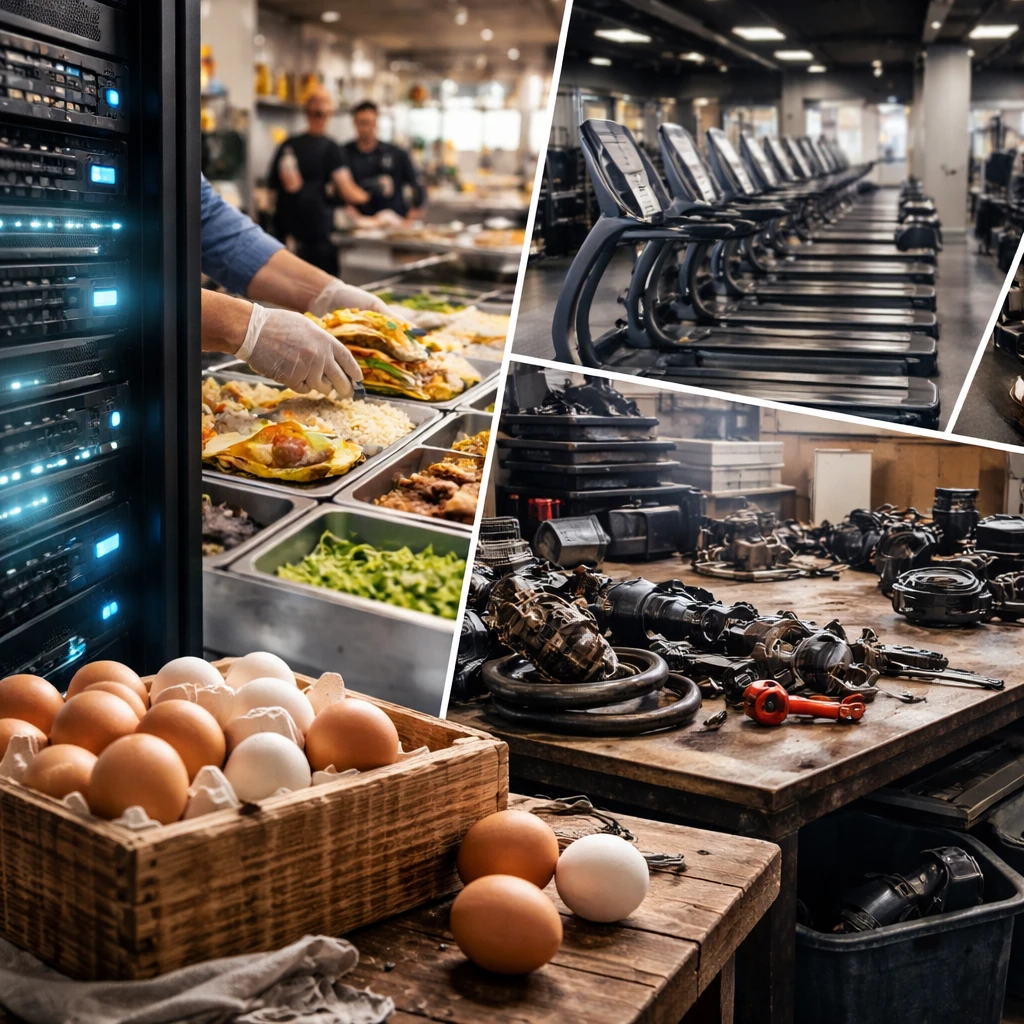
Wall Street analysts delivered a mixed set of verdicts over the past week, changing ratings and price targets across five widely held names. The moves reflect a range of forces now shaping investor returns - from production bottlenecks inside chip manufacturing lines to commodity-glutted food supply chains, and from consumer traffic patterns at restaurants and gyms to company-specific margin recovery plans in manufacturing.
Advanced Micro Devices Inc (NASDAQ: AMD) - HSBC downgrades to Hold, $340 price target
TLDR: Rapid share gains collide with manufacturing constraints - HSBC adopts a more cautious stance.
HSBC moved AMD to a Hold rating and set a $340 price target, noting that a recent dramatic run-up in the stock has left little room for further outperformance absent a new catalyst. Since April the shares rose sharply, with HSBC pointing out a 77% increase over that period versus a 17% gain for the Nasdaq. That rally reflects heavy investor interest in AI-related server demand, but HSBC warned the momentum is bumping up against supply-side limits.
According to the bank, the constraint is in production capacity rather than customer orders. HSBC models second-quarter revenue of $10.5 billion - a figure it says is already widely anticipated by investors - and anticipates foundry capacity limits will constrain AMD's ability to expand shipments through the end of the year. The bank also pared back its longer-term expectations for AMD's AI business, trimming a previously published 2026 AI revenue forecast from $18.5 billion to $14.6 billion. Part of that revision reflects uncertainty around ramping the MI455 rack server solution, which HSBC cited as a point of supply chain ambiguity.
With consensus-like numbers baked into the current share price and production bottlenecks in place, HSBC concluded there is limited opportunity for AMD to deliver a materially positive surprise in the near term and therefore moved to a more neutral rating.
Chipotle Mexican Grill Inc (NYSE: CMG) - Argus upgrades to Buy, $40 price target
TLDR: After a painful share decline, Argus sees value and upgrades to Buy.
Argus upgraded Chipotle to Buy and set a $40 target, arguing the stock has already priced in much of the recent weakness. Over the past year the shares fell about 33% while the broader market climbed 29%, and the current share price sits roughly 50% below the company's peak. Argus views the headwinds that weighed on performance - rising beef costs, higher labor expenses, and softer consumer sentiment - as largely reflected in the current valuation.
The research house expects a recovery driven by a focus on unit growth, productivity improvements in restaurants, and an eventual pickup in customer traffic. Argus projects low-double-digit earnings growth over the next two years and believes the present price-to-earnings multiple of 27.5 will appear attractive if growth stabilizes. The firm outlined a scenario of mid-single-digit comparable-sales growth and sustained operating margins as the basis for its confidence in a long-term recovery trajectory.
LCI Industries (NYSE: LCII) - Roth upgrades to Buy, $112 price target noted
TLDR: Roth spots value driven by internal improvements rather than a cyclical rebound in RV demand.
Roth raised its rating on LCI Industries to Buy, initially listing a $112 price target in the upgrade notice. The bank emphasized that while recreational vehicle manufacturers remain in a soft phase, LCI has demonstrated a capacity for self-directed improvement through cost reduction and diversification of its product mix into marine and aftermarket parts.
Roth highlighted a strong first-quarter showing and raised 2026 guidance as evidence that operational adjustments are having meaningful impact. The firm underscored the company’s healthy balance sheet and high free cash flow yield - noting a yield north of 12% - as foundational to its positive view. Separately in its commentary the bank referenced a $164 price target tied to the longer-term outlook, reflecting conviction in sustained earnings growth into 2027 driven by internal efficiency gains and increased content per vehicle.
Roth’s case rests less on a quick rebound in RV retail activity than on the company’s ability to generate returns through margin initiatives and strategic expansion into adjacent markets. For investors prepared to wait, the firm sees LCI’s operational progress as a pathway to outpacing the broader industry’s cyclical performance.
Planet Fitness Inc (NYSE: PLNT) - William Blair downgrades to Market Perform
TLDR: Member growth disappoints and a postponed price action dents management credibility - William Blair reduces expectations.
William Blair lowered its rating on Planet Fitness to Market Perform after a lackluster first quarter, which the firm described as the industry’s most important season for membership trends. The analyst noted the company missed on member additions and also paused a planned increase to its premium "Black Card" pricing after opting for a broader review - a move the firm said could undermine management credibility given prior indications the increase was market-tested.
Financially, the first-quarter upside in revenue and earnings was attributed in large part to equipment sales, which carry lower margins than recurring membership dues. That disconnect prompted William Blair to cut its 2026 same-store sales growth forecast from 5% to 1%. With club-level returns still under pre-pandemic benchmarks and franchised growth stagnating, the analyst concluded the shares lack a clear catalyst to accelerate top-line momentum. Valuation sits near 11 times EBITDA, which William Blair characterizes as reasonable but not sufficient justification to anticipate a near-term rerating without improved growth fundamentals.
Vital Farms Inc (NASDAQ: VITL) - Stifel downgrades to Hold, $10 price target
TLDR: Oversupply in eggs complicates margin recovery - Stifel turns more cautious.
Stifel moved Vital Farms to Hold and attached a $10 price target, pointing to a difficult margin outlook as egg supplies peak just as consumer demand softens. The bank described the company’s near-term response as "price gap management," an approach that involves taking losses through promotional pricing and paying producers to curb production in order to rebalance market supply.
Given competitors are similarly faced with excess inventory, promotional activity has pressured premium pricing, and Stifel sees limited visibility into when margins will normalize. The firm concluded the current decline in the stock does not sufficiently offset the uncertainty around recovery timing, leaving the investment case in a more guarded posture.
Implications across sectors
- Semiconductor equipment and foundry constraints can cap growth even when demand is elevated, affecting capital intensity and near-term revenue visibility.
- Consumer-facing names in restaurants and leisure are sensitive to input-cost pressures and discretionary-spend shifts, which influence margins and comparable-sales trajectories.
- Manufacturing and component suppliers can offset weak end-market demand through internal efficiency, aftermarket diversification, and balance-sheet strength.
- Food producers dependent on commodity supply cycles may face extended periods of promotional pricing and margin compression in the face of oversupply.
This collection of analyst moves underscores how company-specific dynamics - supply chains, cost structures, pricing power, and management execution - continue to drive divergent outcomes even as broader market sentiment shifts. Investors will likely continue to weigh near-term operational realities against longer-term recovery scenarios across these varied sectors.