
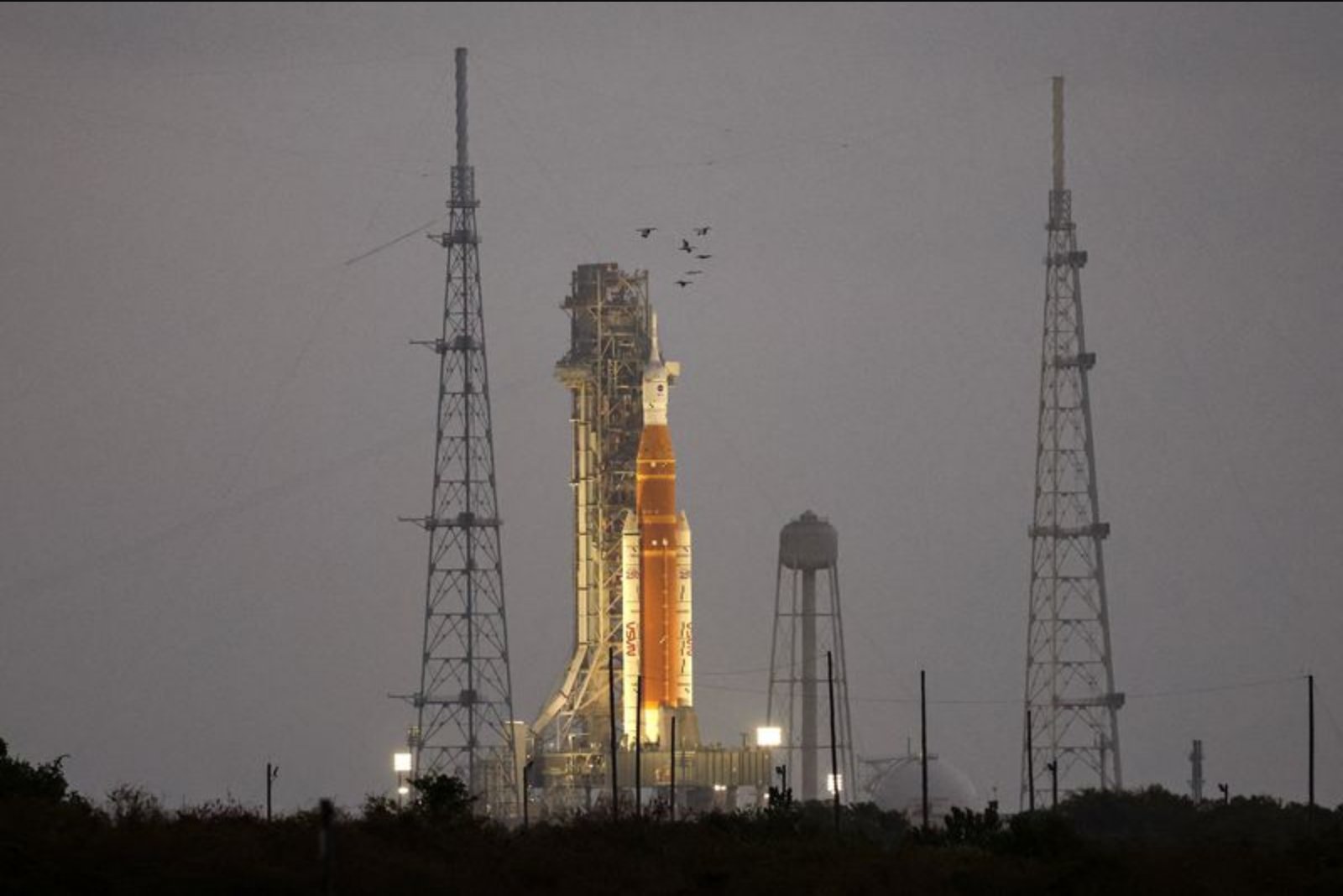
NASA’s Artemis program represents the United States effort to put astronauts back on the Moon for the first time since the Apollo era and to lay the groundwork for a long-term human presence there. Washington has characterized the goal as central to maintaining space leadership in the face of growing lunar ambitions from China. The program’s path since its modern revival has included an accelerated timeline, technical setbacks, commercial partnerships and an organizational reset under new agency leadership.
Origins and hardware
During 2017 and 2018, under the administration of President Donald Trump, NASA was directed to shift its human spaceflight focus back to the Moon after a period when Mars was a higher priority. The modern lunar effort was organized around two main pieces of hardware originally conceived under the earlier, since canceled Constellation program: the Space Launch System rocket and the Orion crew capsule.
Industry roles for these components were defined as part of that effort. Boeing was named prime contractor for the SLS core stage, Northrop Grumman was tasked with producing the rocket’s solid-fuel boosters, and Lockheed Martin was charged with building the Orion spacecraft.
Acceleration and mission sequence
In 2019 the White House set an ambitious objective: land astronauts on the Moon by 2024. Around that time NASA outlined a three-flight sequence for the program, which would be named Artemis months later: Artemis I as an uncrewed test flight, Artemis II as a crewed flyby of the Moon, and Artemis III as the mission designed to put humans on the lunar surface.
Technical challenges and selection of lunar landers
Between 2020 and 2021, technical problems, cost growth and disruptions related to the COVID-19 pandemic pushed back schedules for the SLS rocket, the Orion spacecraft and work on launch infrastructure at Kennedy Space Center. During that period NASA designated SpaceX’s Starship as the program’s first lunar lander, while still publicly holding to the 2024 landing target but acknowledging that the date might no longer be reachable.
First integrated flight test
In November 2022 NASA launched Artemis I, an uncrewed mission that sent an Orion capsule around the Moon and back over a roughly 25-day flight. The mission tested deep-space navigation and communications and evaluated Orion’s heat shield during a high-speed reentry, steps the agency described as critical before putting astronauts aboard.
Recalibration, procurement disputes and timeline shifts
Legal disputes followed NASA’s initial single-provider decision, and in 2023 the agency tapped Jeff Bezos’ Blue Origin as a second lunar lander provider after months of contestation over the initial award to SpaceX. Under the administration of President Joe Biden, NASA reset Artemis timelines and pushed the first crewed lunar landing back to 2027. Throughout this period the agency defended the program amid scrutiny over budgets while pointing to China's parallel lunar ambitions as part of the strategic context.
Crew selection and future test flights
NASA announced the four astronauts who will fly on Artemis II: Reid Wiseman, Victor Glover, Christina Koch and Canadian astronaut Jeremy Hansen. The agency describes Artemis II as the first crewed voyage toward the Moon since Apollo 17 in 1972. Scheduled for launch in April 2026, the roughly 10-day mission will conduct a crewed flyby rather than a landing, sending astronauts farther from Earth than any human flight to date and exercising life support, navigation, communications and heat shield performance in deep space.
Programmatic overhaul under new NASA leadership
After taking office, NASA Administrator Jared Isaacman announced a broad overhaul of Artemis architecture. The changes include scrapping plans for the Lunar Gateway - a proposed station that would have orbited the Moon - and redirecting its planned components toward building a permanent base on the lunar surface. Isaacman also added an additional crewed mission prior to attempting a lunar landing, arguing the extra flight will help crews and ground teams build operational muscle memory in deep space before embarking on sustained surface operations.
Landing later this decade
Artemis is intended to return astronauts to the lunar surface using commercially developed landers, a capability NASA considers a prerequisite for future missions to Mars. SpaceX and Blue Origin are in competition to supply that lunar lander hardware. NASA has said the first moon-walking Artemis crew will use whichever lander completes development first.
Contextual summary
The Artemis program has evolved from a policy directive and a set of hardware plans into a multi-faceted initiative that combines government-developed launch and crew systems with commercially sourced lunar landers. Its schedule has shifted multiple times in response to technical, contractual and organizational factors. The next major milestone in the program is Artemis II, slated for an April 2026 crewed flyby that will be the first human mission toward the Moon in more than five decades, and the program is now planning a crewed landing later in the decade using a privately developed lander.