
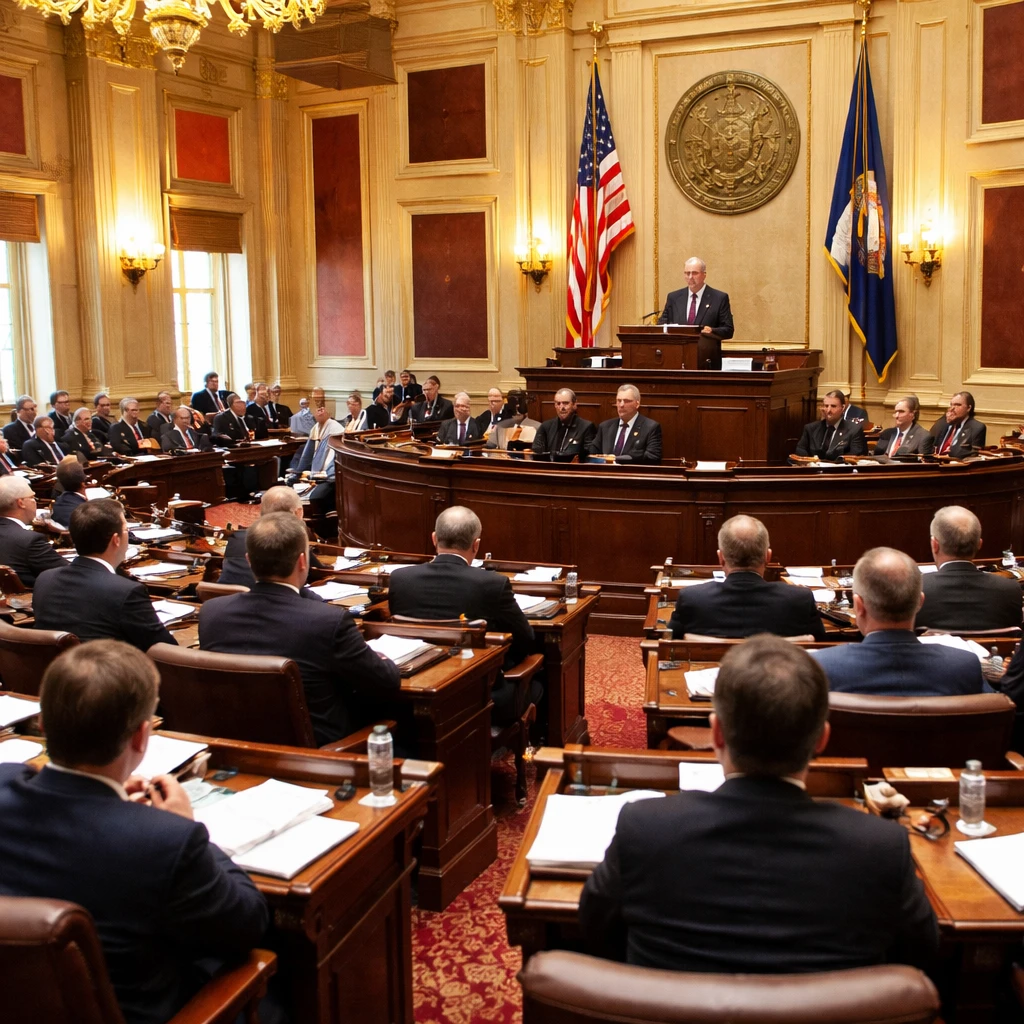
On Friday, Virginia's Senate, controlled by Democrats, approved a constitutional amendment poised to empower state lawmakers with the authority to revise the state's congressional district boundaries. This change aims to counteract recent redistricting strategies undertaken by Republican-led states and may enable Democrats to increase their representation in the U.S. House of Representatives by as many as four seats.
Earlier in the week, the Virginia House of Delegates, the lower chamber of the state's legislature, had already given its endorsement to the amendment. The amendment now awaits voter ratification, which will occur in a special election anticipated to take place this spring. Prior to this vote, lawmakers have indicated that a proposed new congressional map will be released, ensuring voters have adequate information before making their decision.
Currently, Democrats hold six out of Virginia's 11 congressional seats. However, the proposed map could dramatically shift the balance, potentially producing as much as a 10-1 split favoring Democratic representatives.
This constitutional amendment is necessary to supersede an earlier amendment passed in 2020. That measure had established an independent commission responsible for drawing Virginia's congressional districts. The proposed amendment would allow state lawmakers to redraw district lines in response to other states' redistricting actions, a strategy many Republicans have adopted following encouragement from former President Trump. Under this amendment, the legislature would maintain this authority until 2030, after which control would revert back to the independent commission.
Republican legislators criticized the move, suggesting it was politically motivated. Senator Christopher Head expressed on the Senate floor that the amendment was driven by animosity towards the sitting President and a desire to diminish his influence.
In contrast, Democrats defended the amendment as a necessary, temporary response to what they describe as unprecedented and aggressive mid-decade redistricting efforts spearheaded by the former President. Senator Scott Surovell described the amendment as a temporary exception designed to counteract what he termed an extraordinary threat to electoral balance.
Traditionally, congressional redistricting occurs once every decade following the U.S. Census to reflect population changes. However, former President Trump's actions in the past year have disrupted this pattern, leading some states to pursue new maps mid-decade. For instance, Texas Republicans recently redrew congressional boundaries to target five Democratic incumbents, an effort encouraged by Trump. Similar reactions included California Democrats moving to establish a new map aimed at Republican representatives, demonstrating how both parties have engaged in reactive redistricting.
Other states have exhibited resistance; for example, Indiana Republican lawmakers rejected a mid-decade redistricting plan last month despite pressure from the White House, illustrating the limits of partisan control even within a single party.
The proactive approaches taken by California and Virginia Democrats have tempered what initially appeared to be a significant advantage for Republicans in the redistricting arena. Looking ahead, Florida is scheduled to consider new redistricting in April under Republican Governor Ron DeSantis, a change estimated to potentially yield Republicans between three and five additional congressional seats.