
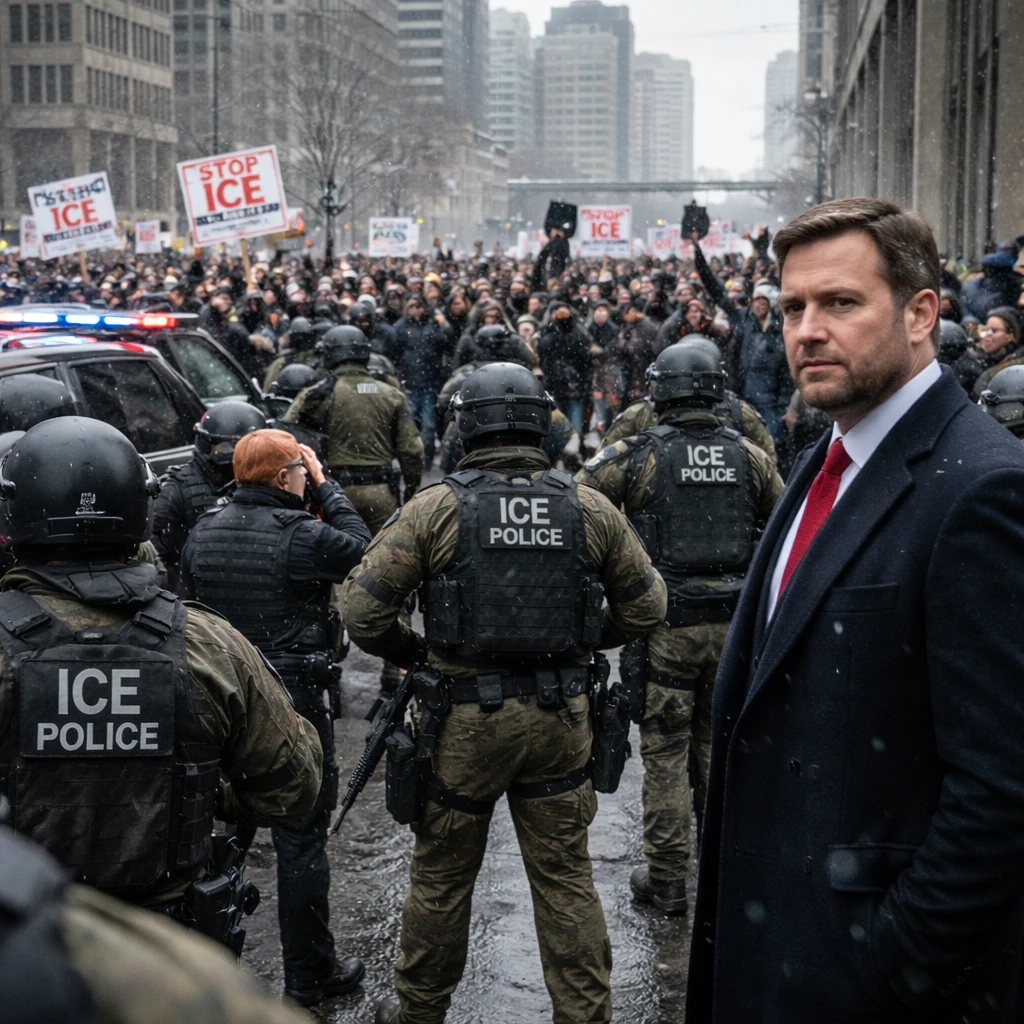
Vice President JD Vance is scheduled to visit Minneapolis to back a large-scale federal immigration enforcement operation that has intensified local tensions. This comes after an ICE officer fatally shot a 37-year-old mother, stirring controversy and division both locally and nationally. The federal presence, involving thousands of law enforcement officers, targets immigration violations and welfare fraud within the Somali community, leading to conflicting reactions between supporters and critics of the administration's approach.
Key Points
- Vice President JD Vance’s visit to Minneapolis underscores federal support for ICE amidst a controversial law enforcement crackdown targeting immigration violations and welfare fraud.
- Minnesota’s federal policing effort is framed by the Trump administration as a necessary response to perceived lenient local policies, but faces strong opposition from local Democrats and community activists.
- The death of Renee Good by an ICE officer has intensified polarizing discourse, with Vance employing the episode as a rallying point for political messaging ahead of upcoming national elections.
The city of Minneapolis is currently experiencing heightened tensions amid a significant federal law enforcement operation focused on immigration enforcement and social service fraud investigations. Vice President JD Vance is set to visit the city on Thursday to express support for these efforts by U.S. Immigration and Customs Enforcement (ICE). This action unfolds in the wake of the January 7 shooting death of Renee Good, a 37-year-old mother of three, by an ICE officer, an incident that has polarized the city and the broader country.
The federal operation includes a deployment of approximately 3,000 officers in the Minneapolis area. Minnesota, recognized as a Democratic-leaning state, is among several jurisdictions targeted by the Republican-led Trump administration's intensified federal police presence. This move is promoted by the administration as necessary to combat immigration violations and conduct fraud investigations specifically affecting social service programs within the Somali community.
Supporters of President Donald Trump view the federal law enforcement rollout as an essential response to what they characterize as lenient crime and immigration policies under Democratic leadership. Conversely, local Democratic officials and demonstrators criticize ICE for what they describe as aggressive tactics and racial profiling. These groups have urged the administration to end its operations, which they argue exacerbate divisions in the community.
On the ground in Minneapolis, heavily armed federal agents clad in tactical gear have carried out searches and arrests targeting individuals identified as dangerous criminal immigration violators. However, these actions have, on occasion, also affected some U.S. citizens. In response, protestors have organized observer patrols, employing whistles to alert residents of ICE activity and expressing disapproval of the increased federal presence.
The situation has not only prompted protests but also highlighted cracks within the president's own base of support. Vice President Vance has notably defended the ICE officer involved in the shooting of Renee Good. Within hours of the fatal incident, Vance publicly supported the officer’s actions, criticized the deceased, and framed the event as a critical political matter ahead of the 2026 midterm elections, which will influence Congressional control.
During his Minneapolis visit, Vance will participate in a roundtable with community leaders and local figures, focusing on the theme of "restoring law and order in Minnesota." He is also slated to meet with ICE officers to reinforce backing for their work. According to White House statements, Vance is expected to criticize Minneapolis’ policy which prohibits city staff from assisting federal immigration enforcement. The administration contends that this policy has undermined public safety and put ICE officers at risk.
Furthermore, Vance will address the Trump administration’s stance on so-called "sanctuary cities" that refuse to cooperate with federal immigration enforcement, threatening to withhold federal funding from these jurisdictions beginning February 1.
Not everyone welcomes Vance's visit or the expanded federal operation. Richard Carlbom, chair of Minnesota’s Democratic Party, expressed concerns that Vance's presence is more politically motivated than conciliatory. Carlbom described the federal actions as a "retribution campaign" against Minnesotans devised by the vice president and president. He has called on residents to continue opposing the federal approach.
In a recent address at the World Economic Forum in Davos, Switzerland, President Trump referenced the Minnesota situation, criticizing local leadership and asserting that federal immigration efforts are beneficial despite a lack of appreciation from the state. He remarked on the treatment of ICE by Minnesota officials, characterizing it as unjust.
Among the local voices opposing the federal crackdown is Patty O’Keefe, a 36-year-old non-profit worker from Minnesota who was pepper-sprayed and detained by federal agents earlier in January while documenting ICE activities. O’Keefe publicly condemned Vance's call for "law and order," accusing federal agents of fomenting chaos and escalating violence. She described the vice president’s rhetoric as divisive and unwelcome in the community.
The White House and President Trump have linked the ICE operation to an investigation into welfare fraud in Minnesota. Since 2022, the Justice Department has reported that at least 56 individuals have pleaded guilty in connection with this probe. President Trump further emphasized his administration’s stance by stating that Minnesota exemplifies his belief that the West should not "mass import foreign cultures."
This federal intervention in Minneapolis not only has political ramifications but also intersects with broader debates over immigration policy, public safety, and community relations, underscoring deep divisions within both the state and the nation.
Risks
- Heightened federal enforcement operations may increase community tensions and lead to potential civil unrest, posing risks to local stability and economic activity, especially in public services sectors.
- Political polarization surrounding immigration enforcement could influence federal funding decisions, impacting state and municipal budgets and providers of social services.
- The controversy surrounding ICE operations and associated violence or detentions may harm the reputation and operational environment for local businesses and non-profit organizations involved in immigrant communities.