
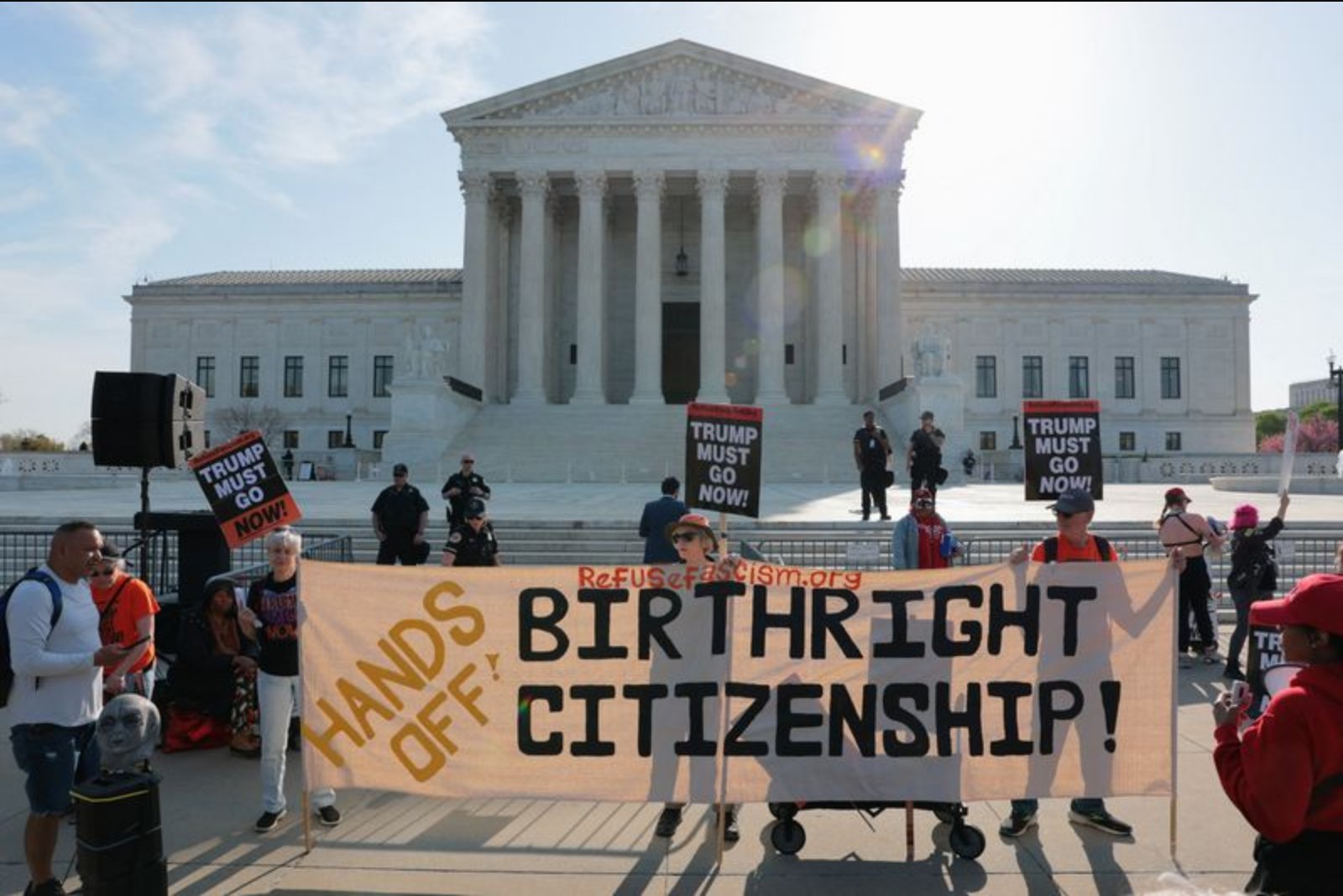
WASHINGTON, April 1 - President Donald Trump was scheduled to be present at the U.S. Supreme Court on Wednesday as justices heard arguments over the legality of an executive order he signed on his first day back in office that would limit birthright citizenship. The decision to attend the arguments marks a rare step for a sitting president in modern times, and the event unfolded amid public demonstrations on the steps of the neoclassical courthouse on Capitol Hill.
Outside the court, demonstrators had gathered ahead of the session, some carrying signs critical of the president, including placards that read "Trump must go now." The crowd underscored the politically charged atmosphere surrounding the case, which centers on whether an order directing U.S. agencies not to recognize the citizenship of children born in the United States to parents who are neither American citizens nor legal permanent residents is lawful.
A lower court previously blocked Trump’s executive order of restricting birthright citizenship. The administration has argued that the longstanding practice of conferring citizenship to nearly anyone born on U.S. soil has encouraged illegal immigration and fostered a phenomenon sometimes described as "birth tourism," where foreigners travel to the United States to give birth and thereby secure citizenship for their children.
Trump has publicly criticized that practice. Last year he posted on social media: "Birthright Citizenship was not meant for people taking vacations to become permanent Citizens of the United States of America, and bringing their families with them, all the time laughing at the ’SUCKERS’ that we are!" He added: "But the drug cartels love it! We are, for the sake of being politically correct, a STUPID Country but, in actuality, this is the exact opposite of being politically correct, and it is yet another point that leads to the dysfunction of America."
The Supreme Court has ruled in favor of the president on several emergency measures since he returned to the White House last year, including matters involving immigration, large-scale federal workforce reductions, cuts to foreign aid, efforts to dismantle the Education Department, and a policy to ban transgender people from military service, among other issues. But the court handed Trump a notable defeat on February 20 in a high-profile case challenging the legality of sweeping global tariffs he imposed under a statute intended for national emergencies.
That tariffs decision provoked a sharp response from Trump toward the justices who joined the majority against him. The court said it was not aware of a president attending arguments in modern times, meaning since the current Supreme Court building opened in 1935. The statement noted that while there are 19th century examples of presidents engaging with the court as advocates - including John Quincy Adams, Grover Cleveland and Benjamin Harrison - those occurred when they were not serving as president.
The current Supreme Court alignment is a 6-3 conservative majority that includes three justices appointed by Trump during his first term: Neil Gorsuch in 2017, Brett Kavanaugh in 2018 and Amy Coney Barrett in 2020. Barrett’s appointment solidified the court’s present conservative super-majority and marked a period in which the court has shifted American law to the right, issuing rulings that rolled back abortion rights, rejected race-conscious collegiate admissions policies, and limited the authority of U.S. regulatory agencies, among other significant changes.
In the tariffs case, three of the court’s conservative justices - Chief Justice John Roberts, Neil Gorsuch and Amy Coney Barrett - joined the court’s three liberal justices to hold that Trump had exceeded his authority in imposing the global tariffs. Trump voiced particular fury at Gorsuch and Barrett, saying on the day of the ruling that they were "an embarrassment to their families." He continued his criticism in the days that followed, asserting that the two justices "sicken me because they’re bad for our country."
Following the tariffs decision, Trump said he was "ashamed" of the three conservative justices who opposed him, labeling them "fools and lapdogs for the RINOs and the radical-left Democrats." The term RINO - meaning "Republican in name only" - is sometimes used by conservative Republicans to disparage fellow party members considered disloyal. Trump also claimed the court "has been swayed by foreign interests," a charge he made without presenting evidence.
The birthright citizenship case reached the Supreme Court after the directive was enjoined by a lower court. The administration’s rationale for the order centers on its contention that automatic citizenship for nearly all births on U.S. soil has created incentives that encourage illegal immigration and foster birth tourism. The legal challenge questions whether the president can unilaterally alter the long-standing interpretation of birthright citizenship.
Trump’s presence for the arguments is notable for its rarity and for the heightened tensions between the executive and the judiciary. The demonstration of public opposition outside the court, the recent splits among conservative justices in a major tariffs case, and the administration’s forceful public denunciations of specific justices all contribute to an unusually charged context for what is fundamentally a legal question about the scope of executive authority and the interpretation of citizenship law.
How the court resolves the dispute over the executive order will determine whether the administration may proceed with a policy that would limit recognition of citizenship for children born on U.S. soil to parents who are not citizens or lawful permanent residents. For now, the lower court injunction remains a key procedural fact in the litigation.
The proceedings at the Supreme Court on this matter unfolded against the backdrop of recent high-profile rulings and public criticism of the judiciary from the president, underscoring the legal and political stakes tied to the court’s decisions.