
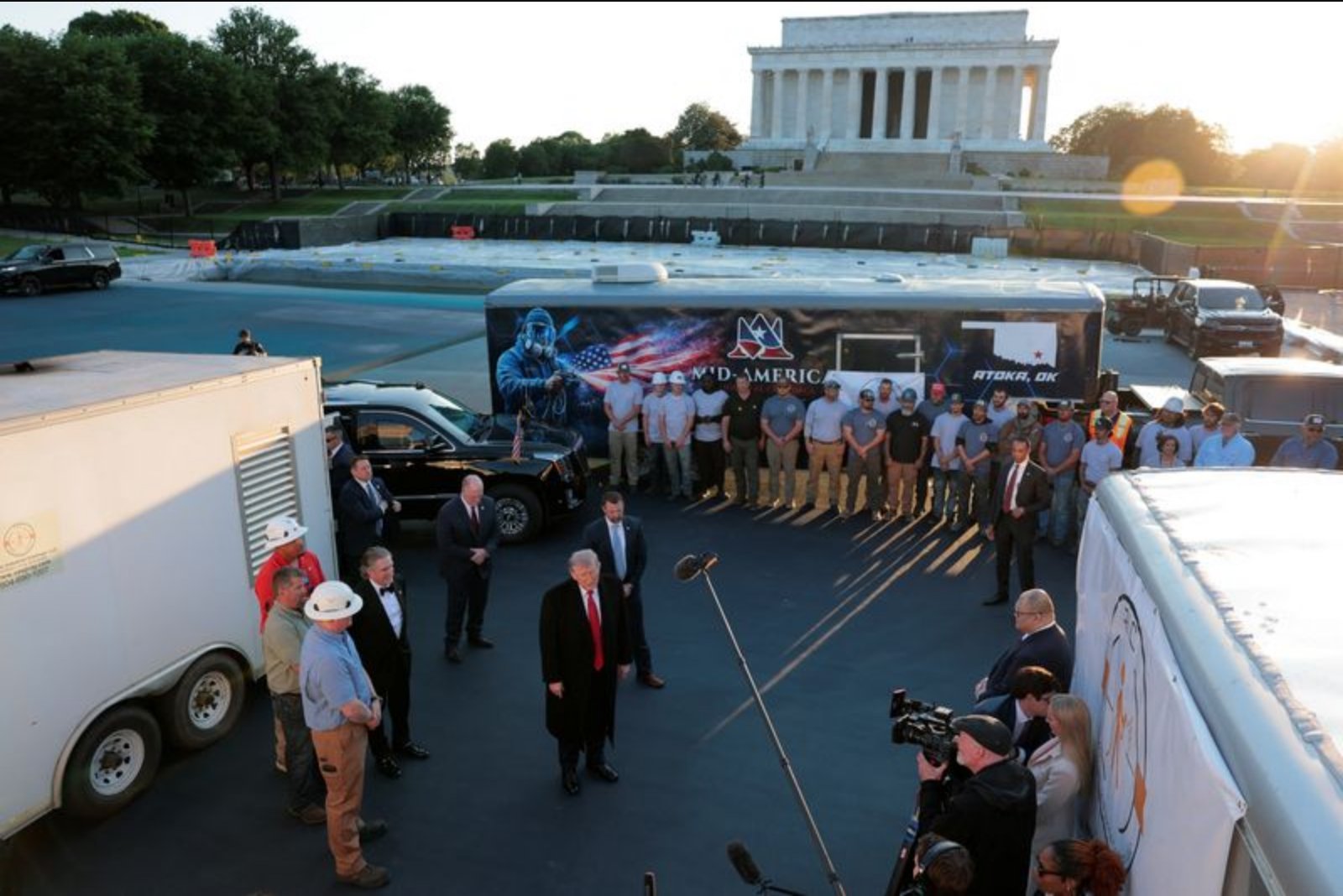
WASHINGTON - U.S. President Donald Trump paid a surprise visit on Thursday to examine renovation work underway at the Lincoln Memorial's reflecting pool, a prominent public feature between the Lincoln Memorial and the Washington Monument. The project, which involves draining, cleaning and resurfacing the nearly century-old basin, is among several high-profile initiatives the former real estate developer is advancing in the capital as he seeks to leave a visible imprint on Washington.
At the site, where workers were performing maintenance in the drained basin, Trump told reporters, "It's really beautiful, and it's going to be fantastic." He described the planned finish for the pool as a replacement of the existing "gray stone" look with "a more vibrant, industrial-strength coating in the color of a blue swimming pool." He added, "It's going to look better than it did in 1922 when it was built."
The scope of the work on the reflecting pool is straightforward: the basin has been emptied for cleaning and will be resurfaced. The area has historically been a backdrop for some of the nation's most significant public gatherings, and the basin stretches between two of the capital's most visited monuments.
The roughly 30-minute inspection occurred against a backdrop of heightened security for Trump. Authorities tightened measures following an incident last month at the White House Correspondents' Dinner in which an armed man attempted to enter the ballroom where the president was scheduled to speak. That episode led to a broader review of security procedures for Trump appearances, with particular attention to public venues and outdoor events in Washington.
Earlier in the week Trump said Secret Service personnel discouraged him from walking directly into the construction area because nearby buildings overlook the site. "They were not thrilled," he said, adding, "We have to be a little conscious of that." Ahead of the visit, Secret Service cleared the heavily touristed area.
Trump has said his decision to oversee the reflecting pool work was spurred by a comment from a friend visiting from Germany. Recounting the conversation at a White House event last month, he quoted the visitor as saying, "It's filthy, dirty. The water is disgusting looking. It's not representative of the country." Trump said that exchange was the catalyst for the project.
Trump framed the renovation as a departure from a larger federal plan he said would have cost roughly $350 million and taken years to finish. Instead, he said, he opted for a $1.9 million renovation intended to be completed in less than two weeks.
While the work itself is limited in scope - draining, cleaning and resurfacing the reflecting pool - the visit underscores the administration's emphasis on visible, expedited projects in the capital. The combination of an expedited timeline and a relatively small price tag compared with the figure Trump cited has been presented by the president as a more immediate, lower-cost approach to updating the landmark's appearance.
Secret Service involvement and the security review prompted by the previous month's incident remained a clear element of planning for the visit. The agency's decision-making on whether the president should enter the construction area reflected concern about exposure due to overlooking buildings and public access in a heavily trafficked part of the National Mall.
Trump's comments, the timing of the visit and the project's posture as a visible, quick renovation make the reflecting pool work one of the most visible examples of the administration's efforts to alter prominent Washington landmarks.