
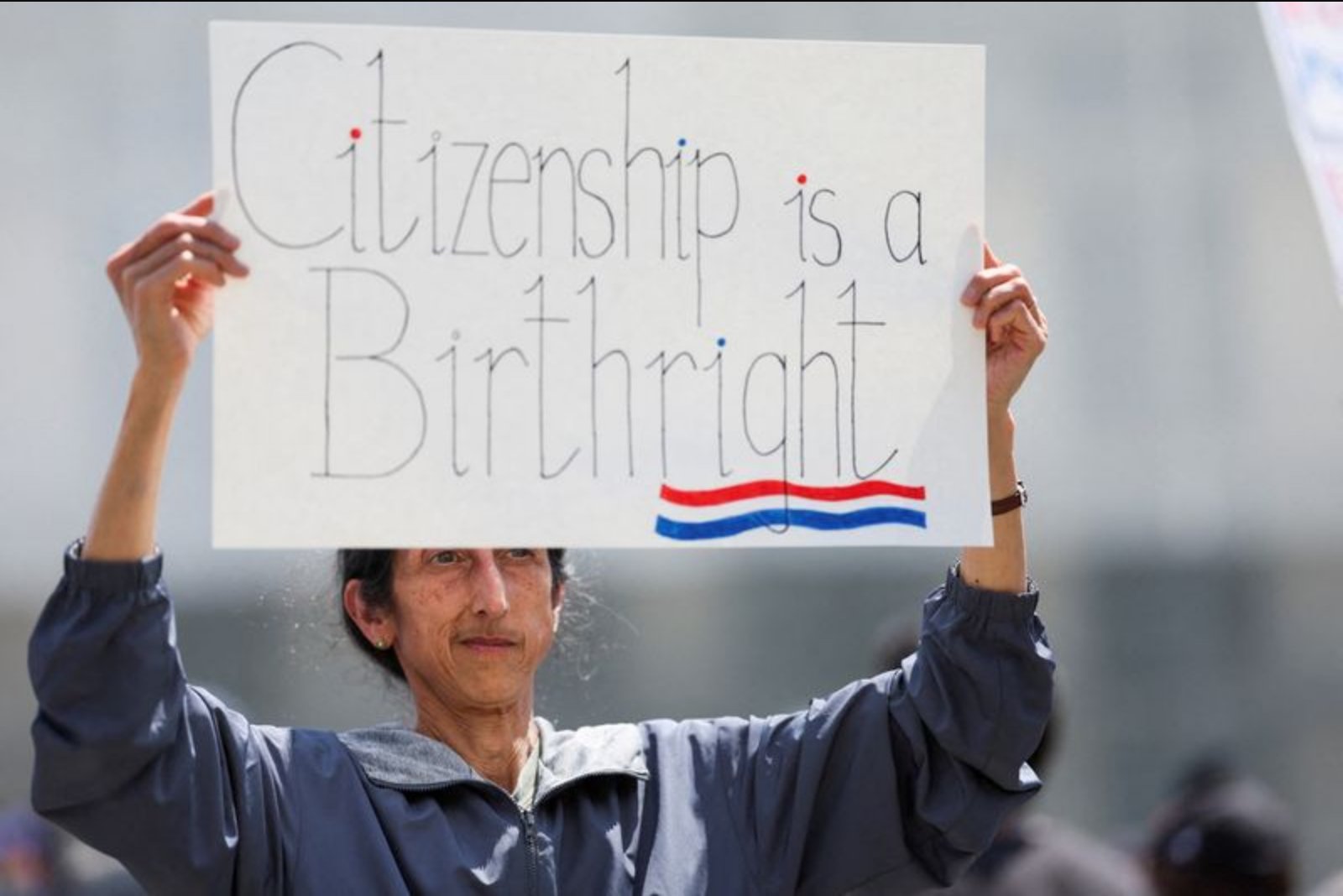
The U.S. Supreme Court is scheduled to hear arguments on Wednesday in an appeal challenging President Donald Trump’s directive aimed at limiting birthright citizenship in the United States. The case centers on an executive order that instructs federal agencies not to treat as citizens children born on U.S. soil when neither parent is an American citizen or a lawful permanent resident.
According to the president’s official schedule, he plans to attend the arguments. The appeal asks the justices to overturn a lower court decision that had enjoined the order in response to a class-action lawsuit brought by parents and children whose citizenship the directive would jeopardize. The lower court found the policy inconsistent with the language of the U.S. Constitution’s 14th Amendment and with a federal statute that codifies birthright citizenship rights.
The restriction on birthright citizenship is a central objective for the Republican president and formed part of a wider set of immigration measures announced on his first day after returning to the White House. Critics of the policy have accused the administration of racial and religious discrimination in its immigration approach.
Legal dispute and arguments
The principal legal question before the justices concerns the scope and meaning of the Citizenship Clause of the 14th Amendment. That clause reads in full: "All persons born or naturalized in the United States, and subject to the jurisdiction thereof, are citizens of the United States and of the state wherein they reside." For generations the clause has been interpreted broadly to confer U.S. citizenship to nearly all babies born within the nation’s borders, with limited exceptions such as children of foreign diplomats or members of an enemy occupying force.
The administration has argued that the phrase "subject to the jurisdiction thereof" narrows the class of those eligible for citizenship at birth. Under the government’s reading, being born in the United States alone is insufficient when parents are in the country unlawfully or are present lawfully but only temporarily, for example as university students or temporary workers. The administration maintains that citizenship should be granted only to children whose parents owe "primary allegiance" to the United States - a category it limits to citizens and lawful permanent residents. That allegiance, the administration argues, is demonstrated by what it calls "lawful domicile," which its lawyers define as "lawful, permanent residence within a nation, with intent to remain."
As part of its rationale, the administration has also pointed to what it describes as an incentive effect of broad birthright citizenship, saying the current practice contributes to illegal immigration and to so-called "birth tourism," where foreign nationals travel to the United States to give birth in order to secure citizenship for their children.
Potential scale of impact
Legal analysts and parties in the case have said an eventual Supreme Court ruling endorsing the administration’s position could have far-reaching consequences. Some estimates cited in litigation suggest the change could affect as many as 250,000 babies born in the United States each year. The order, if sustained, could also require the families of millions more to demonstrate their newborns’ citizenship status.
Historical and precedential issues
The 14th Amendment itself was ratified in 1868 in the wake of the Civil War, which concluded in 1865, and was adopted in part to overturn a 1857 Supreme Court decision that had held that people of African descent could never be U.S. citizens. The challengers in the present case point to an 1898 Supreme Court decision, United States v. Wong Kim Ark, as having already settled the principle that the 14th Amendment confers citizenship on those born on U.S. soil, including children of foreign nationals.
The administration disputes that Wong Kim Ark precludes its reinterpretation. It contends the 1898 ruling actually supports its reading because, in the court’s decision, Wong Kim Ark’s parents were found to have a permanent domicile and residence in the United States at the time of his birth.
Courtroom posture and procedural history
In July of last year, a U.S. district judge in Concord, New Hampshire, Joseph Laplante, allowed the suit challenging the executive order to proceed as a class action and issued a nationwide injunction that prevented the policy from taking effect. That ruling is the subject of the appeal now before the Supreme Court.
The Supreme Court has set a timetable that could result in a decision by the end of June. Last year the court provided the administration with a limited procedural win by restricting the ability of federal judges to issue nationwide injunctions against presidential policies - a ruling that arose from early-stage litigation concluding the directive was unconstitutional but did not itself resolve the underlying merits. The court, which has a six-to-three conservative majority, has intervened in other immigration-related matters since the president’s return to office, permitting in some cases the expansion of deportation measures on an interim basis while legal challenges proceed. Those measures have included steps such as ending certain humanitarian protections or allowing removal to countries where migrants have limited ties, actions the court allowed to move forward while litigation continued.
As the justices hear the arguments, the legal and factual record presented by both sides will shape whether the nation’s long-standing practice of granting citizenship at birth remains intact or is significantly narrowed by executive policy.
Key points
- The Supreme Court will review whether an executive order barring recognition of citizenship for most children born in the U.S. to noncitizen parents violates the 14th Amendment.
- A lower court blocked the order nationwide and allowed a class-action suit to proceed; the administration is appealing that injunction to the Supreme Court.
- Parties estimate the administration’s position could affect up to 250,000 births annually and could require millions of families to establish newborns' citizenship status.
Risks and uncertainties
- Legal uncertainty - The Supreme Court’s ruling could either uphold the long-standing interpretation of the Citizenship Clause or endorse a narrower construction, leaving unresolved the status of many children born in the United States.
- Widespread administrative consequences - A decision in favor of the administration could force families and government agencies to reassess and verify citizenship claims on a large scale, creating procedural and administrative burdens.
- Procedural questions - Prior rulings limiting nationwide injunctions and interim decisions permitting enforcement of certain immigration measures leave open procedural and timing uncertainties that may affect how and when changes would be implemented.