
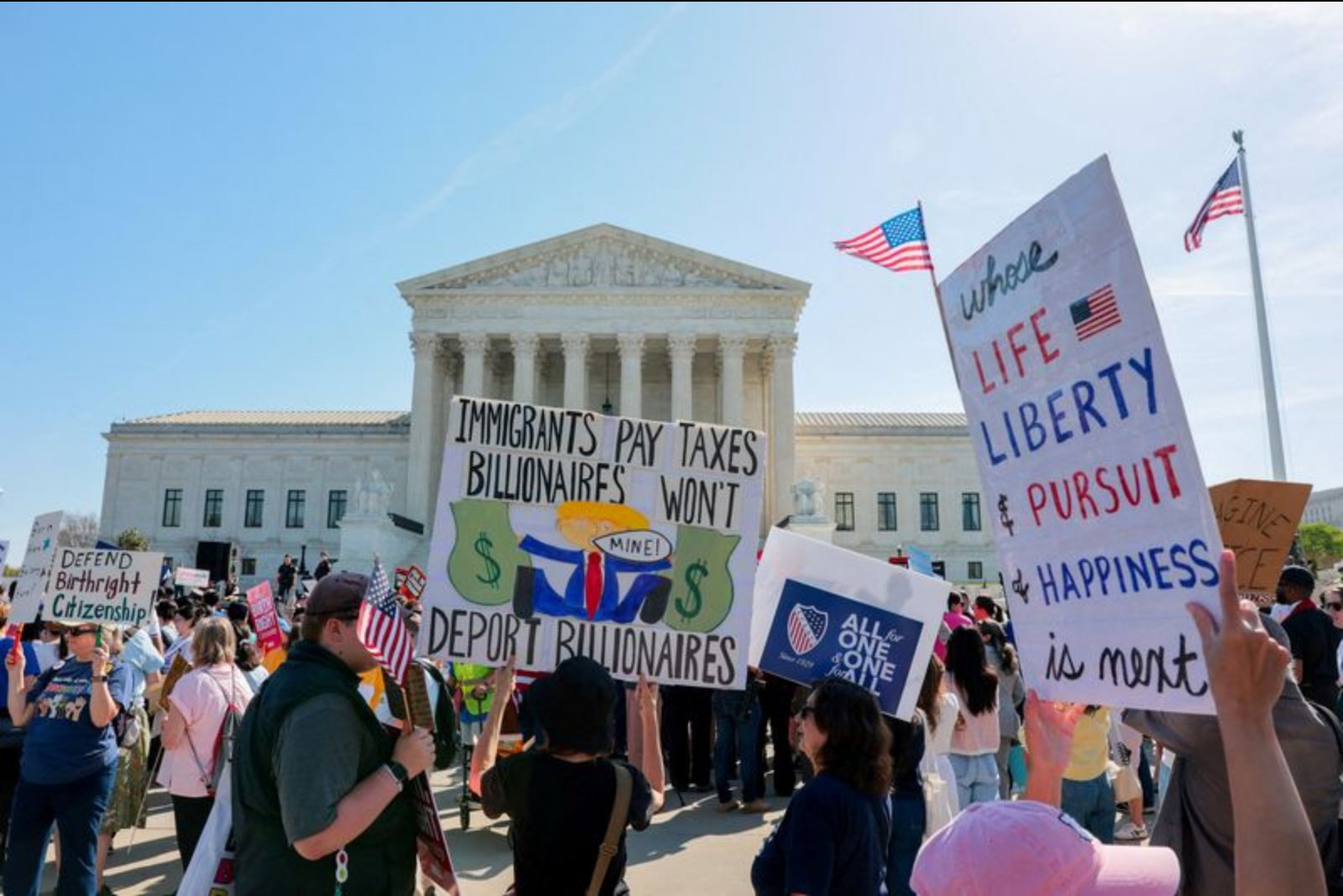
President Donald Trump attended oral arguments at the U.S. Supreme Court as the justices considered whether his executive order, which would deny U.S. citizenship to most children born on American soil to noncitizen parents, can stand. The appearance of a sitting president in the public gallery marked a historic moment, but the tenor of the hearing left the administration’s most ambitious immigration measure facing an uphill climb.
The case reached the high court after a lower court enjoined the order. That ruling held the directive inconsistent with the 14th Amendment to the U.S. Constitution, a provision long read by courts to confer citizenship on nearly everyone born in the United States, save small categories such as children of foreign diplomats or members of an occupying enemy force.
Arguments before the nine justices on Wednesday made clear the court is far from united on the question. Chief Justice John Roberts, who has led the court for more than two decades, questioned whether the administration’s reading of the 14th Amendment was persuasive. Several other justices pressed similar doubts, signaling that the legal theory supporting the president’s order may be both legally unsound and practically unworkable.
The clause at the center of the dispute, commonly called the Citizenship Clause, reads: "All persons born or naturalized in the United States, and subject to the jurisdiction thereof, are citizens of the United States." The administration argues that the phrase "subject to the jurisdiction thereof" narrows the class of those entitled to citizenship. The justices repeatedly returned to the text and to the long judicial and historical practice that has treated most persons born in the United States as citizens.
Kevin Johnson, an immigration law scholar at the University of California, Davis, said the court is likely to be swayed by the plain language of the Citizenship Clause and by what he described as a "long, unbroken history" of recognizing birthright citizenship. "I do not think that Chief Justice Roberts wants to go down in history as presiding over a court that ended birthright citizenship," Johnson said.
During the exchange, Chief Justice Roberts described the administration’s interpretation as "quirky." He also appeared to take issue with an argument offered by U.S. Solicitor General D. John Sauer, who defended the president’s directive by pointing to worries about so-called "birth tourism" - foreigners traveling to the United States to give birth and obtain citizenship for their children. Sauer stated, "We’re in a new world now. Eight billion people are one plane ride away from having a child who’s a U.S. citizen." Roberts responded succinctly: "Well, it’s a new world. It’s the same Constitution."
Not every justice sounded skeptical. Conservative Justice Samuel Alito appeared open to the administration’s suggestion that birthright citizenship should be limited to those with what the administration characterized as "lawful domicile" - defined in the government’s filings as lawful, permanent residence in a nation coupled with an intent to remain. Even so, the overall impression from the bench was one of substantial doubt about the legal footing of the administration’s approach.
Trump issued the order on his first day back in office in January 2025. The directive instructed federal agencies not to recognize U.S. citizenship for children born in the United States if neither parent is a U.S. citizen or a lawful permanent resident - commonly known as a green card holder. The order sits at the center of a broader push by the administration to severely limit both legal and illegal immigration, a package of measures that has included an effort to pursue mass deportation.
Many of those other immigration-related actions have also been litigated, and in several instances the Supreme Court has allowed the administration to proceed while the legal challenges move through the courts. The court has, for example, permitted the end of certain humanitarian protections for migrants, allowed deportations to nations where migrants have minimal ties, and sanctioned aggressive enforcement operations that can target individuals on the basis of race or language in particular contexts.
At the same time, the justices have not been uniformly deferential. In some matters the court has insisted that migrants receive fair procedures as required by the constitutional guarantee of due process. That mixed record helps explain why advocates on both sides of the citizenship question view the case as pivotal.
Elora Mukherjee, director of the immigrant rights clinic at Columbia Law School, said it is consistent with the court’s recent pattern that justices might side with the administration on certain immigration measures but reject this one. "Birthright citizenship is core to our identity as a nation," Mukherjee said. "It is unlike any of the other contexts ... which are not central to how all Americans live their lives and are not central to how we as a nation for generations have viewed ourselves."
George Mason University law professor Ilya Somin, who focuses on constitutional issues, noted that the high court has frequently deferred to the administration on immigration-related cases. But he added that the arguments in this matter could presage a different outcome because, in his view, the weight of precedent and established practice favors one side more strongly than in many other recent disputes the court has decided.
The broader legal stakes are significant. Observers pointed to other recent high-profile decisions where the court limited administration authority - most notably a 6-3 ruling in February that struck down the sweeping global tariffs the president sought to implement under emergency trade law. That earlier decision prompted a sharp reaction from the president and helped frame the contentious relationship between the White House and the court.
Trump has publicly criticized the justices at times, including in response to rulings that did not favor his position. Following the February tariffs decision, he labeled two of his own appointees - Neil Gorsuch and Amy Coney Barrett - "an embarrassment to their families" and called the justices who ruled against him unpatriotic and disloyal. During Wednesday’s arguments, Trump dismissed certain justices he appointed as wanting to "show their independence," and in an on-the-record comment called them "stupid people."
The president’s presence in the courtroom is not expected to sway the justices. The court typically resolves cases on legal grounds and a decision in this matter is anticipated by the end of June.
As the proceedings unfolded, attention to the symbolism of the courtroom was evident. Above the bench, a carved marble frieze includes a figure known as "Majesty of the Law," depicted with a book at his side. For a president pressing a highly visible and controversial legal argument, such imagery is a reminder of the institution and traditions the court embodies - and of the textual and historical anchors the justices repeatedly invoked during the hearing.
Key legal points from the hearing
- The central legal text at issue is the 14th Amendment's Citizenship Clause: "All persons born or naturalized in the United States, and subject to the jurisdiction thereof, are citizens of the United States."
- The administration urges a narrowed interpretation of "subject to the jurisdiction thereof," while several justices and legal scholars emphasized the long-standing judicial interpretation that supports broad birthright citizenship.
- The case arrives at the Supreme Court after a lower-court ruling blocked the president’s order.
Reporting on the arguments drew commentary from legal scholars and immigration advocates who stressed the historical centrality of birthright citizenship to national identity and highlighted the unusual legal posture of the administration’s claim.