
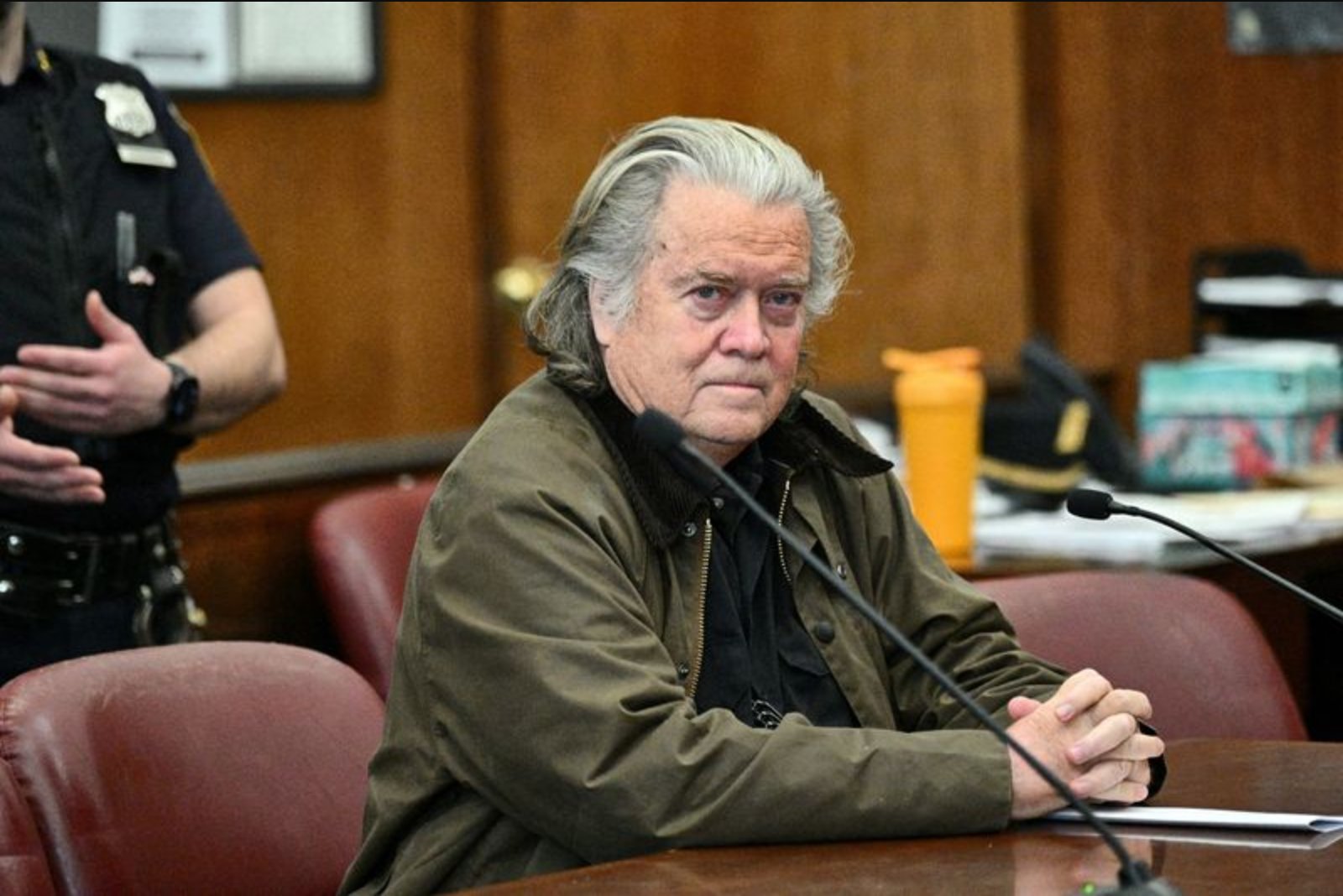
The U.S. Supreme Court on Monday took a procedural step that allows the Justice Department to pursue dismissal of the criminal case against Steve Bannon, the former aide to Donald Trump who was convicted after declining to comply with a congressional subpoena.
In a short unsigned order, the justices vacated a lower court decision that had upheld Bannon's 2022 conviction on two counts of contempt of Congress for refusing to turn over documents or testify to a Democratic-led House committee investigating the January 6, 2021 attack on the U.S. Capitol. The order returned the matter to the lower court for further consideration "in light of the pending motion to dismiss the indictment."
The Justice Department, in filings urging the Supreme Court to overturn the appellate ruling, said it had concluded that dismissing the case "is in the interests of justice." The department had already filed a motion to dismiss at the trial court level, setting the stage for the high court's procedural action.
Bannon was convicted by a Washington jury on two counts of contempt of Congress after the House committee that investigated the January 6 attack sought documents and testimony he declined to provide. The committee's work centered on efforts to block congressional certification of Democrat Joe Biden's election victory over Trump during the Republican president's unsuccessful 2020 reelection bid; the committee concluded the rioters attempted to stop that certification.
Bannon has characterized the committee's inquiry and the charges pursued by the Justice Department during the Biden administration as politically motivated.
At his sentencing hearing, prosecutor J.P. Cooney said Bannon deliberately chose to "thumb his nose at Congress." Cooney added, "Bannon is not above the law, and that’s what makes this case important." A jury found him guilty on the two counts that led to his conviction in 2022.
Following a separate decision by the Supreme Court in June 2024 that denied his request to remain free while an appeal proceeded, Bannon served a four-month term at a low-security federal facility in Danbury, Connecticut. He was released a week before Trump’s victory over Democrat Kamala Harris in the 2024 election. After his release, Bannon described himself as a political prisoner and told reporters, "I am far from broken. I have been empowered by my four months at Danbury federal prison." He later resumed hosting his "War Room" podcast.
Once a central figure in Trump's inner circle, Bannon, now 72, served as a senior adviser to Trump's 2016 presidential campaign and as White House chief strategist early in Trump's first term in 2017. The relationship suffered a falling out that was reportedly repaired in later years.
The House January 6 committee reported that Bannon spoke with Trump at least twice on the day before the Capitol attack, attended a planning meeting at a Washington hotel, and warned on his podcast that "all hell is going to break loose tomorrow." Those committee findings were part of the factual backdrop to the subpoenas that Bannon resisted and that led to his contempt charges.
After the conviction, the U.S. Court of Appeals for the District of Columbia Circuit in 2024 affirmed the verdict, prompting Bannon to seek final review at the Supreme Court. His legal team has advanced multiple challenges to the subpoenas, including arguments related to executive privilege and the committee's authority to issue the orders.
Bannon's legal entanglements extend beyond the contempt case. In February 2025 he pleaded guilty in New York state court to a fraud charge tied to allegations that he misled donors during a 2019 private fundraising campaign to support Trump's proposed border wall. He avoided a jail sentence in that New York matter. Separately, in 2021 Trump issued a pardon after Bannon had been indicted on federal charges in connection with the same border wall fundraising effort.
As the lower court now reexamines the case in light of the Justice Department's motion, the immediate legal path — and potential next steps — remain procedural. The Supreme Court's brief order does not itself grant dismissal; rather, it clears a procedural hurdle so the trial court can address the government's request directly.
This development leaves unresolved questions about the ultimate disposition of the indictment and any further appeals, even as it represents a significant pivot point in a case that has drawn attention for its connection to the events of January 6 and for the broader debates it has sparked about congressional subpoenas, executive privilege, and accountability for those who resist legislative subpoenas.