
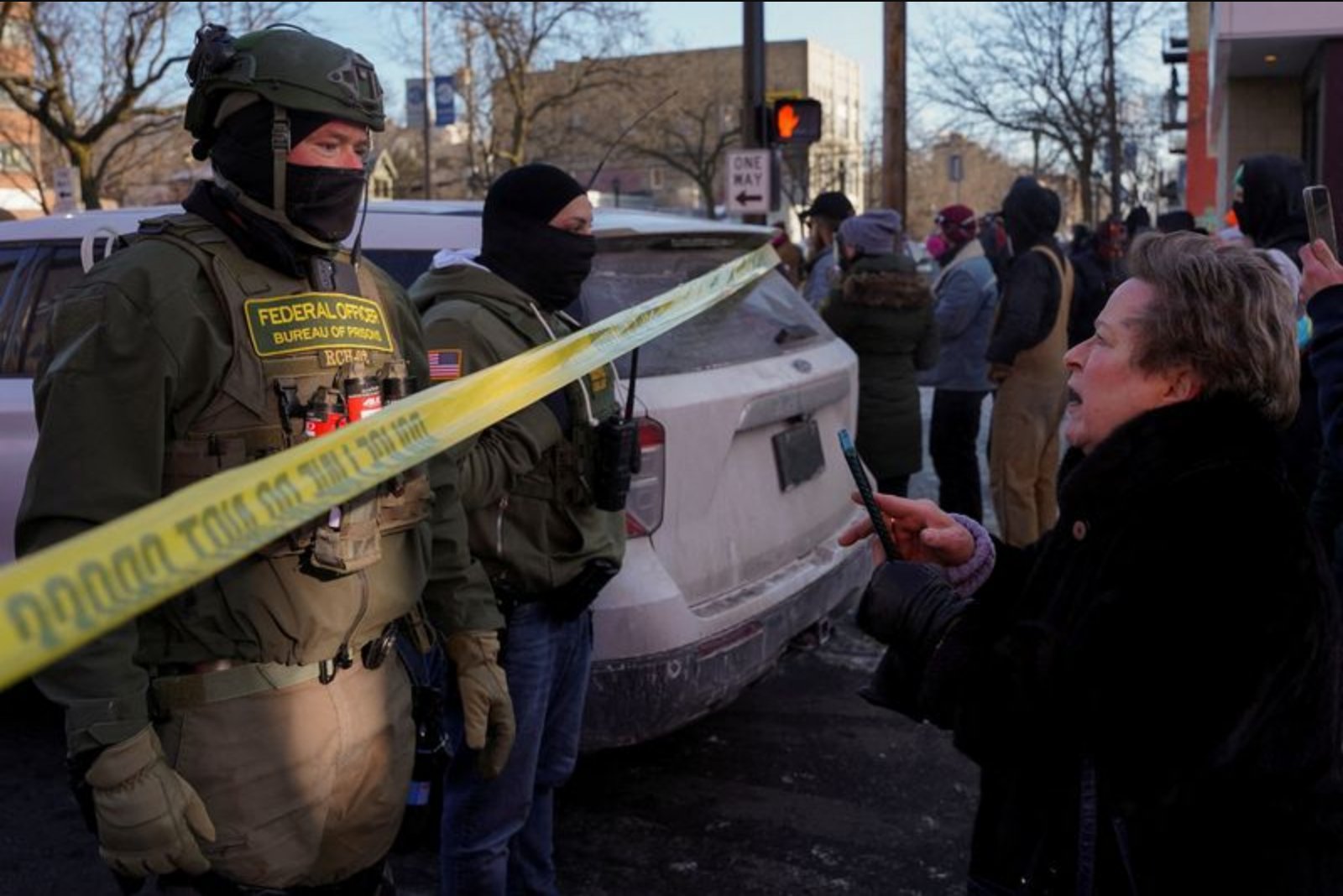
Washington - A Reuters review of six recent episodes involving U.S. immigration agents found that top Department of Homeland Security officials and related federal spokespeople frequently issued immediate accounts of violent encounters that were later challenged by video, court documents or medical findings. The cases include two fatal shootings in Minneapolis this month - deaths of Renee Good and Alex Pretti - as well as shootings and other confrontations in Minnesota, Chicago and Texas.
The review shows a pattern in which agency statements issued shortly after confrontations described subjects as aggressors or portrayed the incidents as justified uses of force. In several instances, independent evidence subsequently emerged that conflicted with those initial representations. Former DHS press secretary David Lapan, who served in 2017 during the prior administration, said the department appears intent on shaping an immediate narrative and remains untroubled when elements of that narrative are proven incorrect. "They are trying to control a narrative from the very start, and they don’t seem to care when they’re proven wrong," Lapan said.
DHS provided Reuters with its prior public statements about the incidents when asked for comment and emphasized officer safety in carrying out the current administration's immigration enforcement priorities. DHS spokesperson Tricia McLaughlin said, "We have seen a highly coordinated campaign of violence against our law enforcement," and added the department seeks to "give swift, accurate information to the American people." White House press secretary Karoline Leavitt told reporters the president "wants to let the investigation continue and let the facts lead."
The review examined six episodes in which early official accounts from DHS, U.S. Immigration and Customs Enforcement, Border Patrol spokespeople or other agents of the government were later contradicted by additional evidence. The cases involved two Minneapolis fatal shootings this month, a non-lethal Minnesota shooting later described in court filings as a case of mistaken identity, a death in an ICE detention center in Texas that was initially described by the agency as an attempted suicide but later ruled a homicide, a contentious Chicago-area confrontation that led to dismissal of federal charges, and a judicial opinion that criticized government accounts of events and officials' explanations for use of force.
Pretti shooting - DHS said he had a gun, video showed a phone
When Alex Pretti, 37, was shot and killed by U.S. Border Patrol agents during an encounter in Minneapolis, the Department of Homeland Security issued a statement noting that Pretti possessed a firearm and suggested the situation "looks like a situation where an individual wanted to do maximum damage and massacre law enforcement." DHS posted on the social network X that Pretti "approached US Border Patrol officers with a 9 mm semi-automatic handgun" and shared a photograph the agency said showed the weapon. The statement said officers attempted to disarm the suspect and that the suspect "violently resisted." White House aide Stephen Miller described Pretti on X as a "domestic terrorist" and a "would-be assassin."
Video of the encounter later verified by Reuters showed Pretti holding a cell phone, not a gun, as agents wrestled him to the ground. Additional footage indicated that an officer removed Pretti's gun from his person shortly before the first shots were fired. Records seen by Reuters show Pretti had a legal permit to carry the weapon.
In a subsequent statement to Reuters, DHS described Pretti as having "committed a federal crime while armed as he obstructed an active law enforcement operation" and characterized the situation as "evolving."
Renee Good shooting - DHS said she "weaponized her vehicle"
On January 7, U.S. Immigration and Customs Enforcement said Renee Good, 37, was a "violent rioter" who had "weaponized her vehicle, attempting to run over our law enforcement officers in an attempt to kill them - an act of domestic terrorism." The department said the ICE officer who fired and killed her "saved his own life and that of his fellow officers." President Trump said Good "ran over the ICE officer" and that the officer acted in self-defense.
Video taken from several vantage points, including body-worn camera footage recorded by the officer who fired, presented a conflicting picture. The recordings show Good seated in her car as officers converged and the vehicle partially blocked a street. One agent, identified as Jonathan Ross, moved to the front of the vehicle while another stood at the driver's window. The videos capture the car moving forward with its wheels turned away from Ross as he drew his weapon and fired three shots, killing Good as the car passed by. The footage reviewed by Reuters appeared to show contact between Ross and the vehicle, although Reuters could not determine whether Ross made physical contact with the car or whether the car struck him.
Mistaken identity in another Minnesota pursuit
On January 15, DHS said officers were conducting a "targeted traffic stop" in Minneapolis for Venezuelan immigrant Julio Sosa-Celis, who allegedly sped away, crashed, and fled on foot. The department's early statement said Sosa-Celis and two other men struck an ICE officer pursuing them with a snow shovel and broom handle, prompting the officer to shoot.
Court documents later unsealed provided a different narrative. An FBI affidavit said officers had scanned a license plate registered to a different person suspected of an immigration violation, causing them to pursue the wrong vehicle. The affidavit said that another Venezuelan man was the car's sole occupant and driver; that man crashed and fled to an apartment building where Sosa-Celis was present. At the building, the affidavit said an ICE officer attempting to detain the car's driver was struck by the driver and Sosa-Celis with a broom, while a third man allegedly wielded a shovel, before the officer fired his weapon.
The affidavit indicated that when the officer drew his gun, the alleged attackers dropped the broom and shovel and were fleeing toward the apartment as he fired. Robin Wolpert, an attorney representing Sosa-Celis, said his client would plead not guilty if indicted and said the affidavit established that the ICE officer shot Sosa-Celis from about 10 feet away while he was fleeing, which Wolpert said demonstrated the officer "was not in immediate danger." DHS did not address the FBI affidavit's differing account when Reuters asked for comment on the matter.
Detention death in Texas - initial account revised after coroner's finding
ICE announced that Cuban immigrant Geraldo Lunas Campos died in an El Paso, Texas, detention center on January 3 and said he experienced "medical distress" while the death was under investigation. A later publication reported that the El Paso County medical examiner's office was likely to rule the death a homicide, with a preliminary cause of death described as "asphyxia due to neck and chest compression." The publication cited a witness who said guards were choking Lunas and that he told them he could not breathe - details not present in ICE's initial statement.
Following the publication, DHS issued a new statement saying Lunas first tried to take his own life and then resisted security officers before he died. The medical examiner later released a report concluding the death was a homicide caused by asphyxia from neck and torso compression, according to the reporting. Lunas' death was one of six deaths in ICE custody in January, a notably high number for the period.
Chicago-area incidents and judicial rebuke
A federal judge addressing use-of-force restrictions on immigration agents in Chicago wrote in a November opinion that the government's "widespread misrepresentations call into question everything that defendants say they are doing in their characterization" of a crackdown. The judge, U.S. District Court Judge Sara Ellis, highlighted an instance in which Homeland Security posted on X that "rioters surrounded law enforcement" and "attacked" a van transporting detainees, and that the confrontation escalated until someone threw a rock that struck Border Patrol commander-at-large Gregory Bovino in the head. Five days later in court, Bovino testified that the rock had not struck him at the time he first used tear gas. "It did almost hit me," he said. Judge Ellis wrote that Bovino "lied multiple times" about why he needed to deploy a tear gas canister at protesters.
Ellis also questioned authorities' assertions that deploying tear gas was necessary to allow agents to exit another operation in October, finding that the agents' own actions prolonged the encounter. "Every minor inconsistency adds up, and at some point, it becomes difficult, if not impossible, to believe almost anything" the government said, the judge wrote.
In one high-profile Chicago-area episode, DHS initially said on October 4 that several drivers "rammed" law enforcement in Broadview, a suburb, and that a woman driver was "armed with a semi-automatic weapon," prompting agents to fire defensive shots at an armed U.S. citizen. The woman, identified as Marimar Martinez, 30, was shot five times by an agent and later indicted on charges of impeding a federal officer with a deadly weapon. The agent involved sent text messages boasting of his marksmanship, material that was filed in court.
Martinez's lawyer, Christopher Parente, told the court that body-worn camera footage from one of the agents contradicted DHS's account. Martinez said in court that an agent had actually rammed her vehicle. Parente said Martinez left her gun in her purse on the passenger seat and never brandished it. DHS was incorrect about the incident's location - the shooting occurred in the Chicago neighborhood of Brighton Park, not Broadview. On November 20, government prosecutors asked a court to dismiss the case against Martinez, saying they were "reviewing new facts and information" gathered during the operation. DHS directed questions about federal criminal charges to the Justice Department, which did not immediately respond to requests for comment.
Taken together, the six incidents cited in the review illustrate repeated instances in which early public statements from DHS and affiliated enforcement agencies were later modified, contradicted, or undermined by independent evidence. In some cases that evidence was video recorded by bystanders or officers' body-worn cameras; in others it surfaced in court filings or in medical examiner reports.
The discrepancies have led to scrutiny from judges and defense attorneys, and prompted skeptical coverage when new material emerged that did not align with initial government descriptions. Agency officials, including DHS leadership, have framed the incidents within a broader narrative of violence against law enforcement and stressed the need to provide prompt public information. At the same time, legal filings, video verification and medical determinations in several cases have presented significantly different accounts of what occurred on the ground.
Officials and legal representatives involved in these matters are pursuing investigations, prosecutions and civil litigation in multiple jurisdictions. The cases remain subject to further review by federal and local investigators, prosecutors and medical examiners. Where court records or medical reports have been made public, they have played a key role in contrasting early government statements with subsequent findings or claims.
As these matters proceed through investigative and judicial channels, they underline tensions between rapid public communications by enforcement agencies and the emergence of independent evidence that can complicate those early narratives. Whether public trust in the agencies' accounts will be affected over the longer term will depend on the outcomes of the investigations, any subsequent policy changes in how agencies communicate after violent encounters, and how agencies address inconsistencies when they are exposed by video, court documents or medical findings.