
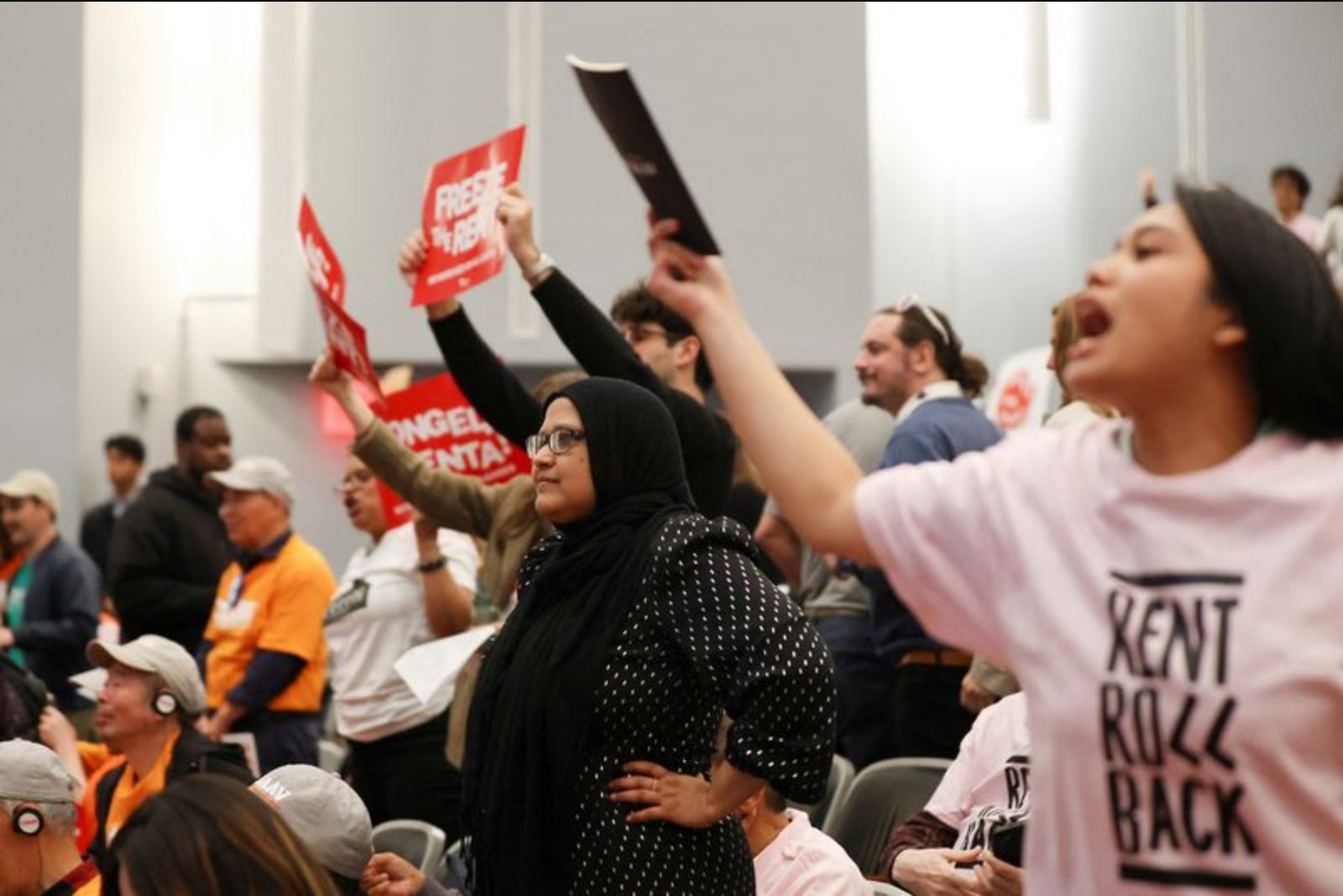
In a packed college auditorium punctuated by chants and applause, New York City’s Rent Guidelines Board moved provisionally to consider a rent freeze for roughly one million rent-regulated apartments, advancing the central housing pledge of Mayor Zohran Mamdani.
The board, which conducts a weeks-long annual review before issuing a final decision in June, frames adjustments to rent-stabilized leases by weighing tenant incomes, landlords’ returns, inflation, taxes, changes in housing supply and other variables in detailed public calculations. Rent-stabilized apartments represent about one quarter of New York City households.
Late on Thursday, amid outbursts from hundreds of tenants in the audience, the board set preliminary ranges for next month’s final vote: zero to 2% increases for one-year lease renewals and zero to 4% for two-year renewals. That voting window preserves the option of a full freeze - signaled by the zero figure - while also leaving room for some increase.
From the stage, nine board members heard chants of "Freeze the rent!" and applause every time a member mentioned the word "zero." Numbers above zero were met with boos. The board nonetheless pushed forward with a motion setting the 0-2% range for one-year renewals; the measure passed on a 7-1 vote, with one member abstaining. Six of the board’s members were appointed by Mayor Mamdani.
Mamdani campaigned last year as a democratic socialist, centering his pitch on a rent freeze and measures to rein in rising costs for groceries, childcare and other essentials. The median rent for a newly leased apartment in the city was cited at $3,950 by listings firm StreetEasy as part of the public discussion around housing affordability.
Since taking office in January, after moving from a roughly $2,300-per-month one-bedroom in Queens to the five-bedroom Gracie Mansion, the mayor has become the focus of close attention from New Yorkers who want to know whether campaign promises will translate into policy. He has limited direct influence over the board’s final decision beyond public advocacy, but he has used city resources to inform residents of their rights and to drive turnout at public hearings before the June 25 final vote.
Supporters say the mayor understands the city’s housing pressures. Moreom Perven, who has lived in a rent-stabilized studio in Jamaica, Queens since 2000 and now pays just under $1,300 a month, said she felt hopeful going into the hearing. Perven, 49, pointed to widespread maintenance issues in her building and a large backlog of complaints: across 187 apartments in her building there were 270 active complaints and 66 open housing code violations in city building records.
Describing repeated disputes with her landlord, Perven listed problems she and neighbors say persist: roaches, mice, broken tiles, water leaks, mold and bed bugs. She also described having to purchase and place a second refrigerator-freezer because the landlord-supplied unit had not been functioning. Perven works part time as a tenants counselor for a housing-rights advocacy group and attended Thursday’s hearing with other residents.
Hundreds of tenants rallied outside the hearing, carrying signs in English, Spanish, Chinese and Bengali, beating drums and attempting to bring whistles that security would not allow inside. Tenants at the hearing broadly divided into two camps: the Tenants Bloc, which is pushing for a rent freeze - an outcome that has occurred only three times in more than 50 years of rent-stabilization law - and the Rent Justice Coalition, which has called for a rent "rollback" to reverse a cumulative 12% increase enacted over the preceding four-year mayoral term under Eric Adams.
Property owners and their advocates offered countervailing testimony. Groups including the Real Estate Board of New York told the board that operating costs, particularly in older buildings, are rising and that the preliminary ranges do not reflect what they say is clear financial distress evidenced in the data. REBNY executive Basha Gerhards argued that a freeze or near-freeze is unjustifiable.
The clash of claims - tenants citing poor conditions and unaffordable increases, and owners citing rising operating costs - framed much of the hearing. Tenants left the meeting guardedly optimistic that a zero option remained, but pessimistic about the possibility of securing a rent rollback this year. Perven said she expected tenants to keep organizing and to press through the remaining public hearings up to the June 25 final vote.
With the Rent Guidelines Board’s final decision still weeks away, the provisional vote keeps intact multiple possible outcomes: everything from a freeze to modest increases. The decision will affect roughly one million regulated apartments and is being watched closely by residents and stakeholders on both sides of the housing debate.
Summary
The Rent Guidelines Board’s preliminary vote in New York left a rent freeze as a possible outcome for about one million rent-stabilized apartments by setting ranges of 0-2% for one-year renewals and 0-4% for two-year renewals. The measure passed 7-1 with one abstention amid vocal tenant demonstrations and opposition from property owner groups citing rising costs. The final decision is scheduled for June 25.
Key points
- Preliminary vote set rent adjustment ranges at 0-2% for one-year renewals and 0-4% for two-year renewals; final vote on June 25 (impacts: housing market, property management, municipal finance).
- Board vote was 7-1 with one abstention; six board members were appointed by Mayor Mamdani (impacts: local policy and political dynamics).
- Tenants pushed both for a rent freeze and for an unprecedented rent rollback to reverse a cumulative 12% increase under the prior mayor; landlords cited rising operating costs, especially in older buildings (impacts: real estate, construction/maintenance sectors).
Risks and uncertainties
- Final outcome remains uncertain - the provisional range includes zero but also allows increases, and historically final votes have tended to land between the extremes (affects renters and rental revenue expectations).
- Property owners warn of financial strain tied to rising operating costs in older buildings, a factor that could influence the board’s calculation and building-level capital planning (affects property owners and maintenance contractors).
- Tenants worry a rollback is unlikely this year despite the inclusion of zero in the range, leaving unresolved disputes over building conditions and affordability (affects tenant advocacy and local political mobilization).
Disclosure