
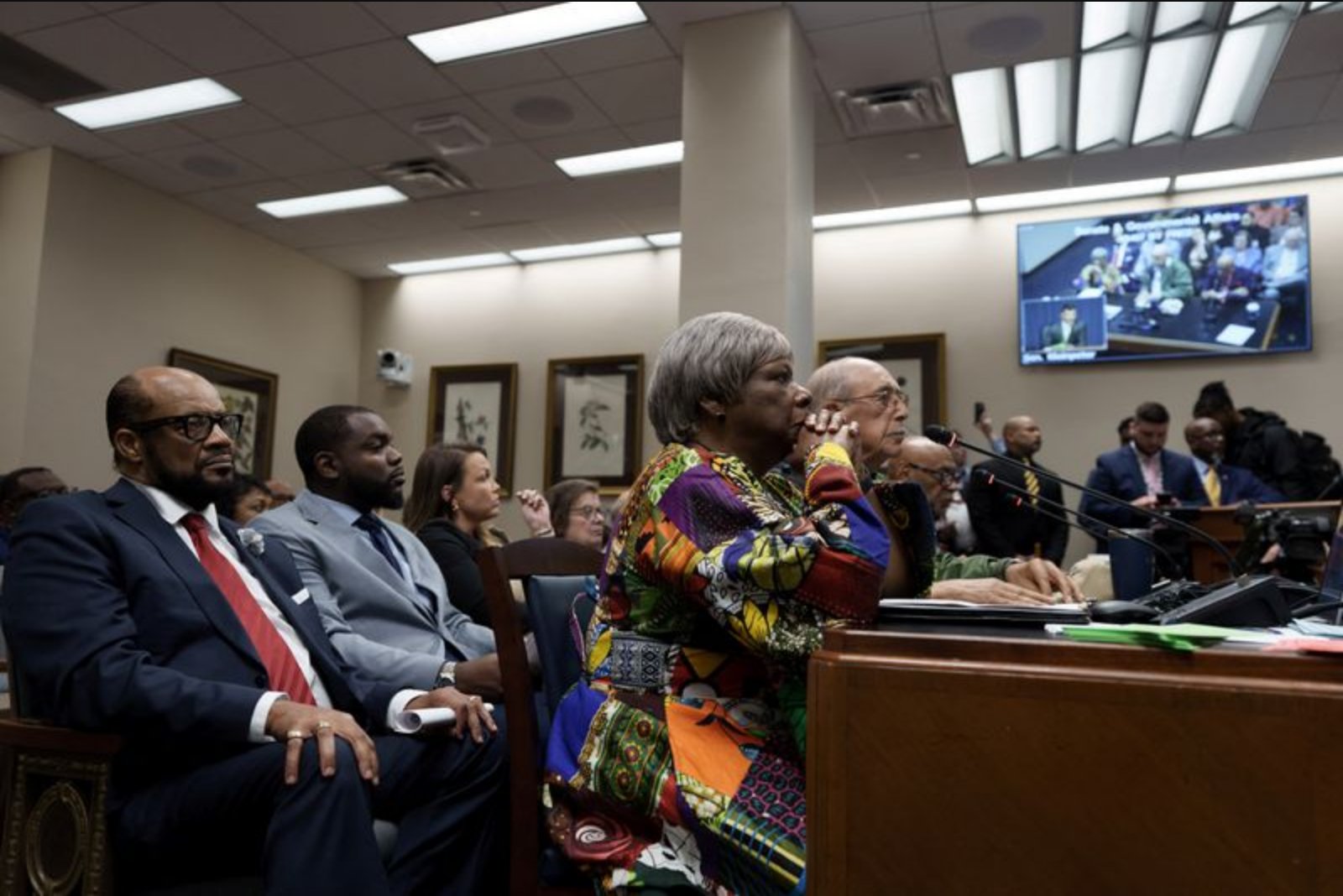
BATON ROUGE, Louisiana - Testimony at a contentious Senate committee hearing on Friday carried the weight of history and personal memory as those opposing a Republican plan to redraw congressional districts warned the proposal would erase at least one majority-Black U.S. House district.
Leona Tate, one of the "New Orleans Four" who as a child helped desegregate a public school in the South, addressed state senators and recounted the trauma of racial slurs, death threats and being escorted to class by armed U.S. Marshals. Standing more than six decades after those events, Tate told lawmakers the effect of the proposed maps felt like a replay of past intimidation, only administered by elected officials and procedural maneuvers rather than a mob.
"I need you to understand what it feels like to stand here, to have walked through that mob as a child, and to now watch elected officials do the same thing that mob was trying to do - just with better suits and a parliamentary procedure," she said at the hearing held in the state capitol.
More than eight hours of testimony followed, with Black members of Congress, pastors, activists and voters delivering remarks that ranged from emotional to angry and deeply personal. Demonstrators outside the hearing room cheered speakers; at one point they shouted "Let him speak!" after Republican committee Chairman Caleb Kleinpeter cut a microphone while a Democratic colleague was speaking during a heated exchange.
Security at the chamber also prevented Mike McClanahan, president of the state chapter of the NAACP, from entering the room, an action that underscored how fractious the session became.
The furor in Baton Rouge is tied directly to last week’s U.S. Supreme Court decision that undercut a central provision of a landmark civil rights statute. That ruling opened the door for Republican state lawmakers to redraw congressional maps that would likely erase one or both of Louisiana’s two Democratic-held, majority-Black districts.
Black voters comprise roughly one-third of Louisiana’s electorate and typically support Democratic candidates. Republicans already hold the remaining four congressional districts in the state. The change in the legal landscape prompted Governor Jeff Landry to postpone the scheduled U.S. House primary elections that had been set for May 16, despite tens of thousands of ballots having been mailed in advance.
At early voting sites this week, voters encountered signs taped to doors indicating that House races had been canceled, even as other contests continued. Officials and voters alike have been left without clarity on the status of ballots already cast or on when any rescheduled primaries might take place.
Senate committee Chairman Kleinpeter told reporters after the hearing that questions about the process would need to be resolved by the Louisiana secretary of state. He defended the move to redraw maps, saying the Supreme Court had determined the current maps were unconstitutional and that the state therefore must proceed with drawing new boundaries.
"The truth of the matter is the Supreme Court came down and said that the maps are unconstitutional," Kleinpeter said. "So we’re going forward with drawing new maps."
Lawmakers, voting rights advocates and civil rights leaders described the fight as part of a broader, intensifying national effort to revisit congressional lines across several Southern states. What began as a redistricting battle last year in Texas has accelerated in places such as Tennessee, Alabama and South Carolina, where Republican officials are pursuing similar plans that would eliminate majority-Black districts following the Supreme Court's decision.
Democrats have also advanced redistricting efforts, but those plans suffered a setback on Friday when the Virginia Supreme Court invalidated a new map approved by voters that likely would have produced gains for Democrats in four seats. The combined series of rulings and map changes has shifted the partisan landscape in favor of Republicans as they prepare to defend a narrow U.S. House majority heading into November’s midterms.
Back in Baton Rouge, civil rights groups and legal advocates said the governor’s postponement of the House primaries has generated widespread confusion.
"Folks are unsure of what is happening with these ballots, what elections are or are not happening," said Sarah Whittington, advocacy director for the American Civil Liberties Union of Louisiana, which has filed suit to block Governor Landry’s decision. "Invalidating a single part of a ballot and alleging that the rest of it is valid, I think, just undermines the entire faith in the system."
Landry’s office did not respond to a request for comment on the lawsuit or on the decision to suspend the primaries.
Amid the legal wrangling, Democratic leaders urged voters to remain engaged. Representative Cleo Fields, whose district the Supreme Court found unconstitutional, said his party is continuing to encourage turnout and vigilance, warning that efforts to narrow congressional representation could presage attempts to reshape state and local bodies as well.
"This is about congressional elections today; tomorrow, it’ll be state legislatures, it’ll be city council, it’ll be school boards," Fields said in an interview.
Inside the hearing, several Black leaders framed the proposed map changes as a regression toward state-led discrimination, explicitly invoking the civil rights movement. Fields noted that since Reconstruction, Louisiana has elected just four African Americans to Congress, and those four were present at the committee session: U.S. Representative Troy Carter and former U.S. representatives Cedric Richmond and William Jefferson, along with Fields himself.
State senators considered a variety of plans. Among them were three proposals advanced by Republican state Senator Jay Morris that, if enacted, could lead to Republicans taking five - or potentially all six - of Louisiana’s U.S. House seats.
"Neither race nor party affiliation nor voting patterns were considered when this was prepared," Morris said of one of the maps that would likely yield a clean Republican sweep. That assertion was contested by activists and Democratic state senators, who argued that the inevitable result would be a dilution of Black Louisianans’ political influence.
Tate urged senators to choose a map that recognized the state’s demographic reality rather than marginalizing Black voters. "You have a choice in front of you," she said. "You can draw a map that reflects who Louisiana actually is: a state where Black voices belong in the halls of Congress. Or you can draw a map that tells my grandchildren, 'Your voices don’t count.'"
Other critics warned about the potential political and moral consequences for Republicans if they adopt maps that critics say undercut democratic representation.
Brandon Boutin, a Baptist pastor, told lawmakers that the redistricting fight concerns more than lines on a map. "This redistricting issue is not just about lines on a map," he said. "It’s about whether democracy is sacred. It’s about whether every citizen has equal value in the eyes of the law."
The hearing in Baton Rouge underscored the fraught and evolving nature of electoral administration following the Supreme Court decision. Lawmakers are now wrestling with both the legal implications of that ruling and the political fallout of rescheduling elections and redrawing districts as ballots circulate among voters. With national redistricting debates accelerating, the contest in Louisiana offers a snapshot of how a single court decision can ripple through state politics, administrative processes and public trust in elections.
For now, much remains unresolved: the fate of mailed ballots, the timing and legality of any rescheduled primaries, the final shape of congressional lines and the broader consequences for representation of Black voters in Louisiana. Those questions will be answered in the coming days and weeks - through legislative votes, legal challenges and administrative decisions - as the state moves ahead with a redistricting process made possible by the court ruling that sparked this controversy.