
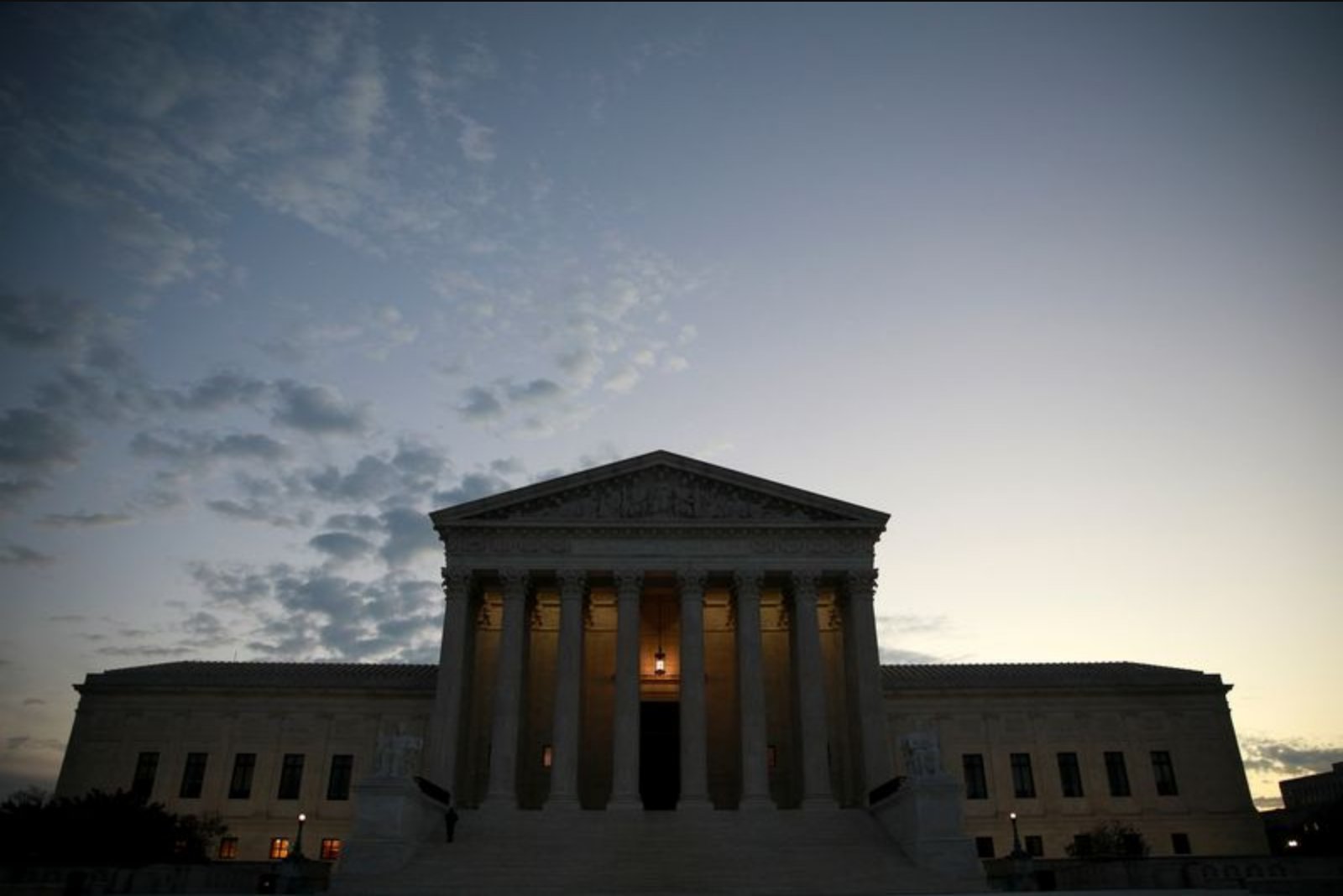
Supreme Court justices on Wednesday raised serious questions about the legality and practicality of a presidential directive that would deny automatic U.S. citizenship at birth to children whose parents are neither U.S. citizens nor lawful permanent residents. The hearing unfolded with President Donald Trump present in the courtroom, drawing intense scrutiny from the bench as the justices sought to test the administration's legal theory and its application in the real world.
Trump, wearing a red tie and dark suit, attended the session and sat in the front row of the public gallery after arriving by motorcade from the White House. He left partway through the arguments shortly after the Justice Department lawyer representing his administration completed his presentation. Accompanying him at the courthouse were White House Counsel David Warrington, Commerce Secretary Howard Lutnick and Attorney General Pamela Bondi. Wednesday marked the first time a sitting president attended arguments at the court, according to the court's historian.
The justices spent more than two hours questioning the government’s lawyer, U.S. Solicitor General D. John Sauer, in the administration’s appeal of a lower court ruling that had blocked the directive. The full court, with its 6-3 conservative majority, pressed the solicitor general on both the textual interpretation of the Citizenship Clause of the 14th Amendment and the operational consequences of adopting the administration’s approach.
Sauer told the justices that many countries do not provide automatic citizenship to everyone born on their soil and described birthright citizenship in the United States as demeaning to what he called a "priceless and profound gift." He argued the policy operates as a pull factor for illegal immigration and rewards those who violate immigration laws. Sauer further urged that the phrase "subject to the jurisdiction thereof" in the 14th Amendment was not satisfied merely by being born in the United States, and that citizenship should be limited to children of those whose primary allegiance is to the United States - namely citizens and lawful permanent residents.
The administration's position asserts that "lawful domicile" - defined by its lawyers as lawful, permanent residence within a nation with an intent to remain - is the key to establishing that allegiance. On that foundation, it seeks to exclude from birthright citizenship the children of certain immigrants whose presence in the United States the administration views as temporary or unlawful.
Several justices questioned both the legal reach of that interpretation and how it would be implemented in practice. Conservative Chief Justice John Roberts described the solicitor general's attempt to limit the reach of the Citizenship Clause as "quirky." Roberts noted that the historical examples Sauer relied on - the longstanding understanding that the clause did not grant citizenship to children of ambassadors or to members of an enemy occupying force - were narrow and idiosyncratic. Roberts asked how the government could expand from those specific exceptions to a broad exclusion encompassing those present in the country unlawfully.
Roberts also pressed Sauer for evidence supporting the administration's stated worry about "birth tourism," asking whether the government had reliable information about how common birth tourism is or how significant a problem it poses. Sauer acknowledged there was no definitive figure and pointed to media reports about companies abroad that facilitate birth tourism.
Liberal Justice Elena Kagan took aim at the administration's textual approach, saying the government's reading of the 14th Amendment was not readily supported by the amendment's language. She characterized some of the sources Sauer relied upon as obscure and questioned whether they could carry the weight necessary to justify such a drastic reinterpretation of a constitutional guarantee.
Arguing on behalf of the challengers, American Civil Liberties Union attorney Cecillia Wang told the justices the presidential directive was unlawful and inconsistent with the clear public understanding of the citizenship rule. Wang said the common understanding - that anyone born in the United States is a citizen - was enshrined in the 14th Amendment to place citizenship beyond the reach of government officials who might try to eliminate it.
Several justices probed the practicality of the administration's proposed framework for determining who qualifies as a child of someone with the requisite "primary allegiance". Justice Neil Gorsuch asked pointed logistical questions: whose domicile would matter, the mother or the father; what about unmarried parents; and how would courts or administrative agencies determine domicile or intent to remain for every birth? He suggested the practical hurdles could be substantial and asked how the government would carry out such an inquiry for individual newborns.
Justice Amy Coney Barrett pressed similar points, asking how intent to remain would be adjudicated and noting that in many cases the parents of a newborn - or which parent to examine - might be unknown. Barrett highlighted the difficulty of making such a determination at the time of birth and pointed out that even the parents of U.S. citizens sometimes have uncertain intent to stay.
Conservative Justice Samuel Alito posed a hypothetical to challenge the challengers' counsel about whether a child born in the United States but also a national of a foreign country could be considered "subject to any foreign power" because of obligations like military service to that foreign nation. Alito referenced an 1866 civil rights law that excluded from citizenship those who were "subject to any foreign power," asking whether that framework could be relevant to the administration's position.
The challengers relied in part on longstanding precedent, including an 1898 Supreme Court decision that recognized birthright citizenship for children born on U.S. soil even when their parents were foreign nationals. That case, they said, had already resolved the question in favor of broad birthright citizenship - a point Justice Gorsuch appeared reluctant to ignore. Gorsuch observed that the court's earlier decision limited the government's ability to adopt the administration's narrower reading, and he noted that a justice who disagreed with that 1898 ruling later said it even covered children of temporary visitors.
The solicitor general countered that the 1898 precedent supported the administration in that the court in that case relied on the fact that the parents had a permanent domicile in the United States at the time of the child's birth. The administration urged that the distinction between parents with permanent domicile and those without should control who receives the benefit of the Citizenship Clause.
Chief Justice Roberts and other justices repeatedly sought clarity on how the administration's approach would operate across the broad range of birth scenarios and what rules would apply to families, hospitals and government agencies responsible for vital records. Roberts' skepticism focused on whether the government could reasonably expand the historically narrow exceptions to cover most people who enter or remain in the country without authorization.
At the hearing, the court also heard argument over procedural matters. The directive had been challenged in a class-action lawsuit by parents and children whose citizenship would be affected if the order took effect. U.S. District Judge Joseph Laplante in New Hampshire had allowed the suit to proceed as a class action and had enjoined the policy nationwide, setting up the administration's appeal to the Supreme Court.
Lower courts concluded the directive violated both the Citizenship Clause of the 14th Amendment and a federal statute that codifies birthright citizenship rights. The district court's nationwide injunction was the target of the government's appeal.
The constitutional history of the Citizenship Clause was part of the court's conversation. The 14th Amendment was ratified in 1868 after the Civil War and was enacted to ensure that those born in the United States, with only narrow exceptions, became citizens. The amendment was designed in part to overturn a prior Supreme Court decision that had held that Black people could not be U.S. citizens. Those historical facts were referenced during the arguments as the justices evaluated how the text and its historical setting should be read.
Outside the courtroom, the president commented on the proceedings, writing on social media soon after the arguments that the United States was "STUPID" for having birthright citizenship. Later at an event in the White House, he criticized the Supreme Court's recent handling of cases and called some justices he had appointed "stupid people" for appearing to want to show independence. He had previously been sharply critical of the court after it struck down sweeping global tariffs he had imposed, saying he was "sickened" by two of the justices he appointed and calling them "an embarrassment to their families."
President Trump issued the birthright citizenship directive on the first day of his current term as part of a series of immigration policies aimed at cracking down on both illegal and certain legal entries into the United States. The policy change was a top priority for the administration and has drawn accusations from critics that it reflects racial and religious discrimination in immigration enforcement.
Justice Alito observed that the framers of the 14th Amendment likely did not envision contemporary patterns of international migration and illegal border crossings when they drafted the provision. He suggested the nation was grappling with issues that were largely unknown when the amendment was adopted.
If the Supreme Court were to endorse the administration's view, some estimates cited during the case suggest the ruling could affect as many as 250,000 babies born in the United States each year and require many families to prove the citizenship status of their newborns. The prospect of a ruling with that scope was part of the backdrop to the justices' persistent inquiries about implementation and scope.
The court has supported the administration in other major immigration disputes since the president returned to office, but on this issue the justices' questions suggested deep reservations about the legal and factual bases for the directive. The case is expected to be decided by the end of June.
Summary of Proceedings
The Supreme Court heard oral arguments over a presidential directive aimed at limiting birthright citizenship. With the president present, the justices closely examined the administration's legal theory that being born in the country is not in itself sufficient for citizenship and that the term "subject to the jurisdiction thereof" excludes children of certain immigrants. The solicitor general argued that the policy would reduce incentives for unauthorized immigration, while challengers contended the directive contravenes the text and settled interpretation of the 14th Amendment. The bench probed the textual basis, historical sources, practical implementation questions and evidentiary support for claims such as birth tourism. A lower court had enjoined the policy as violating the Constitution and federal law, and that injunction was the subject of the appeal.
Key Points
- Supreme Court justices across ideological lines expressed skepticism about the administration’s attempt to narrow birthright citizenship under the 14th Amendment and questioned the textual and historical bases for doing so.
- Justices extensively probed how the proposed rule would work in practice - from determining which parent's domicile matters to how intent to remain would be established at or after birth.
- The dispute raises potential broad effects: some estimates referenced in the proceedings suggest up to 250,000 births a year could be affected and millions of families might face new burdens proving newborns' citizenship status.
Risks and Uncertainties
- Legal uncertainty - The case turns on contested textual and historical interpretations of the 14th Amendment and a federal statute; a Supreme Court decision either way will reshape the legal landscape and could introduce immediate compliance and litigation risks for families, hospitals and government agencies.
- Operational complexity - Justices raised practical concerns about how the government would adjudicate domicile and intent-to-remain questions for individual births, signaling potential administrative burdens and inconsistent outcomes if the administration's approach were upheld.
- Social and demographic consequences - An ultimate ruling limiting birthright citizenship would create uncertainty for affected families and could require proof of parental status at birth, with wide-ranging implications for civil records and potential downstream effects on sectors that interact with new parents and infants.
What Comes Next
The Supreme Court is scheduled to issue a decision by the end of June. The ruling will resolve whether the administration can impose a significant reinterpretation of the Citizenship Clause or whether longstanding readings of the 14th Amendment and relevant federal law remain controlling.