
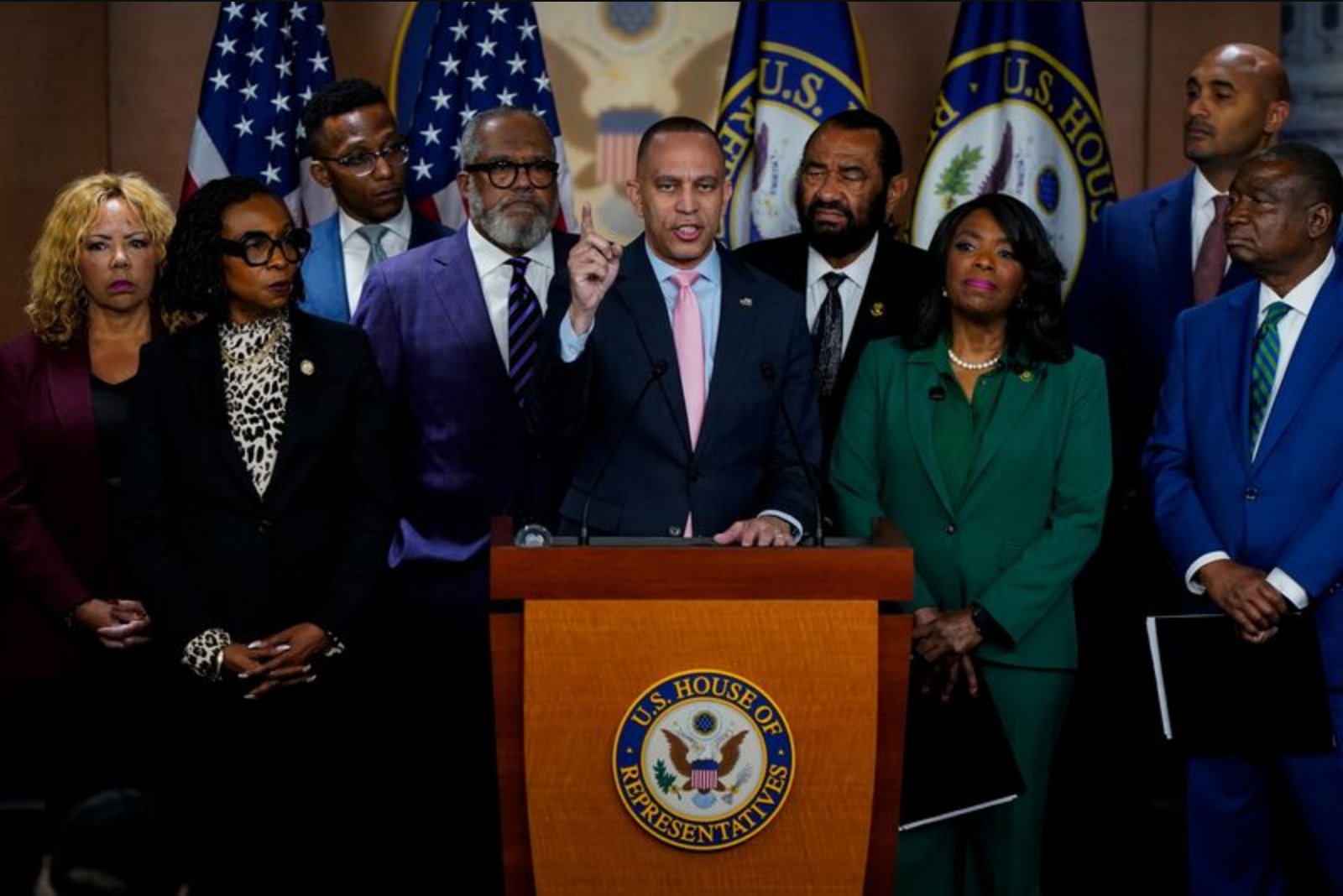
In a memo sent to members of the House Democratic Caucus on Monday, House Democratic Leader Hakeem Jeffries declared his party is on track to win control of the U.S. House of Representatives in November and outlined plans for what he described as a "massive Democratic redistricting counteroffensive" designed to "bury" Republicans ahead of the 2028 presidential election.
Jeffries acknowledged legal setbacks that have benefited Republican mapmakers this cycle but argued those developments do not doom Democratic prospects. He pointed to recent rulings by the U.S. Supreme Court and a state high court in Virginia as elements that have allowed Republican-led states across the South to redraw maps without majority-minority districts, and that nullified a voter-approved map in Virginia that could have produced four seats that Democrats formerly lost to Republicans.
At present, Republicans hold a slim 217-212 majority in the House, with one independent caucusing with the GOP. Five House seats remain vacant because of deaths and resignations. Jeffries said Democrats need to net three seats in November to win the majority and that his letter reflects confidence the party is well positioned to do so despite the adverse court decisions.
The Democratic leader characterized the current GOP strategy as an attempt to reshape electoral terrain rather than address voters' material concerns. "Donald Trump is deeply unpopular and Republicans have failed to make life better for the American people," Jeffries wrote, citing high costs of living and soaring gas prices as central issues in the party's messaging. He added: "Instead of changing direction, GOP extremists are scheming to change the electoral composition of districts throughout the country."
Jeffries argued that winning the House would have direct policy and oversight consequences: a Democratic majority would be able to stall the president's agenda and would give Democrats authority to open congressional investigations into the president and his administration via committees.
While Republicans have been successful so far in the redistricting battles this cycle, Jeffries emphasized that map advantages are not a guarantee of retaining control at the ballot box. He highlighted active resistance from within the Democratic coalition, noting that members of the Congressional Black Caucus and national civil rights groups are contesting what they describe as racial gerrymanders in the Deep South. According to Jeffries, litigation is ongoing in four states and "several others are taking steps to decisively respond to what the U.S. Supreme Court has unleashed."
Jeffries said he believes the new Republican maps will not ultimately "meaningfully benefit" the GOP and suggested that, paradoxically, aggressive redrawing by Republicans may energize Democratic voters. "Quite the opposite. Democratic enthusiasm and resolve have grown more intense," he wrote, adding that "Even after being aided and abetted by blatantly undemocratic court decisions, the failed GOP majority will not be able to gerrymander themselves back into power."
On the other side of the dispute, Richard Hudson, a North Carolina Republican who chairs the House Republicans' campaign arm, told Fox News on Sunday that conditions look "fantastic" for his party. Hudson said Republicans face a favorable battlefield, with a map that tilts toward GOP advantage, and argued the party has superior candidates and more financial resources at the committee level. "On all the metrics that matter, we’re winning," he said.
Jeffries also referenced polling that shows political headwinds for the president. A poll last month found the president's approval had dropped to 34%, the lowest level of his current term, a figure the Democratic leader used to underscore his contention that Republicans are vulnerable heading into the midterms.
The letter combines legal, political, and messaging strategies: pushback through litigation, targeted political organizing in affected districts, and public messaging focused on affordability and energy costs. Jeffries positioned that multipronged approach as the Democratic response to a cycle in which Republicans have so far prevailed in drawing more favorable lines but, in his view, have not addressed voters' immediate economic concerns.
Contextual note: The letter and the reactions quoted above frame an escalating partisan battle over electoral maps and control of the House that includes litigation in multiple states, narrow margins in the chamber, and competing claims about who benefits from new district lines. The practical effects include possible shifts in oversight, legislation, and political attention if control changes.