
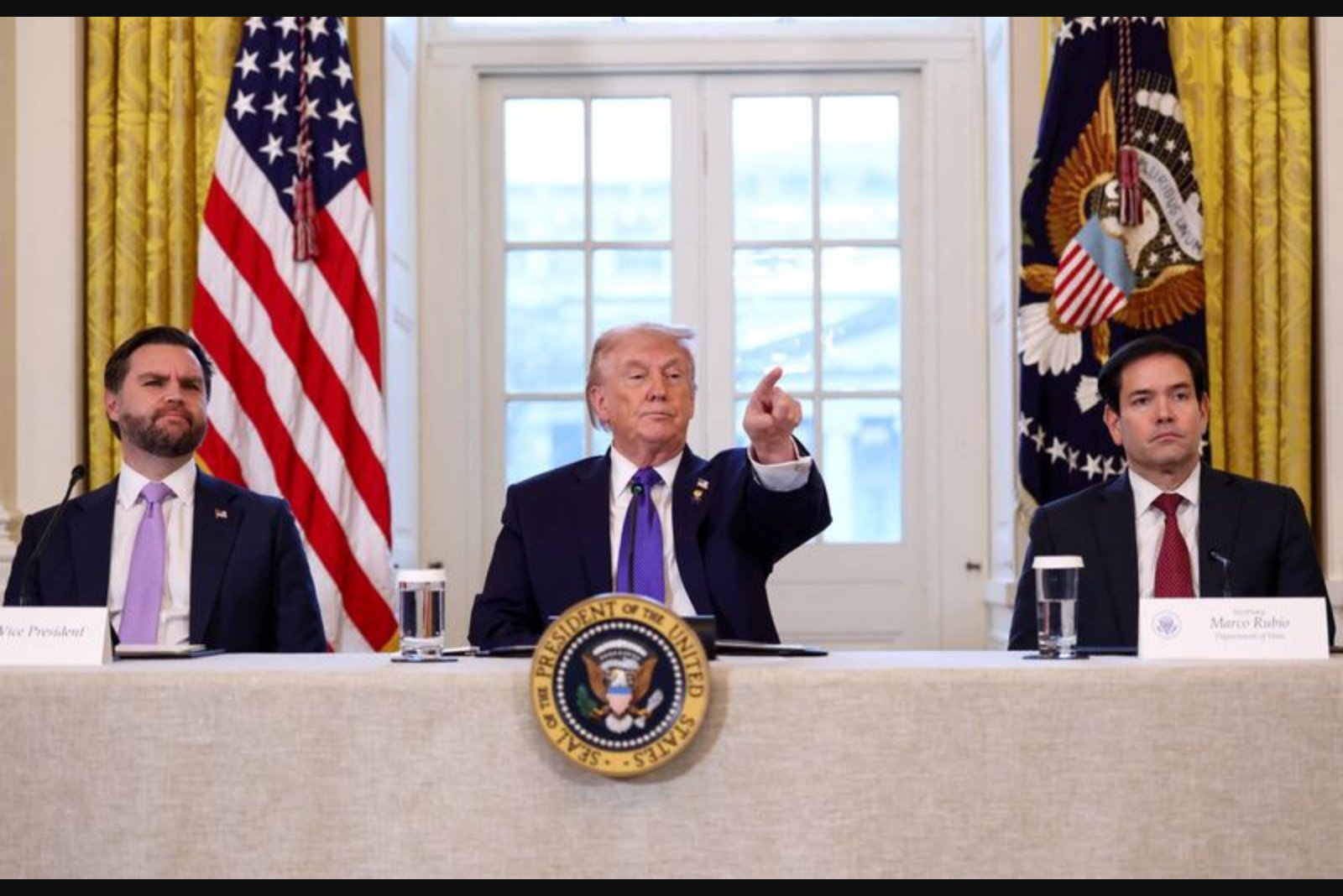
WASHINGTON, March 29 - The ongoing U.S. military operation targeting Iran has become a pivotal test for two of President Donald Trump’s highest-ranking lieutenants: Vice President JD Vance and Secretary of State Marco Rubio. Both men are broadly regarded within Republican circles as potential contenders for the party’s post-Trump leadership, and each has adopted a distinct posture as the conflict evolves.
Vance and Rubio have been drawn into continuing efforts to secure an end to the hostilities, according to the administration, as officials seek to compel Iran to accept U.S. demands regarding its nuclear and ballistic missile programs and to ensure unimpeded oil transit through the Strait of Hormuz. The episode has intensified internal discussions about succession inside the White House, with President Trump reportedly asking allies and advisers privately whether the party’s future should be led by "JD or Marco?," two people familiar with his views said.
Political analysts and Republican officials say the trajectory of the military operation - now in its fifth week - could materially affect both men’s standing ahead of the 2028 presidential contest. A rapid, decisive outcome perceived as favorable to the United States could strengthen Rubio, who has aligned closely with the administration’s more hawkish stance and has stood out publicly as a vigorous defender of the campaign. Conversely, a drawn-out conflict could offer Vance an opening to argue that his caution reflects the anti-war instincts of Trump’s base while not requiring him to break openly with the president.
Positions and public posture
Vance, 41, a former Marine and Iraq veteran, has a record of arguing against prolonged U.S. entanglements overseas. His public statements on Iran have been deliberate and restrained, and the president himself has acknowledged "philosophical differences" between them over the conflict. Vance previously described himself as a "never-Trumper" but has since become a loyal member of the administration. In a public appearance in the Oval Office earlier this month, standing beside the president, Vance voiced support for Mr. Trump’s handling of the situation and reiterated agreement that Iran should not acquire a nuclear weapon.
Rubio, 54, who also functions as the president’s national security adviser, has been more openly hawkish and has mounted a robust public defense of the strikes. He has been presented by the White House as a visible defender of the campaign and, in public remarks, said plainly, "He’s not going to leave a danger like this in place." Rubio’s recent statements drew criticism from some conservative backers after he suggested that Israel pushed the United States toward the conflict, a comment that required damage control by the secretary and the White House. Since then, the president has praised Rubio’s contributions.
Signals from the White House
Within Republican ranks there is intense attention to which senior aide appears to hold the president’s favor as the conflict unfolds. A Republican with close ties to the White House observed that "everyone is watching the body language that Trump makes on Rubio and not seeing the same on Vance." Some rank-and-file Republicans perceive signs of the president leaning toward Rubio, though observers note the president could reverse course quickly.
The White House pushed back against suggestions of an administration preference. Spokesman Steven Cheung said, "No amount of crazed media speculation about Vice President Vance and Secretary Rubio will deter this administration’s mission of fighting for the American people."
Those closest to the vice president portray his role as collaborative. A Vance spokeswoman said, "Vice President Vance is proud to be a part of a highly effective team that, under President Trump’s bold leadership, has had incredible success in making America safer, more secure and more prosperous." A senior White House official, speaking on the condition of anonymity to discuss a sensitive topic, added that Trump tolerates ideological differences so long as aides remain loyal, and that Vance’s skepticism has served to inform the president about the sentiments of a segment of his voter base.
Sources indicate that Vance could take on a more hands-on negotiating role if progress is made by the president’s special envoy, Steve Witkoff, and son-in-law Jared Kushner. A person familiar with Vance’s thinking told reporters that the vice president intends to wait until after the November midterm elections before deciding whether to pursue a presidential bid in 2028.
Potential 2028 dynamics
Rubio has publicly stated he would not run for president if Vance chooses to enter the race, and those familiar with Rubio’s preferences say he would be willing to serve as Vance’s running mate. Still, perceptions of weakness or vulnerability on Vance’s part could encourage Rubio or other Republicans to mount competitive challenges. Republican strategist Ron Bonjean warned that the president has "a long memory" and suggested that any perceived shortfall in allegiance from Vance might jeopardize his chances of securing the president’s endorsement if Mr. Trump remains popular with the MAGA base.
Mr. Trump has floated the prospect of Vance and Rubio running together on a single ticket, saying such a pairing would be formidable. But a senior White House official cautioned that the president does not want to anoint a successor prematurely.
A March poll found that 79% of Republicans view Vance favorably, with 19% holding an unfavorable view. The same poll showed Rubio with a 71% favorable rating among Republicans and a 15% unfavorable rating. For comparison, the president himself registered a 79% favorable rating and a 20% unfavorable view among Republicans in that survey.
Political costs and public reaction
President Trump’s overall approval rating has fallen in recent days to 36%, the lowest since his return to the White House, according to a four-day poll completed last week. The decline was driven in part by a surge in fuel prices and broad public disapproval of the Iran campaign, the polling indicated.
Some conservative leaders say the outcome of the campaign will carry notable political consequences. Matt Schlapp, who runs the Conservative Political Action Conference, said the Iran operation will have "big political consequences." He argued that a clear and successful outcome would politically reward those seen as having done the right thing, while a conflict that "goes on and on and on" would be politically damaging.
Republicans, as a group, remain broadly supportive of the strikes on Iran, according to polling. Support among Republicans stood at 75%, while approval among Democrats was 6% and among independents 24%, the poll showed.
Public contrast at a Cabinet meeting
The contrast between the two senior aides was visible during a televised Cabinet meeting. Rubio mounted an unequivocal defense of the president’s actions, while Vance struck a more reserved tone and emphasized options to deny Iran a nuclear capability. Vance concluded his remarks by extending religious and personal goodwill toward troops and Christians observing Holy Week and Easter, telling servicemembers, "We continue to stand behind you, and continue to support you every step of the way."
When asked whether Rubio was concerned that a protracted conflict could harm his political prospects, a senior State Department official replied, "He has not spent a second thinking about this."
Conclusion
With term limits preventing President Trump from seeking another term in 2028, the administration’s handling of the Iran conflict has become a near-term referendum on a potential line of succession inside the Republican Party. How the campaign is perceived by Republican voters and the broader public - whether as a short, successful operation or as an extended engagement - will likely shape the narrative around both JD Vance and Marco Rubio as they are viewed through the lens of possible future leadership.