
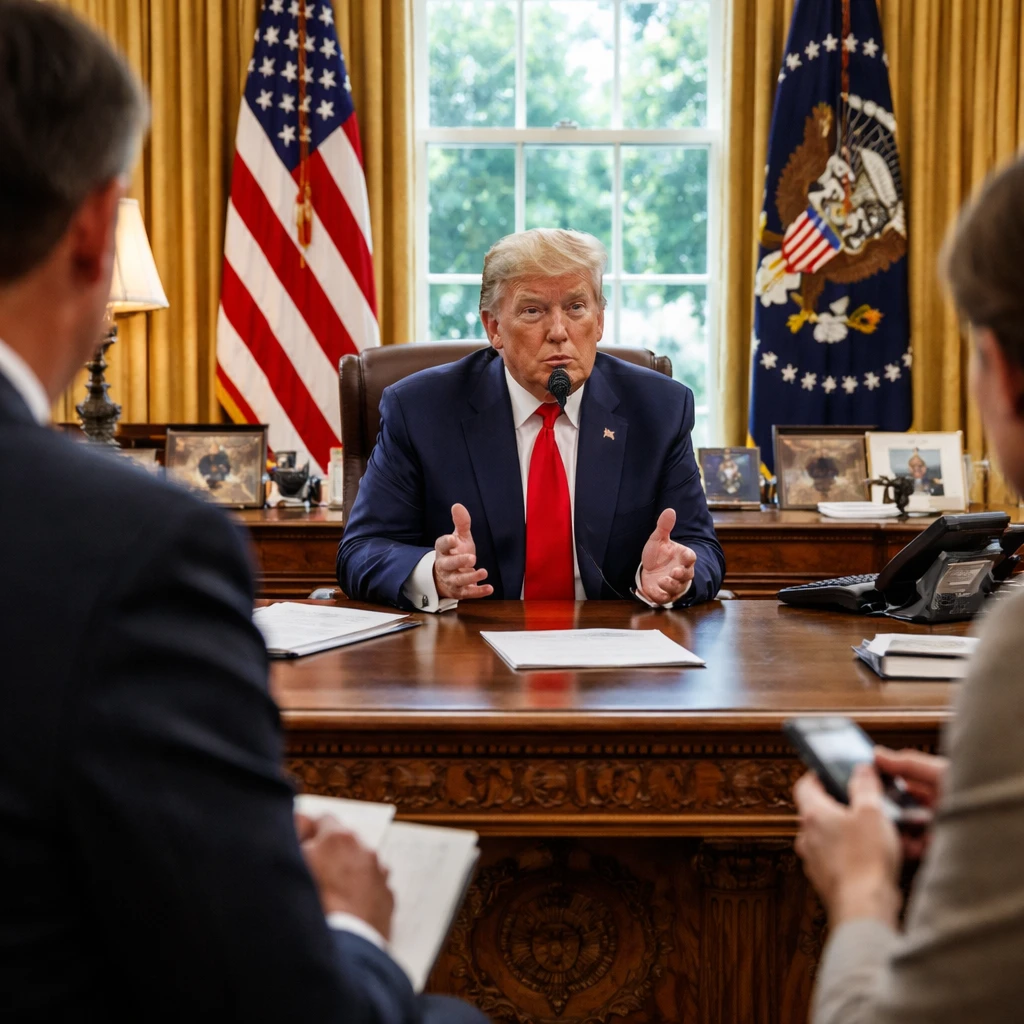
During a candid 30-minute interview conducted in the Oval Office, U.S. President Donald Trump conveyed his steadfast approach to several pressing issues facing his administration. He notably brushed aside criticism from various quarters, including the general public, business leaders, and politicians within his own party.
On the matter of Greenland, where discussions about possible U.S. involvement have raised questions, Trump dismissed a Reuters/Ipsos poll indicating mild American opposition as "fake," underscoring his disregard for polling data in favor of his own judgment. Similarly, when challenged about Republican senators' resistance to the ongoing inquiry into Federal Reserve Chairman Jerome Powell, Trump expressed a dismissive "I don't care," reaffirming his disinterest in opposing viewpoints. This attitude extended to economic concerns highlighted by figures like JPMorgan Chase CEO Jamie Dimon, whose apprehensions about White House intervention in the Federal Reserve policy Trump also downplayed with the same phrase.
In regard to domestic economic conditions, Trump maintained his assertion that the U.S. economy stands as the strongest in history, though he acknowledged the need to better communicate his accomplishments to the public, pointing to an extensive binder documenting his administration’s achievements. Throughout the conversation, he indicated that his governance style prioritizes his personal convictions over popular opinion, stating, "A lot of times, you can't convince a voter. You have to just do what's right." He referenced past decisions initially deemed unpopular that ultimately proved successful.
Turning to Iran, earlier remarks released the same day suggested the crackdown on protesters might be easing, though Trump did not disclose the sources of his information. His statements in the interview reflected a cautious stance, lacking commitment to any immediate military action against Iran despite continued threats. He stopped short of advocating for regime change, nor did he endorse any particular alternative leadership, including Iran’s exiled crown prince, Reza Pahlavi. "We have to play it day by day," he commented on navigating the situation.
Efforts toward peace, another focal point in the discussion, revealed the ongoing challenges. The president cited the ceasefire in Gaza as an achievement but noted Hamas remained armed, complicating disarmament efforts tied to the agreement. "They were born with a gun in the hand," he remarked, leaving the success of future disarmament uncertain. On the conflict in Ukraine, Trump suggested that a peace deal with Russia might be attainable, placing the obstacle on Ukrainian President Volodymyr Zelenskiy, who insists that peace should not come at any cost.
When addressing a tragic recent incident involving U.S. Immigration and Customs Enforcement (ICE), where agent-involved gunfire resulted in the death of Renee Nicole Good, Trump described the event as "a very unfortunate incident." His homeland security secretary's labeling of Good as a domestic terrorist contrasted with the president's acknowledgment of a difficult position faced by ICE officers amid disrespect and violence. He doubled down on his policy of deploying armed agents in American cities, citing efforts to remove thousands of criminals from the country, although this claim lacks supporting evidence.
Looking ahead to the midterm elections, Trump voiced frustration over the historical trend of the party holding the presidency losing congressional seats in the second year. He expressed doubt over Republicans maintaining control of either the House or Senate. Nevertheless, he emphasized the substantial achievements of his administration, noting they were significant enough to question the need for an election.