
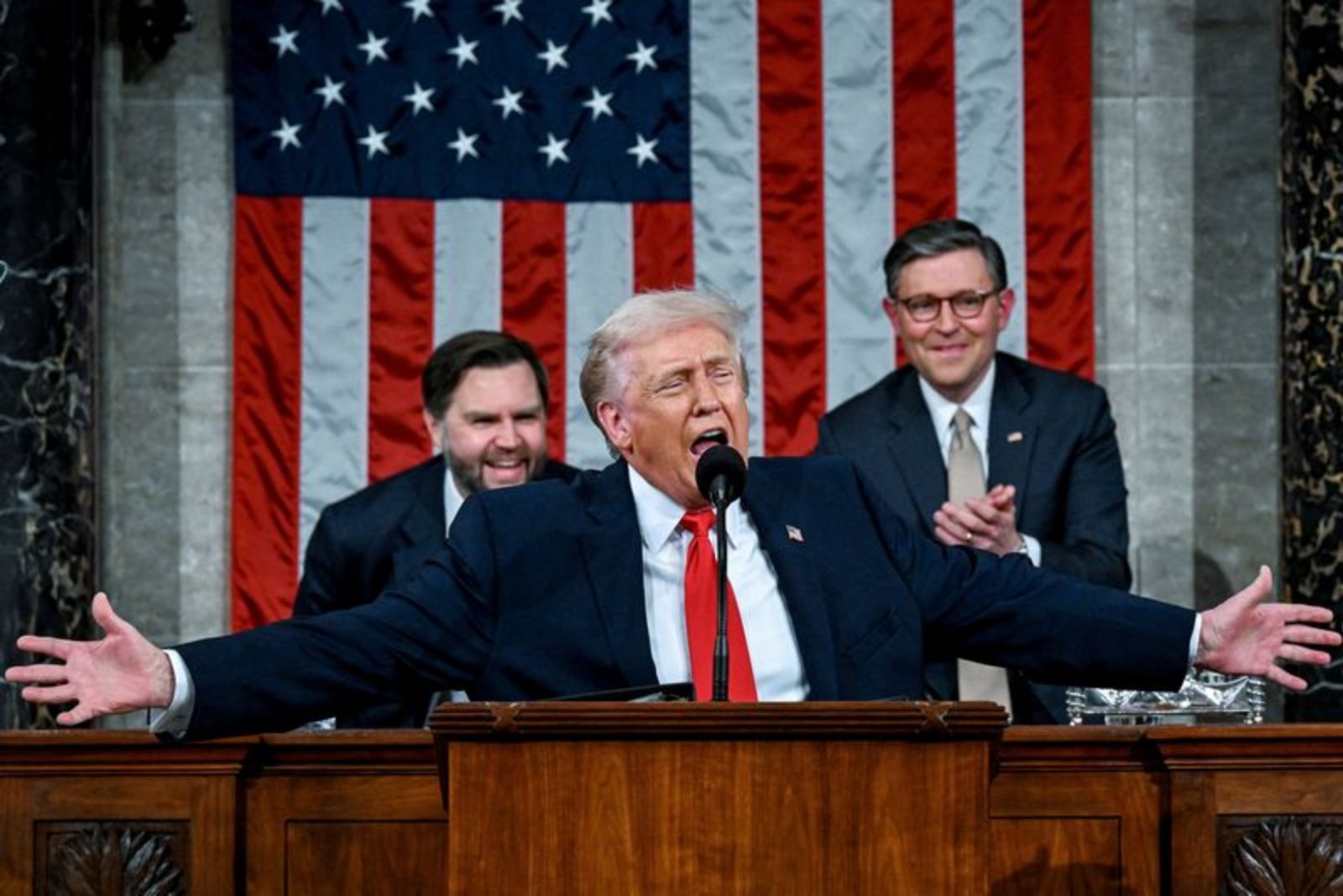
House Republicans are gathering at a Florida retreat this week with the explicit goal of advancing President Donald Trump’s legislative priorities, even as external pressures - including a widening war in the Middle East and rising consumer costs - expose the fragility of their slender majority.
Speaker Mike Johnson and the GOP leadership have flown lawmakers to Trump’s Doral golf resort in hopes that the setting will help unify a conference that has lately required persistent coaxing to secure votes. Trump is scheduled to address the group on Monday. Several Republicans have voiced frustration with his shifting emphasis away from domestic economic issues toward international affairs such as the U.S.-Israeli war with Iran and toward trade moves they say have raised prices through tariffs.
The arithmetic in the House leaves little room for dissent. With a 218-214 margin, party leaders can afford at most two defections on bills uniformly opposed by Democrats. That narrow margin is tightened further by frequent opposition from Representative Thomas Massie, a Kentucky Republican and deficit hawk, who often votes "no" on spending measures.
"There’s still things we want to do this year with this majority to work with President Trump to make life more affordable for American families," Majority Leader Steve Scalise told reporters. "The country expects us to still deliver, and we’re going to do just that," he added, reiterating the party’s emphasis on affordability as a campaign and governing priority.
Republican strategists and leaders are acutely aware that affordability - especially concerns over healthcare and housing costs - is a central issue for voters as November approaches. Reuters/Ipsos polling cited by leaders shows Democrats hold a slight advantage on the cost-of-living issue, a dynamic Republicans are eager to reverse.
One procedural tool under active consideration is budget reconciliation, a parliamentary mechanism that can allow passage of certain fiscal measures with a simple majority in the Senate, thereby circumventing a Democratic filibuster. House Republicans invoked reconciliation last year to pass what they called the "One Big Beautiful Bill." That package, which included tax and spending changes, proved unpopular with the public and is projected to add $4.7 trillion to the U.S. deficit over 10 years. U.S. debt currently stands at $38.5 trillion.
On the campaign trail and in policy messaging, Republicans are promoting the tax cuts included in that law - such as cuts on tipping and overtime income - as measures that improve affordability for families. They believe that deploying another reconciliation bill could help persuade voters at a time when independent analysts warn Democrats could retake control of the House.
"To put the gear into neutral and coast, legislatively, with no commitment to further action would be governing malpractice," House Budget Committee Chairman Jodey Arrington told reporters, framing legislative activity as a necessity rather than an option for maintaining political credibility.
The Senate calculus complicates the picture. Although Republicans hold a 53-47 advantage there, most legislation requires 60 votes to overcome a filibuster. Reconciliation offers a path to push through a bill with only 51 votes, a critical distinction for a party seeking to enact a national agenda without Democratic support. Even so, some Senate Republicans express reservations about another reconciliation push, warning it could expose internal party divisions publicly and allow Democrats to force politically sensitive amendment votes in the lead-up to November.
"The goal is not to have reconciliation. The goal is to solve a policy issue," Senator James Lankford, vice chair of the Senate Republican Conference, said. "I would support it, if we were able to find consensus on what we’re trying to accomplish and it’s the right tool to accomplish it." His comment underscores the tension between procedural expedience and the desire for bipartisan or at least intra-party consensus.
In Florida, Johnson and his team say they will press lawmakers to coalesce around an agenda that includes housing and other affordability initiatives, tariffs and trade policy, additional tax cuts, and increased spending for defense, immigration enforcement and transportation infrastructure. Hardline conservatives in the conference insist that any new spending must be offset by cuts elsewhere in the budget.
"We have a big playbook. The idea is to determine which of the plays in that big menu are the ones we want to run, and what the priorities are," Johnson told reporters, portraying the retreat as a workshop to prioritize proposals from a broad set of options.
There is also debate within the GOP about funding any Pentagon request for supplemental aid tied to the Iran war. Some Republicans believe such a supplemental would have to be routed through reconciliation because of anticipated Democratic opposition to Trump’s actions in the Middle East.
House Democratic Leader Hakeem Jeffries criticized that framing at a press appearance, arguing that taxpayer dollars are being spent on military operations in the Middle East. "Let’s have the debate about how taxpayer dollars are being wasted right now - billions spent to bomb the Middle East, triggering an all-out war that now involves more than a dozen countries, as opposed to Republicans bothering to find a dime to lower grocery prices or make life better for the American people," he said, casting the choices as one between foreign military commitments and domestic affordability measures.
As the retreat unfolds, Republican leaders face the dual tasks of narrowing policy choices from a broad agenda and ensuring the votes to pass those choices. The combination of an international conflict that has shifted national attention, rising consumer costs that voters cite as a key concern, and razor-thin margins in both chambers of Congress leaves the GOP confronting a difficult legislative path into the midterm campaign season.