
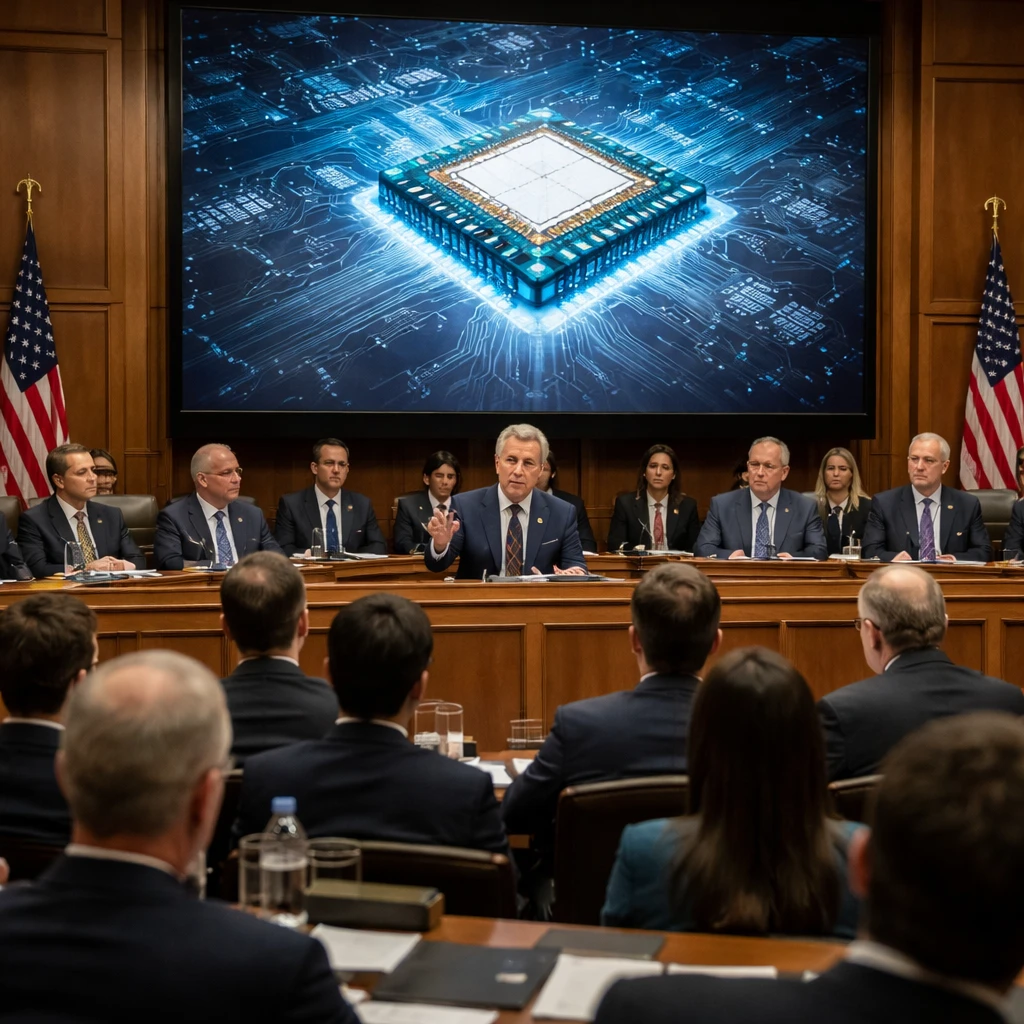
The U.S. House Foreign Affairs Committee took a significant step on Wednesday by passing legislation that aims to tighten Congressional oversight on the export of cutting-edge artificial intelligence (AI) chips to China and other rival nations. The committee voted overwhelmingly in favor of the "AI Overwatch Act," a bill introduced last December by Representative Brian Mast of Florida, who leads the committee.
This legislative initiative emerged following President Donald Trump's decision to approve shipments of Nvidia’s powerful H200 AI chips to China, a move that raised concerns among lawmakers regarding technological advantages and national defense implications. The proposed law would grant both the House Foreign Affairs Committee and the Senate Banking Committee up to 30 days to review export licenses for advanced AI semiconductor technologies destined for competitor countries, with authority to impede such exports during the evaluation period.
The committee's current draft also extends its restrictions by including a prohibition on exporting Nvidia’s top-tier Blackwell chips, reflecting escalating efforts to contain the transfer of high-end AI processing capabilities. The legislation secured bipartisan support in the Foreign Affairs Committee, with forty-two members voting to advance the bill, two opposing it, and one member abstaining.
Observers noted that the bill’s prospects improved after a coordinated media campaign opposed to the measure surfaced last week, putting the spotlight on ideological divisions over trade and technology policy. Representative Mast articulated the rationale behind the bill prior to the vote, emphasizing the strategic significance of AI chips beyond consumer applications. "If we were just talking about war games on Xbox, then Jensen Huang could sell as many chips as he wants, to anybody that he wants," Mast remarked, referencing Nvidia’s CEO. "But this is not about kids playing Halo on their television. This is about the future of military warfare."
Representatives from Nvidia, the White House, and the office of David Sacks, the President’s AI czar, did not provide comment regarding the bill when contacted.
Last week, David Sacks drew attention by sharing a post on the social media platform X accusing the bill of being driven by Never Trump factions and former Obama and Biden administration affiliates attempting to undermine the previous President's policies and America First approach. The post also targeted AI firm Anthropic’s CEO, Dario Amodei, accusing him of employing former Biden staff to advocate for the measure. Sacks responded affirmatively to these claims.
Anthropic declined to comment on both the allegation and the legislation. However, Amodei publicly criticized the shipment of advanced chips such as Nvidia’s H200 to China at the World Economic Forum in Davos, labeling it "crazy" and likening it to "selling nuclear weapons to North Korea."
Conservative activist Laura Loomer and others also voiced disapproval of the bill in recent social media commentary, framing it as "pro-China sabotage disguised as oversight." In response, Mast and other committee members dismissed these critiques, affirming that the legislation is necessary to safeguard U.S. national security interests. Representative Michael McCaul of Texas highlighted the influence of industry groups reportedly opposing the bill due to profit motives, stating, "There are special interest groups out there right now with millions of dollars funded by the very people who will profit off the sale of these chips and others that ... are waging a social media campaign war...against this bill. Shame on them."