
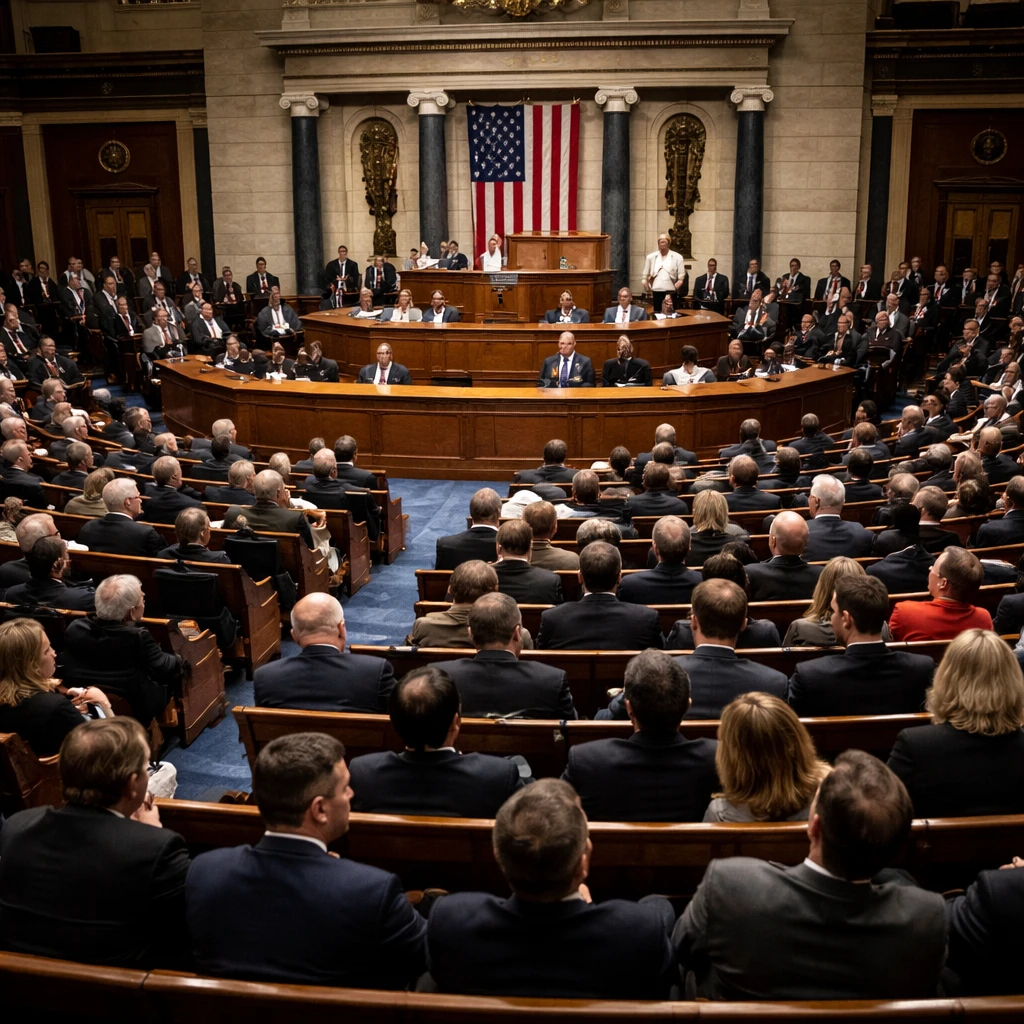
In a sharply divided vote, the U.S. House of Representatives failed to pass a resolution that sought to limit President Donald Trump's ability to undertake additional military initiatives in Venezuela without obtaining explicit congressional authorization. The measure was defeated as the chamber split evenly, 215 to 215, failing to achieve the majority needed for approval. The resolution was in line with a similar piece of legislation that recently fell short in the Senate, reflecting bipartisan concerns about the scope of presidential war-making powers.
The resolution stipulated that armed forces must be withdrawn from Venezuela unless Congress formally authorizes a declaration of war or grants a specific statutory authorization for the use of military force. The close margin in the House vote highlighted unease among some lawmakers, including Republicans, regarding the administration's foreign policy decisions and the constitutional prerogative of Congress to sanction military deployments.
Opponents of the resolution contended that its provisions were unnecessary given the current absence of U.S. troops in Venezuela. Representative Brian Mast, a Republican from Florida and chair of the House Foreign Affairs Committee, emphasized this point during the debate, stating, "We do not have anybody there in Venezuela fighting." He further criticized the initiative as a partisan maneuver, asserting that it was intended primarily to target President Trump. "It’s about spite," Mast remarked, "You will condemn him no matter what he does."
Supporters of the resolution framed the measure as a safeguard against further U.S. entanglement in prolonged military conflicts. They cited the longstanding interventions in Afghanistan and Iraq as cautionary examples of so-called "forever wars." Representative Gregory Meeks, the top Democrat on the Foreign Affairs Committee from New York, stressed that "The American people want us to lower their cost of living, not enable war," underscoring the desire to prioritize domestic economic concerns over overseas military engagements.
The Trump administration's recent actions in Venezuela have included a reported U.S. military operation on January 3 that resulted in the capture of Venezuelan President Nicolás Maduro. A significant naval presence has been maintained around Venezuela, with U.S. forces enforcing a blockade and engaging vessels in the southern Caribbean and Pacific regions over several months.
President Trump has also made statements indicating intentions for a prolonged U.S. presence in Venezuela. Moreover, he has indicated support for Iranian protestors and issued threats suggesting the potential use of military force to seize Greenland, a territory belonging to Denmark, a NATO ally. Such comments have elicited criticism from various quarters.
Some Democrats expressed disappointment with the Trump administration for leaving much of Maduro's government structure intact and not providing a clear plan to manage Venezuela following Maduro's removal. Representative Debbie Wasserman Schultz of Florida commented, "The machinery of repression was left in place and the Democratic hopes of Venezuelans are being left behind," reflecting concerns about the administration’s strategy.
The recent votes on Congressional war powers have been notably close. The prior Senate measure failed only after Vice President JD Vance intervened to break a tie. Representative Jim McGovern of Massachusetts, a key proponent of the House resolution, stated, "If the president is contemplating further military action, then he has a moral and constitutional obligation to come here and get our approval."
The administration maintains that the operation which led to Maduro's capture was a limited judicial action aimed at bringing him to trial in the United States on drug trafficking charges rather than a military campaign.