
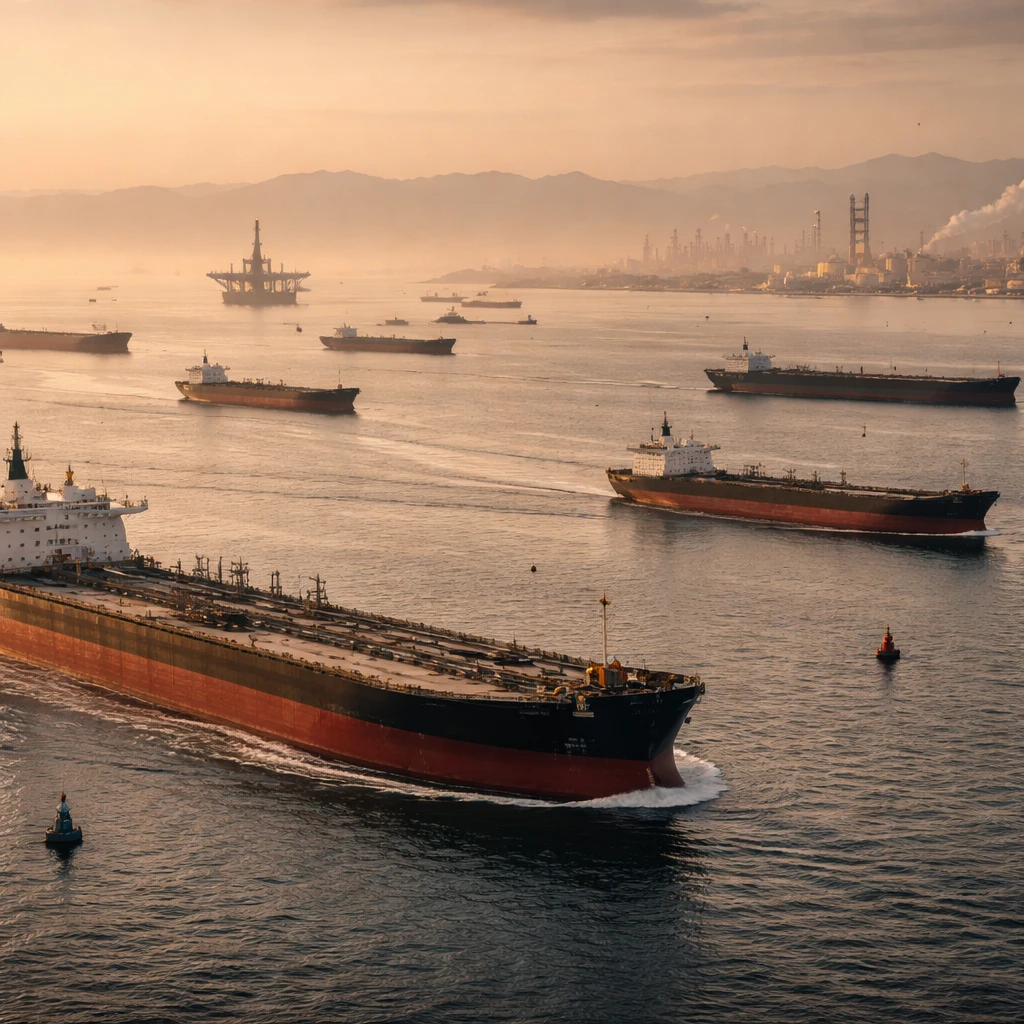
Bank of America has mapped how production and pricing risks tied to the Strait of Hormuz are spread across Europe’s largest oil companies, finding exposure is concentrated in a small group of firms even as higher commodity prices lift earnings across the industry.
The bank identified TotalEnergies, Shell plc, BP plc and Eni SpA as the only European "Big Oil" companies with substantial equity production volumes that are effectively trapped behind the Strait of Hormuz. Within that subset, TotalEnergies is the most directly exposed, with roughly 15% of its annual group production linked to flows that would be affected by disruptions through the strait.
BofA cautioned that, despite this operational exposure, those volumes do not translate into a proportionate share of overall post-tax cash flow for the companies involved. The bank attributed this to the diversified nature of the majors’ asset bases and to their ability to mitigate operational interruptions via trading activities and downstream processing and sales.
At the same time, BofA emphasized that the broader financial effect of any Strait of Hormuz disturbances is felt mainly through global price movements. The bank estimated that recent commodity market shifts - including about a $15 per barrel advance in Brent crude, firmer European gas prices and stronger refining margins - could produce more than $25 billion of additional free cash flow for Europe’s leading oil companies in 2026.
Notably, Equinor ASA is highlighted in the bank’s analysis as one of the largest beneficiaries of the higher price environment. BofA estimates Equinor could capture in excess of 20% of the incremental cash-flow upside, even though the company has limited direct production tied to Hormuz flows.
The findings arrive amid growing investor attention to scenarios in which disruptions in the Strait of Hormuz continue into late 2026. Under such scenarios, some market views consider extreme cases where oil prices could exceed $200 per barrel. BofA noted that prolonged disruptions would likely increase volatility while reinforcing the pricing leverage enjoyed by globally diversified energy majors.
Context and implications
The bank’s work draws a distinction between operational exposure - the physical concentration of equity production behind a chokepoint - and economic exposure, which accrues through commodity price changes that benefit companies across regions and business lines. For the named European majors, direct production risk is concentrated, but the larger earnings opportunity from higher prices is broadly shared.
This split matters for investors and market participants assessing sector-level cash flow sensitivity to geopolitical shocks: firms with assets physically exposed to the Strait face operational disruption risk, while firms with broad market positions and downstream channels stand to gain from price moves.