
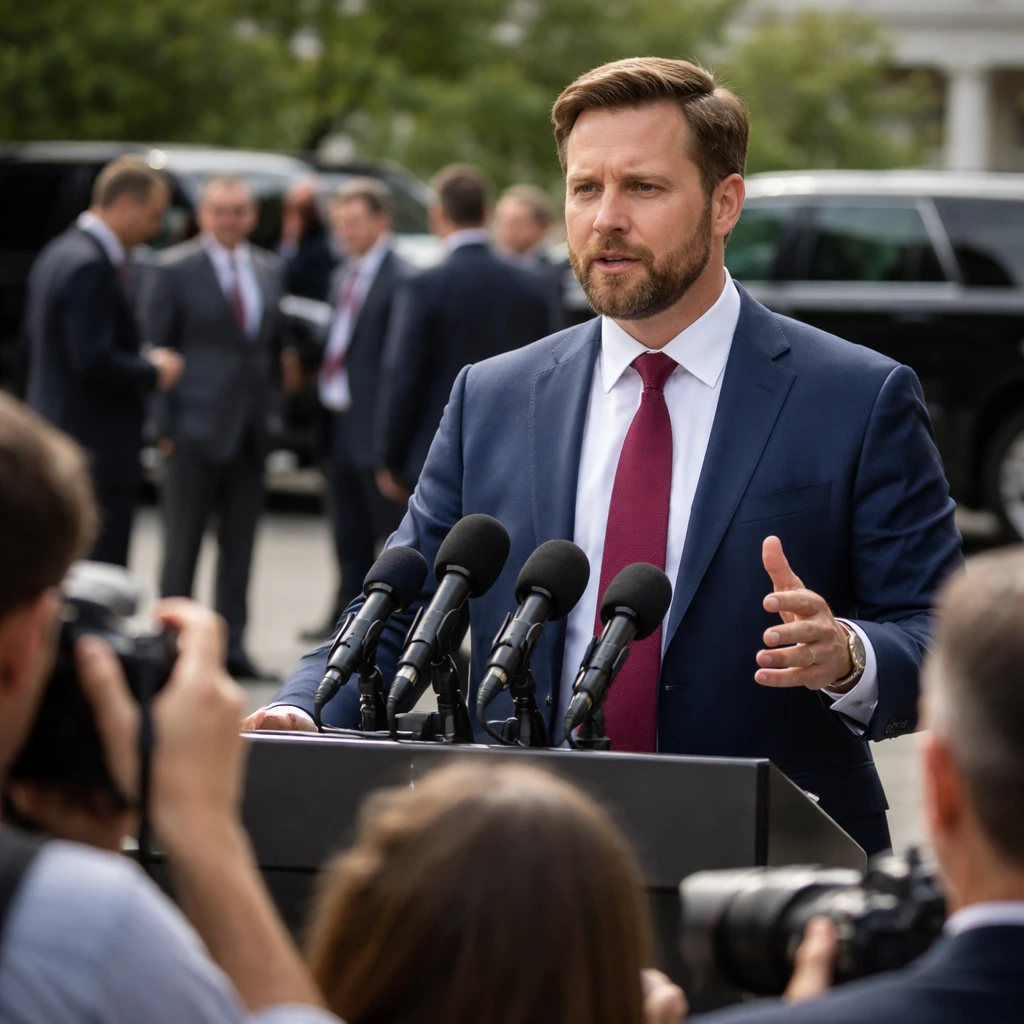
U.S. Vice President JD Vance spoke to reporters on Wednesday to address a dispute over the Iran ceasefire agreement as President Donald Trump prepares to send a U.S. negotiating team to Pakistan for talks set to begin on Saturday.
White House press secretary Karoline Leavitt confirmed the composition of the delegation, saying Vance will lead the team alongside U.S. special envoy Steve Witkoff and Jared Kushner, who is the president's son-in-law.
Vance responded directly to claims made by Iranian Parliament Speaker Mohammad Bagher Ghalibaf, who said three provisions of Iran's 10-Point Proposal had been violated before negotiations even started. Ghalibaf pointed to three alleged breaches: a failure to respect a ceasefire in Lebanon, an incursion by a drone into Iranian airspace, and denial of Iran's claimed enrichment rights.
The vice president characterized the concern about Lebanon as a plausible misunderstanding, asserting that neither the United States nor Israel had treated Lebanon as part of the ceasefire. He also said the Israelis had offered to inspect themselves in Lebanon and noted that U.S.-Israel discussions occurred on Wednesday.
When asked about Ghalibaf's accusations, Vance questioned the Iranian official's grasp of English and observed that no ceasefire is entirely free of minor incidents. "No ceasefire ever goes without a little choppiness," he said, adding that the U.S. objective is to halt the bombing but that the process will take time.
On the issue of nuclear enrichment, Vance reiterated that the U.S. position remains unchanged. He warned that if Iran fails to uphold its end of any agreement, there will be consequences. He was explicit that there would be no sanctions relief in the event Iran develops a nuclear weapon.
The vice president said the administration will evaluate what Iran is prepared to give up during the negotiations and suggested that the outcome of the talks will depend on whether Tehran provides what the United States needs. "If Iran does not provide what the U.S. needs, talks will be bad," he said.
Vance also reported early signs that the Strait is starting to reopen and expressed a view that, fundamentally, the U.S. is in a good position vis-a-vis Iran. He indicated that the delegation will press Tehran during the upcoming discussions in Pakistan.
Context summary
The vice president is leading a U.S. delegation to Pakistan for negotiations beginning Saturday. Iranian officials have alleged three pre-negotiation breaches of a 10-point proposal; U.S. officials dispute at least some of those claims and emphasize ongoing enforcement of the U.S. stance on enrichment and sanctions relief.