
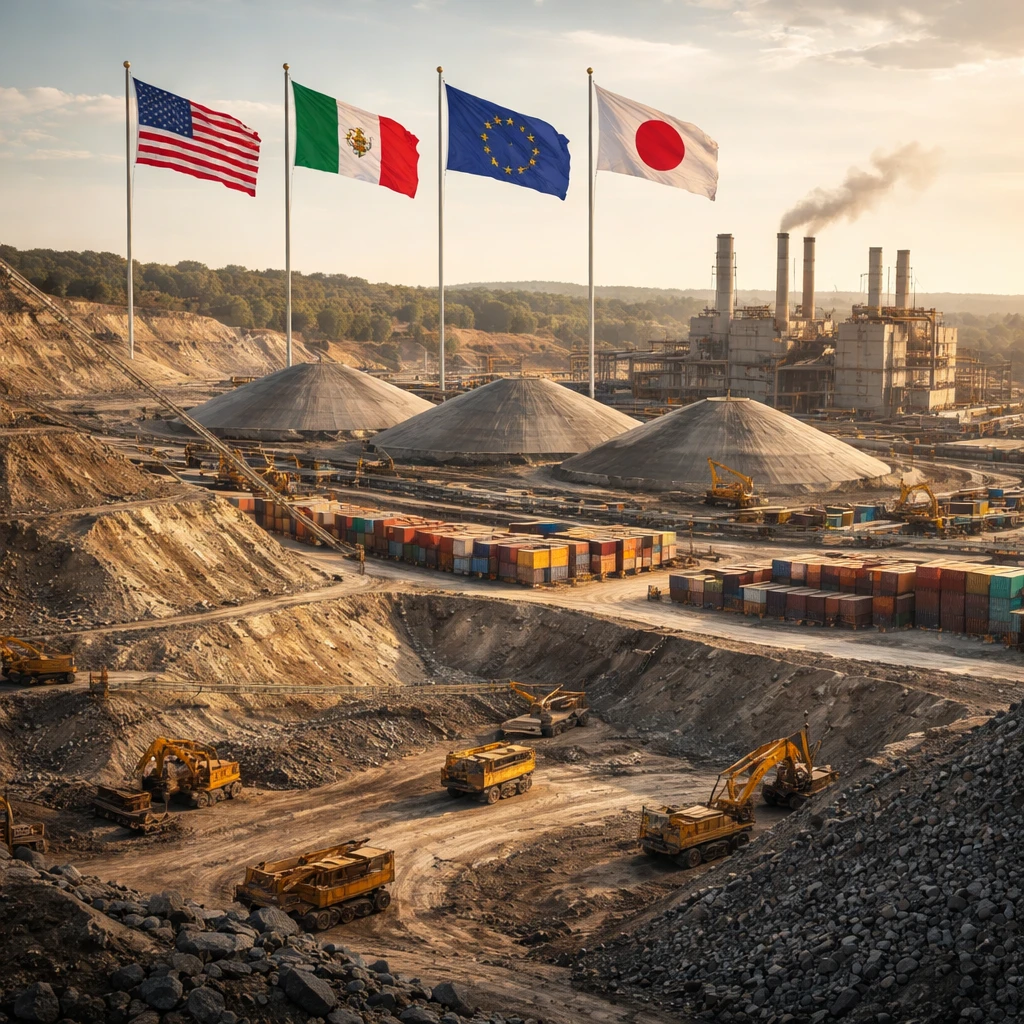
The United States is advancing plans with Mexico, the European Union and Japan to establish minimum prices for critical minerals, U.S. Trade Representative Jamieson Greer said Wednesday.
Officials described the initiative as a coordinated set of policies intended to address vulnerabilities in North American critical minerals supply chains. Greer said the effort with Mexico will be framed as an "action plan" to be implemented over the next 60 days and tied to a scheduled review of the United States-Mexico-Canada trade agreement (USMCA) that is due by July 1.
According to a Trade Representative's office official, Washington and Mexico will examine mechanisms to introduce price floors on imports of critical minerals and how such minimum pricing might be extended to other countries through future agreements. In parallel, the U.S. is engaging with the EU and Japan on a strategic partnership on critical minerals that could also contemplate price floors.
Greer said cooperation with the EU and Japan shows "that the world's largest market-oriented economies are committed to developing a new paradigm for preferential trade in critical minerals." As part of that relationship, the U.S. and the 27-nation EU plan to sign a memorandum of understanding on critical mineral supply chain security within the next 30 days.
The discussions with the EU will include sharing information on stockpiling critical minerals and exploring cooperation in mining, refining and processing activities. The action plan with Mexico is expected to aim for coordinated stockpiling and common regulatory approaches for mining, processing and trade. It also envisions coordinated measures on investment, geological mapping and rapid responses to supply chain disruptions.
Officials said the initial focus between the U.S. and Mexico will be on a limited set of critical minerals, with the exact elements to be identified later. The effort is described as part of a broader U.S. government priority to reduce dependence on China by strengthening domestic and allied supply chains for these materials.
The administration has emphasized critical minerals as a trade and industrial policy priority. The coverage highlights rare earths as a subgroup of critical minerals that are used across a range of goods, from munitions to consumer electronics.
Details about which minerals will be included in initial measures, how price floors would be implemented in practice, and the timeline for expanding the arrangements beyond Mexico, the EU and Japan were not specified in the announcement. The official account indicates further negotiations and technical work will determine the precise elements of the proposals and the operational steps to be taken in the coming weeks.