
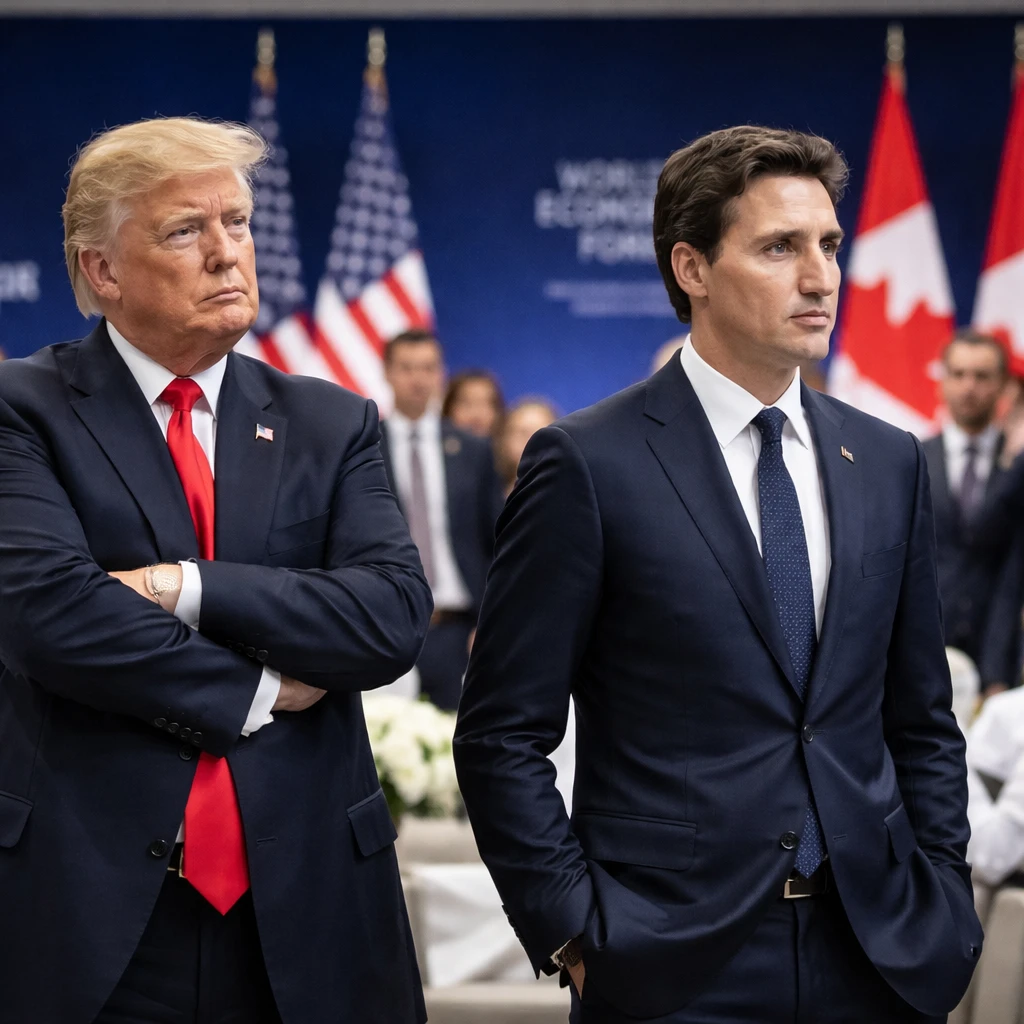
Relations between Washington and Ottawa deteriorated further late Thursday as U.S. President Donald Trump formally revoked Canada’s invitation to be part of his newly established "Board of Peace." This development signals a deepening rift following a week marked by public confrontations over Arctic sovereignty disputes and contestations surrounding global economic dominance.
The decision was communicated via a social media post from President Trump shortly after his address at the World Economic Forum held in Davos, Switzerland. In the post, Trump directly addressed Prime Minister Mark Carney, stating, "Please let this Letter serve to represent that the Board of Peace is withdrawing its invitation to you."
At the heart of this fallout lies a fundamental disagreement stemming from President Trump’s controversial proposal to annex Greenland, a notion strongly opposed by Carney and several NATO allies. During his own Davos speech, Carney critiqued the use of economic integration as a strategic instrument by dominant nations to undermine middle-power countries such as Canada.
Trump responded immediately from the Davos platform, dismissing Carney’s observations and underscoring what he described as Canada's dependence on American support. “I watched your prime minister yesterday. He wasn’t so grateful — they should be grateful to the U.S., Canada,” Trump declared to those attending the forum.
Originally, the "Board of Peace" was established under the authority of the UN Security Council to manage the rebuilding efforts in Gaza. However, its redefined objectives suggest a broader, more enduring role on the international stage. While the board’s UN mandate concentrates on regional recovery, its $1 billion fee for permanent membership has prompted concern that it may serve as a U.S.-led rival to traditional UN mechanisms.
Countries willing to secure permanent seats on the board are required to remit the substantial fee; failure to meet this financial prerequisite limits membership to a three-year term. Earlier in the week, Canada’s Finance Minister François-Philippe Champagne categorically rejected the payment condition, commenting, "one thing which is clear is that Canada is not going to pay if we were to join the Board of Peace."
As other Middle Eastern nations including Saudi Arabia and Qatar have opted into the initiative, Canada now stands alongside the United Kingdom and France in abstaining from participation. Speaking from a cabinet retreat in Quebec City, Carney emphasized the strength of the bilateral relationship but firmly stated, "Canada doesn’t live because of the United States."