
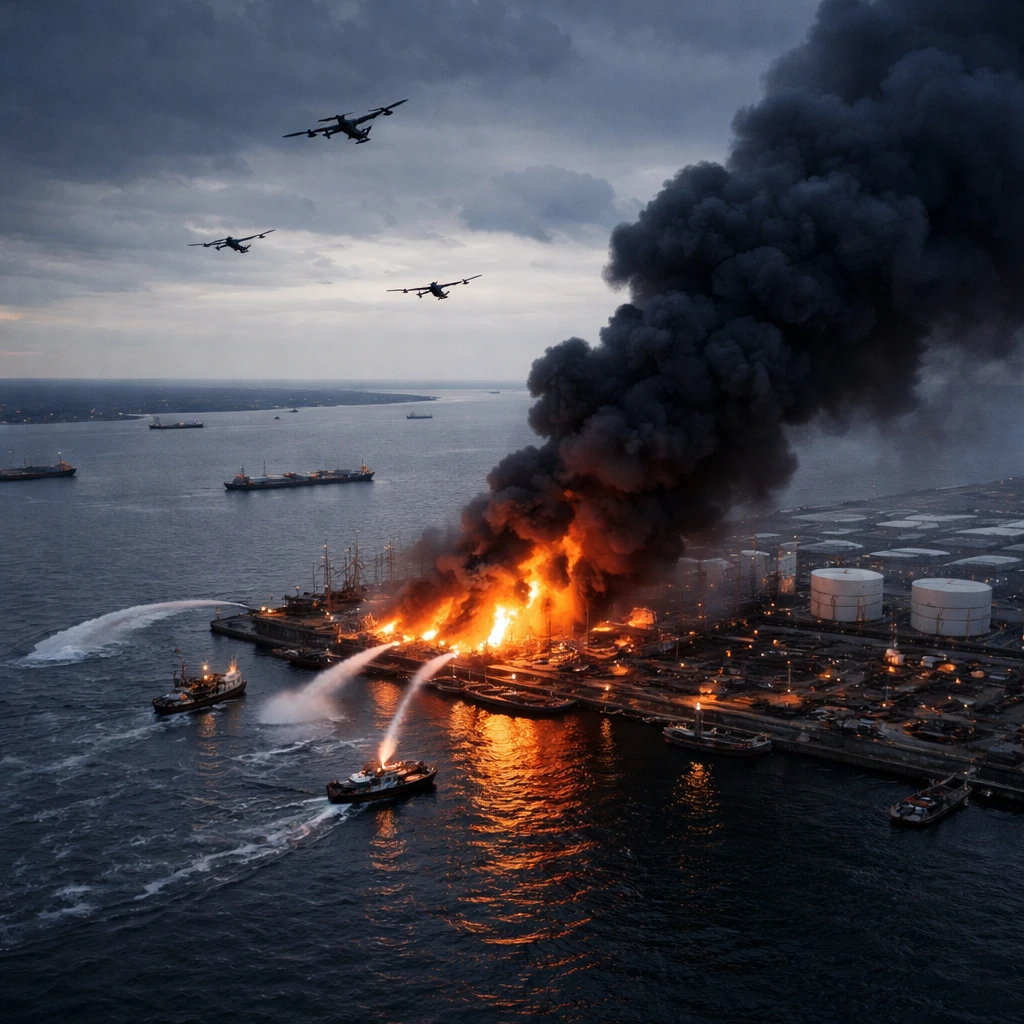
Russian crude shipments from the Baltic have been sharply disrupted after a new round of Ukrainian drone attacks struck Ust-Luga and affected nearby Primorsk, two of the country’s main oil export gateways. Leningrad Governor Alexander Drozdenko said local air defenses intercepted 31 drones overnight, and emergency responders are contending with a major blaze at the Ust-Luga terminal.
The assault represents a notable intensification of Kyiv’s campaign to strike energy infrastructure. Operators have halted loadings at Ust-Luga since last Wednesday, effectively taking one of Russia’s principal maritime terminals out of operation.
Baltic export hubs offline
The sustained targeting of the Leningrad region has simultaneously affected Ust-Luga and Primorsk, the two key Baltic outlets for Russian oil. Before these disruptions, the pair together accounted for roughly 45% of Russia’s seaborne crude exports, amounting to about 1.72 million barrels per day. With both ports sustaining material damage, a substantial share of the nation’s energy logistics is now sidelined.
The immediate operational consequence is a bottleneck in the movement of physical barrels, creating strain on export capacity at a time when markets are already sensitive to supply shifts. That constraint reduces Moscow’s ability to realize additional export revenue that would otherwise flow from recent oil price gains linked to conflict-driven volatility in the Middle East.
Implications for Russia’s fiscal and military posture
The timing of the strikes is especially consequential for the Kremlin’s budget. Higher global oil prices had provided a potential source of revenue to narrow a widening fiscal gap, but the inability to load and ship crude undermines that benefit. As the conflict moves into its fifth year, the focus on economic and energy infrastructure signals a tactical turn toward attrition of industrial capacity, where sustaining military operations increasingly depends on the intactness of energy terminals.
Ongoing exchanges and investor concerns
Fighting continues to play out across multiple fronts, with daily drone and missile exchanges. Russia has struck Ukrainian industrial and civilian targets in areas including Mykolaiv, while Kyiv’s operations against Baltic ports introduce a structural challenge that air defenses alone struggle to neutralize.
Market participants and investors are watching closely how long repairs will take at Ust-Luga and Primorsk. Protracted outages would likely force a re-routing of global crude flows and could sustain upward pressure on international oil benchmarks by keeping a firm floor under prices.
Summary
Ukrainian drone strikes have halted crude loadings at Ust-Luga and damaged Primorsk, both crucial Baltic export hubs that together handled about 1.72 million barrels per day or roughly 45% of Russia’s seaborne crude exports. Local authorities reported 31 drones intercepted overnight while firefighters tackle a significant terminal blaze. The disruption limits Russia’s ability to capitalize on higher global oil prices and represents a shift toward targeting economic infrastructure as part of the broader conflict.