
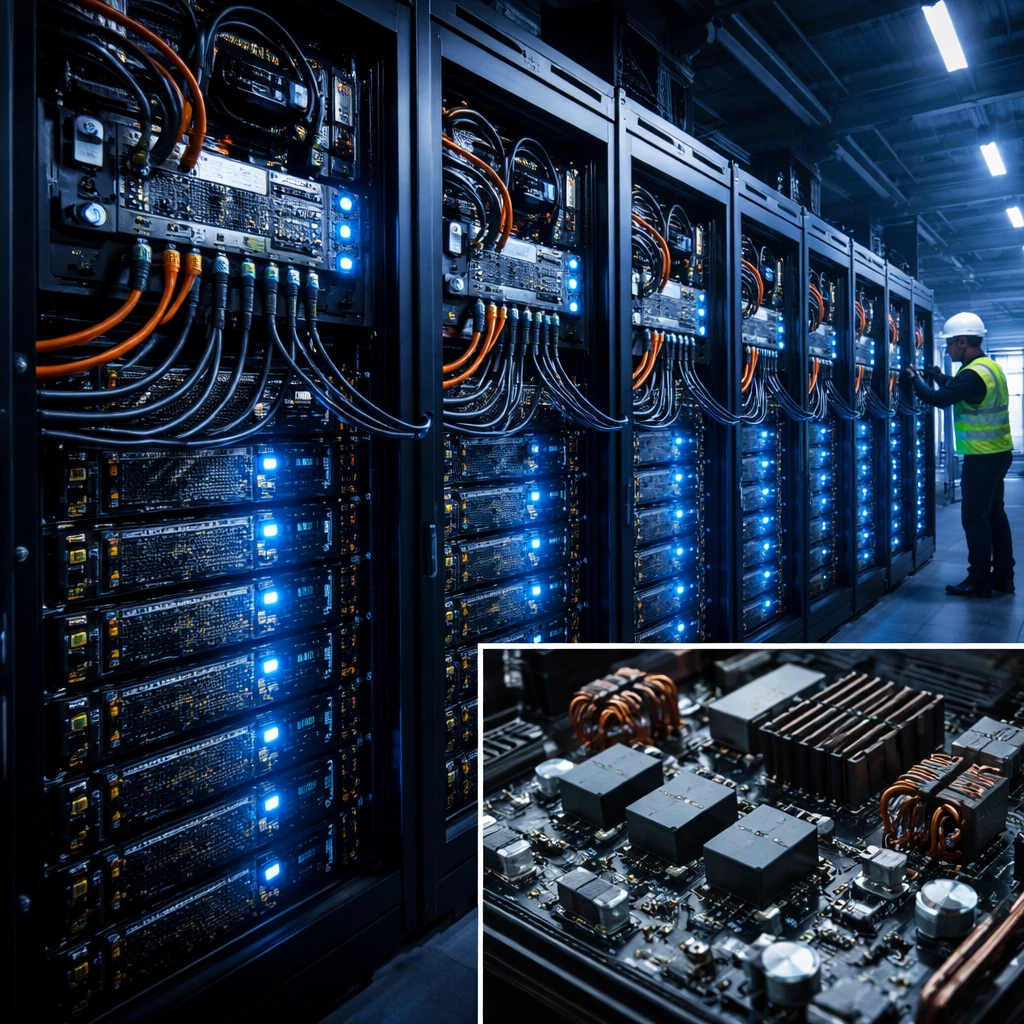
Investment bank UBS believes makers of analog and power semiconductors stand to benefit materially from the large-scale deployment of artificial intelligence data centers. Unlike digital processing units such as GPUs, which perform computation, these analog and power components control how electricity is converted, distributed and regulated across data center infrastructure.
These chips play roles at multiple points along the power chain. They are used to convert grid electricity into the form servers require and to stabilize voltages feeding GPUs and other high-performance compute hardware. As AI workloads boost electricity consumption inside modern facilities, the need for components that manage and regulate power is intensifying.
UBS says the shift toward AI-focused servers is increasing the importance of power semiconductors - devices that convert and control electricity across servers and related infrastructure. The bank projects the total addressable market for AI data center power semiconductors will grow notably over the coming years, from an estimated $1.5 billion in 2025 to about $2.5 billion in 2026 and to roughly $3.8 billion by 2028, assuming continued scaling of AI infrastructure.
A primary force behind that expansion is the rapid increase in power density per server rack as more GPUs are aggregated into single systems. UBS cites an expected rise in electricity per rack from around 40 kilowatts in 2023 to as much as 1 megawatt by 2028. That jump in required power per rack proportionally raises the volume and sophistication of power management hardware needed within data centers.
That evolution in rack-level power is also prompting changes in data center electrical architecture. UBS notes a trend toward 800-volt direct current power systems, which can improve efficiency for high-density deployments but demand more advanced semiconductor components to implement and control those higher-voltage infrastructures.
Within AI servers today, UBS estimates that power supply units and voltage regulator modules represent about 70% of the demand for power semiconductors. These two component classes are essential for converting grid power and delivering stable, precise voltages to GPUs and other compute elements.
The bank highlighted a set of semiconductor companies with exposure to this trend. Infineon and Texas Instruments were identified as leading suppliers in the AI data center power segment. UBS also pointed to Analog Devices, Renesas, ON Semiconductor and STMicroelectronics as firms that are increasing their participation in power systems for AI infrastructure.
Despite the upbeat market outlook, UBS cautioned that the trajectory could change later in the decade. Growth in the power semiconductor opportunity could moderate if the pace of adding new data center capacity slows or if the sector experiences over-ordering somewhere along the supply chain. Such developments would dampen demand for the power-management hardware that the bank expects to expand sharply in the near term.
Summary
UBS forecasts a substantial increase in demand for analog and power semiconductors tied to AI data center buildouts, with the market for AI data center power semiconductors growing from about $1.5 billion in 2025 to roughly $3.8 billion by 2028. Rising rack power densities - from roughly 40 kilowatts in 2023 to an expected 1 megawatt by 2028 - and shifts to 800-volt direct current systems are key drivers. Power supply units and voltage regulator modules account for about 70% of current power semiconductor demand in AI servers. Infineon and Texas Instruments are singled out as leading suppliers, with several other analog chipmakers expanding their presence. UBS warns growth could moderate if new capacity additions slow or if over-ordering occurs in the supply chain.
Key points
- Analog and power semiconductors control electricity conversion and voltage regulation in data centers, distinct from GPUs which perform processing.
- UBS projects the AI data center power semiconductor market will increase from approximately $1.5 billion in 2025 to about $2.5 billion in 2026 and near $3.8 billion by 2028, driven by higher rack power density and architectural changes.
- Power supply units and voltage regulator modules currently make up roughly 70% of power semiconductor demand in AI servers; companies cited with exposure include Infineon, Texas Instruments, Analog Devices, Renesas, ON Semiconductor and STMicroelectronics.
Risks and uncertainties
- Slower-than-expected additions of new data center capacity could reduce demand for power semiconductors, affecting semiconductor suppliers and data center equipment vendors.
- Over-ordering across the supply chain could lead to inventory correction and a moderation of growth later in the decade, impacting component manufacturers and distributors.
- Adoption timelines for higher-voltage architectures such as 800-volt DC systems could influence the pace at which advanced power semiconductors are required, creating timing risk for suppliers.