
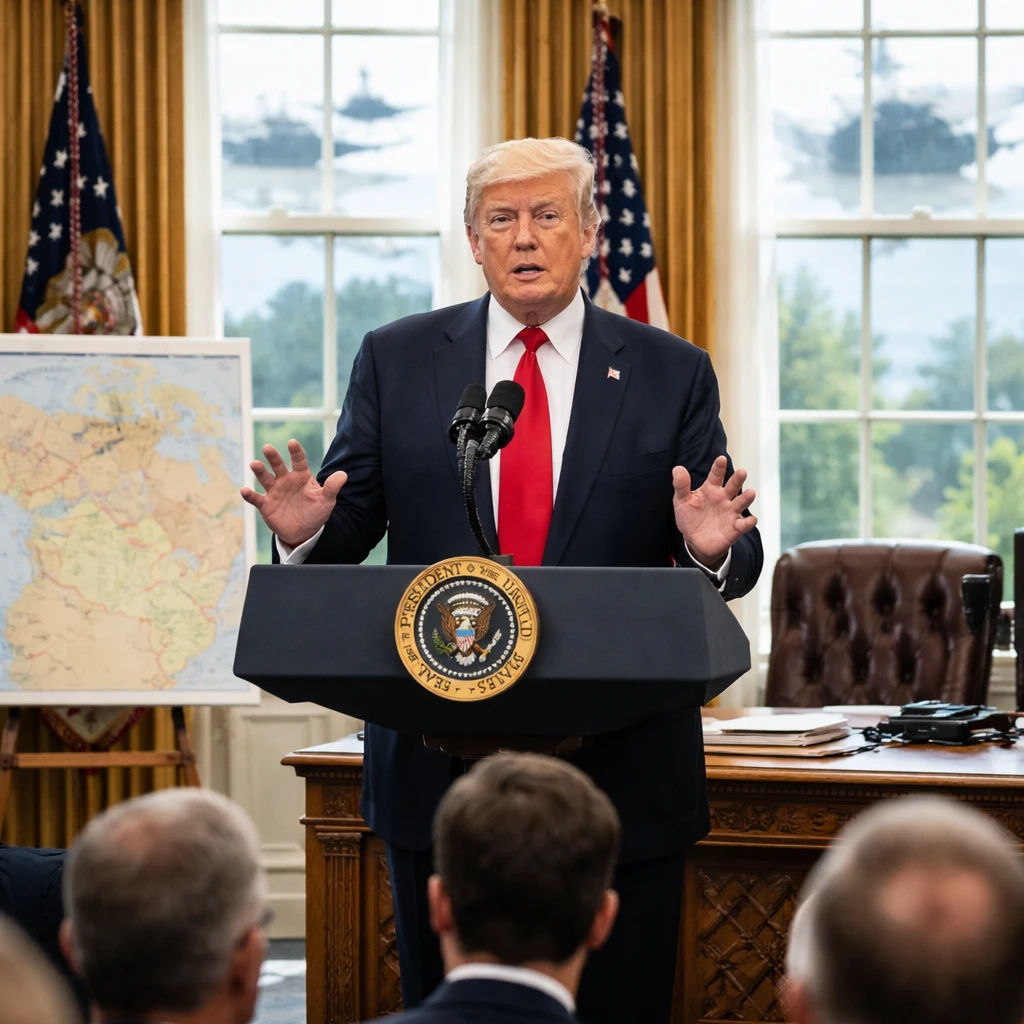
President Trump announced on Tuesday that U.S. forces will leave Iran within "two or three weeks," saying that the United States has achieved its stated objective of neutralizing Iran's nuclear threat. The president also confirmed that U.S. military operations in Iran remain active and described recent strikes against Iranian military infrastructure.
"We’ll be leaving very soon," the president told reporters in the Oval Office, adding, "We leave because there’s no reason for us to do this." He reiterated that a formal deal with Iran is not a precondition for withdrawal, saying, in his words, that "it will take 15-20 years for them to rebuild what we’ve done to them."
Mr. Trump said operations were continuing, and described recent action against missile-production capacity. "Last night, we knocked out tremendous amounts of missile-making facilities," he said.
The president addressed rising gasoline costs during the briefing. With U.S. average pump prices reported above $4 a gallon, he said American motorists should expect relief once military engagement in Iran ends. Asked about the link between the conflict and fuel prices, he responded: "Yeah, and we have a country that’s not going to be throwing a nuclear weapon at us," and added, "And they’re also feeling a lot safer."
On security in the Persian Gulf, Mr. Trump said the task of keeping the Strait of Hormuz open should be borne by the nations that depend on it. "There is no reason for us to do this," he told reporters, and continued: "That’s not for us. That’ll be for France. That’ll be for whoever’s using the strait."
The president also noted that U.S. and Israeli forces had struck Iran on Feb. 28, a development he framed as part of the campaign to remove the nuclear threat. He signaled an impending drawdown of forces, while emphasizing damage inflicted on Iran's military production capacity and asserting the U.S. judgment that the core objective had been met.
Summary
President Trump says U.S. forces will withdraw from Iran in two to three weeks, asserting the nuclear threat has been removed, while military operations continue and recent strikes targeted missile-making facilities. He linked a U.S. exit to expectations of lower gasoline prices and suggested regional users should assume responsibility for securing the Strait of Hormuz.
Key details
- U.S. and Israel attacked Iran on Feb. 28.
- Trump: "We’ll be leaving very soon."
- He said the U.S. does not need a deal with Iran to withdraw and that it "will take 15-20 years for them to rebuild what we’ve done to them."