
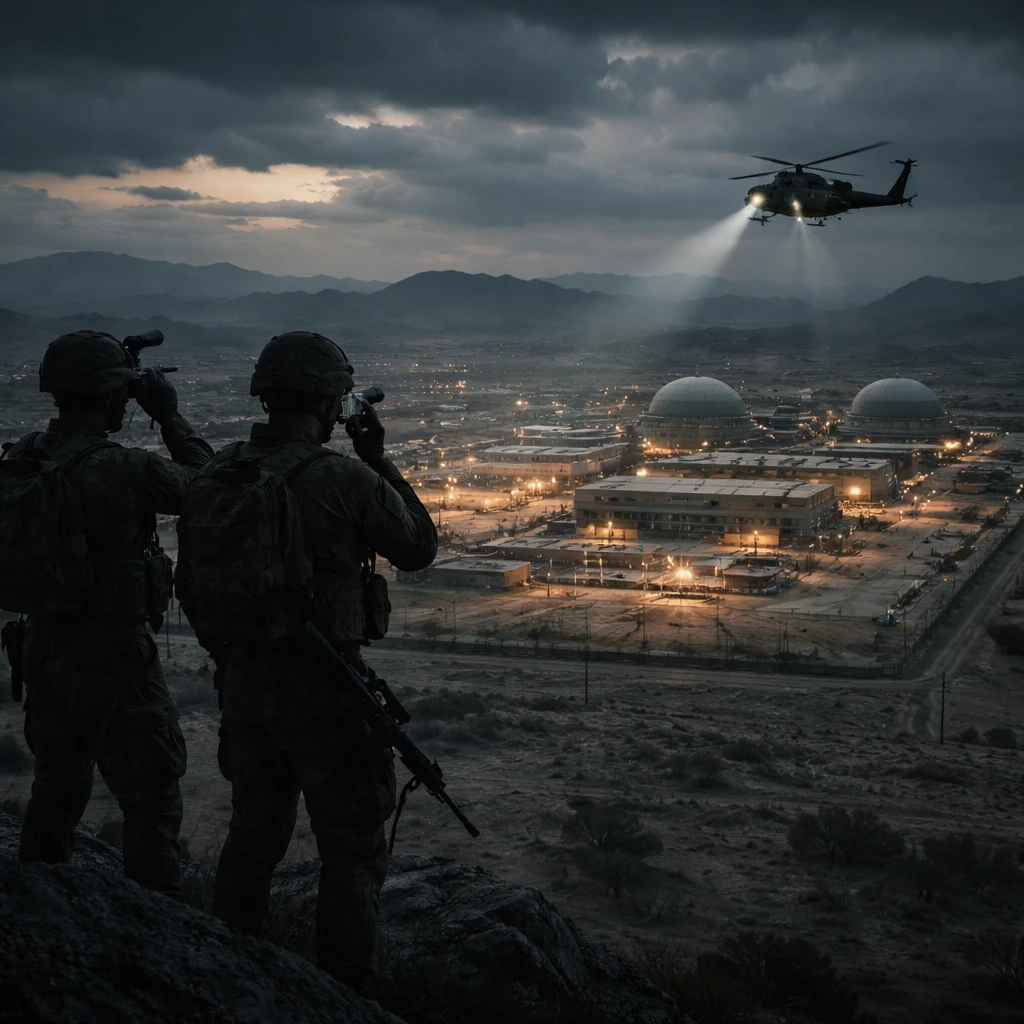
President Trump said Monday he has not authorized any deployment of U.S. troops to Iran’s nuclear enrichment facility in Isfahan, and that a decision on sending forces remains unmade and not close.
In a phone interview with the New York Post from his Trump National Golf Club in Doral, Florida, Trump was explicit: "We haven’t made any decision on that. We’re nowhere near it."
The president’s statement followed an Axios report over the weekend that claimed the U.S. and Israel have discussed the possibility of inserting special operations forces into Iran to secure highly enriched uranium stockpiles. The report, citing four people familiar with the discussions, said the operation would focus on Iran’s roughly 450 kilograms of 60 percent-enriched uranium - material that, according to the reporting, could be processed to weapons grade within weeks.
Trump also addressed the recent succession of Iran’s supreme leadership, telling the Post he was not pleased with the new Supreme Leader, Mojtaba Khamenei, who has supplanted his father Ali Khamenei. When asked whether he planned to take any specific actions regarding the younger Khamenei, the president declined to offer details but stated simply that he is "not happy with him." The 56-year-old Mojtaba Khamenei’s rise to the position occurred after Mr. Trump had earlier warned of consequences for any successor who assumed power without consulting the United States; that prior warning was not repeated in Monday’s interview.
Any mission to seize enriched nuclear material would almost certainly require boots on the ground in Iran and entail operations inside heavily fortified underground facilities. It is not clear from available reporting whether such a mission would be conducted by U.S. forces, Israeli forces, or a combined effort, and accounts indicate it would likely proceed only after planners judged Iran unable to pose a serious threat to forces involved.
The uncertainty over who would execute such an operation was echoed in remarks during a congressional briefing Tuesday, when Secretary of State Marco Rubio was asked whether Iran’s enriched uranium would be secured. "People are going to have to go and get it," he said, without providing specifics on which nation’s forces would carry out the task.
An Israeli defense official told reporters that Mr. Trump and his advisers are giving serious consideration to the deployment of special operations units into Iran for narrowly defined missions.
Preventing Iran from acquiring a nuclear weapon has been identified by the administration as one of its war objectives. Beyond that stated aim, officials have not released detailed operational plans or timelines for any potential ground actions, and public statements have stressed that no final decision has been reached.
Key context and takeaways
- President Trump says no decision has been taken to deploy U.S. troops to Isfahan and that such a move is not imminent.
- Reporting indicates U.S. and Israeli officials have discussed special forces missions to secure roughly 450 kilograms of 60 percent-enriched uranium that could be converted to weapons grade within weeks.
- Officials have not clarified whether any operation would be American, Israeli, or joint, and say such an action would depend on assessments that Iranian defenses no longer pose a significant threat.