
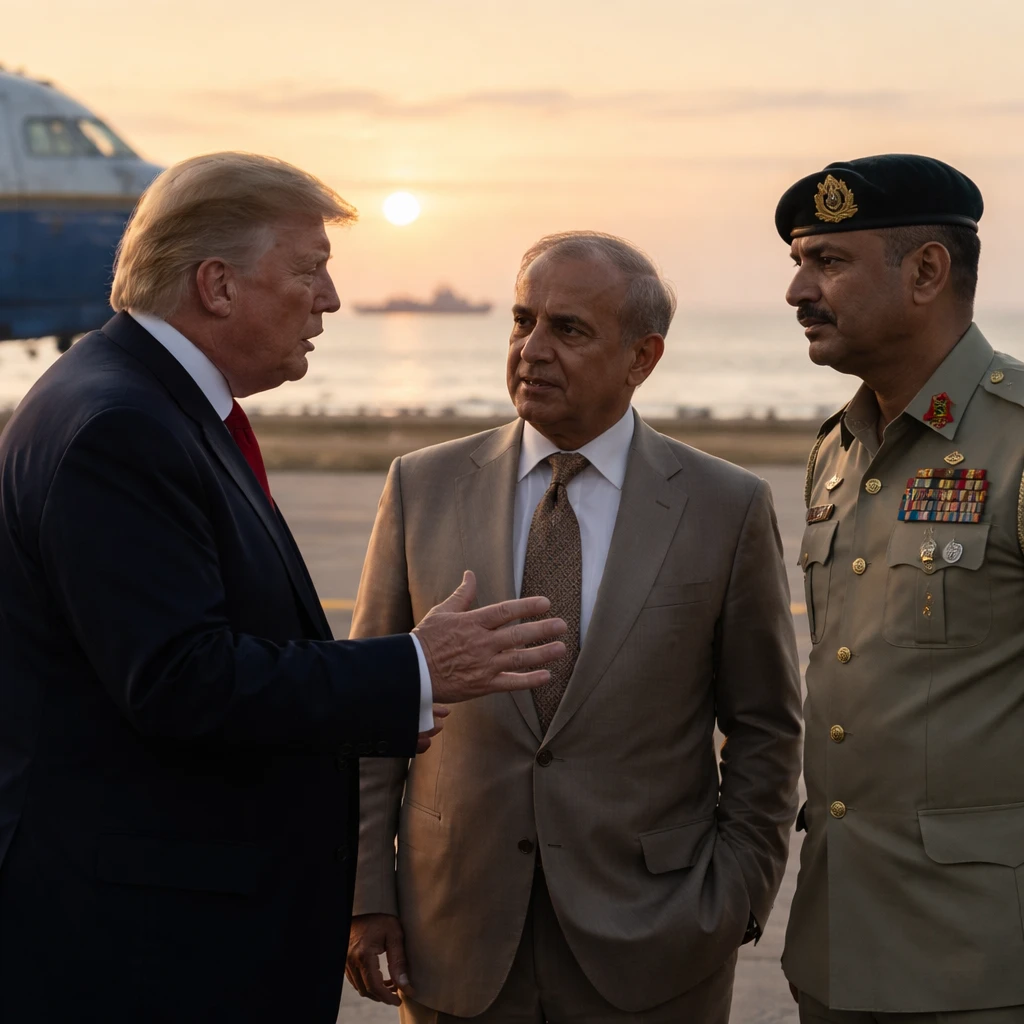
President Donald Trump announced Tuesday evening that he will suspend planned military strikes against Iran for two weeks, a decision driven by mediation efforts from Pakistan as the two countries work toward finalizing a peace agreement.
In a post on Truth Social shortly after 6:30 p.m. EST, the president said he had agreed to hold off on attacks that had been scheduled for 8 p.m. EST after speaking with Pakistani Prime Minister Shehbaz Sharif and Field Marshal Asim Munir. The pause is conditional on Iran undertaking a complete, immediate and safe reopening of the Strait of Hormuz, Trump added.
Trump also said the United States has received a 10-point proposal from Iran that he described as providing a workable basis for further negotiations. He reiterated in his post that the United States has "already met and exceeded all Military objectives" and noted that the "two week period will allow the Agreement to be finalized and consummated."
Earlier in the day, the president had set 8 p.m. EST Tuesday as a final deadline and warned that "a whole civilization will die tonight" if his conditions for peace were not satisfied. Pakistan stepped in with a proposal to extend the timeline by two weeks just hours before that deadline.
Pakistani officials conveyed the extension publicly. Sharif, posting on X, said diplomatic efforts were "progressing steadily, strongly and powerfully" and formally requested that Iran open the Strait of Hormuz for two weeks as a gesture of goodwill. He also urged all parties involved in the conflict to observe a ceasefire.
Trump said that nearly all points of prior contention between the United States and Iran have been agreed to, and that the additional two-week window would allow the remaining details of an agreement to be finalized.
The announcement produced immediate market reactions: the SPDR S&P 500 ETF Trust climbed roughly 1.6% in after-hours trading, while WTI crude oil futures fell nearly 7% to trade around $102.50.
Key points
- President Trump ordered a two-week suspension of planned strikes against Iran after mediation by Pakistan, conditional on Iran reopening the Strait of Hormuz.
- The pause followed direct conversations with Pakistani Prime Minister Shehbaz Sharif and Field Marshal Asim Munir, and came after Pakistan proposed the extension hours before an 8 p.m. EST deadline.
- Markets moved on the news: the SPDR S&P 500 ETF Trust rose about 1.6% after hours and WTI crude futures fell close to 7%, trading near $102.50.
Risks and uncertainties
- The suspension is explicitly contingent on Iran fully and safely reopening the Strait of Hormuz - if that condition is not met, the pause could end abruptly (impacting oil markets and regional security-sensitive sectors).
- The two-week window is meant to allow an agreement to be finalized, but completion is not guaranteed - any failure to finalize could renew military escalations and market volatility.
This account reflects statements made publicly by the U.S. president and Pakistani leadership and market moves reported after the announcement. Details about negotiations beyond the existence of a 10-point Iranian proposal, and the specific contents of that proposal, were not provided in the public statements described here.