
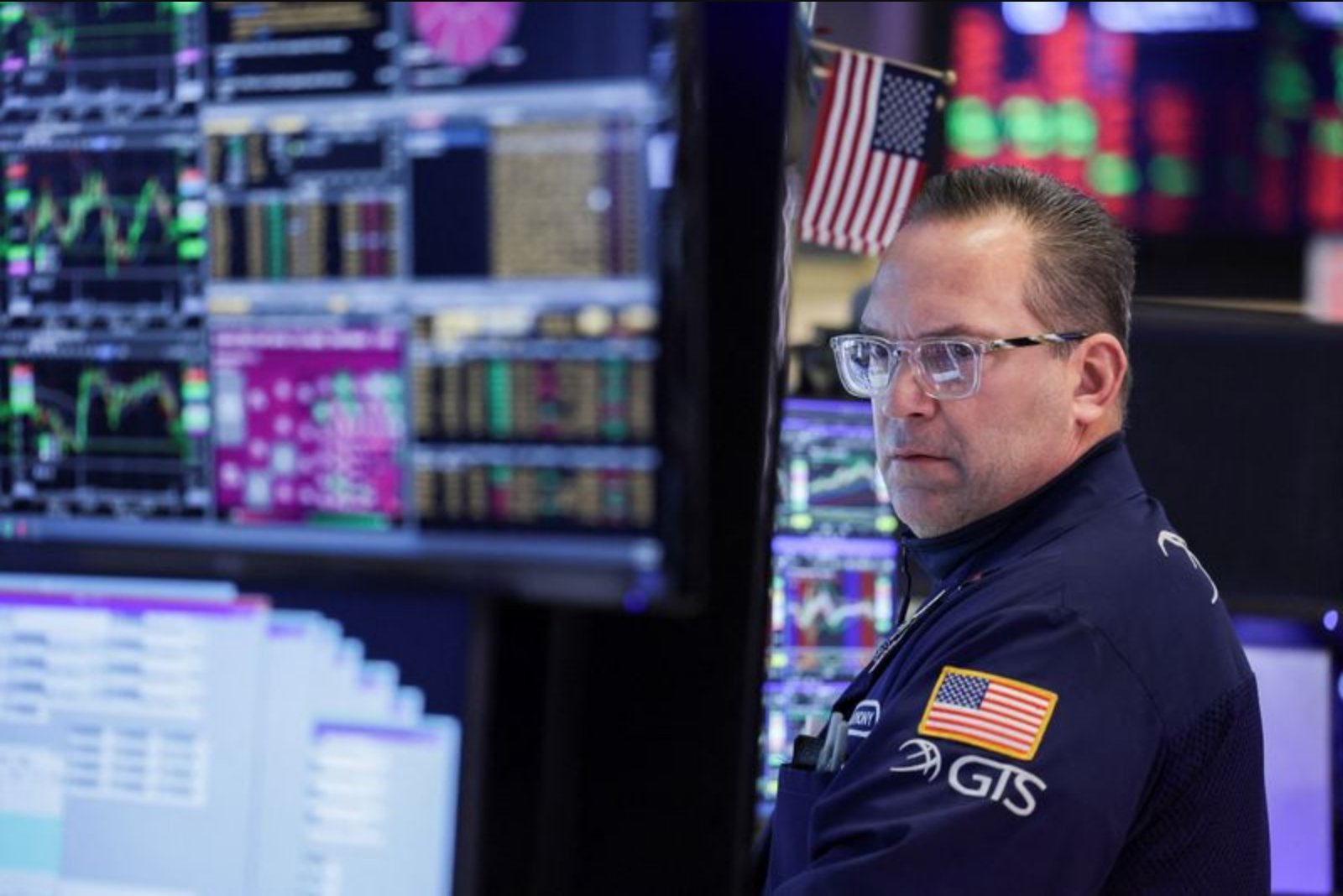
Markets opened the last trading week of March under renewed pressure as investors grappled with growth and inflation risks linked to the Iran conflict entering its fifth week. The S&P 500 and Nasdaq both fell to seven-month lows on Monday, while U.S. government bond yields moved lower, even as oil climbed further above $100 a barrel.
In commentary published today I examine why the jump in market-derived borrowing costs since the outbreak of hostilities could not have occurred at a worse time for the largest technology names - companies that have leaned more heavily on debt to fund an unprecedented wave of investment in artificial intelligence.
If you have time to read further, the following pieces are recommended reading to help unpack the market moves:
- 1. Trump again warns Iran to open Strait of Hormuz
- 2. Powell says Fed can "wait and see" how war affects inflation
- 3. Fed’s faith in anchored inflation expectations may becoming under stress
- 4. Iran war volatility strains trading in world’s biggest markets
- 5. Japan steps up yen intervention threats, signals rate-hike chance
Today’s key market moves
- STOCKS: Asian markets slumped, with Japan down 3% - while European bourses rose, the STOXX 600 was up 1% and Britain’s FTSE 100 climbed 1.6%. On Wall Street, major indexes were mostly lower, with the Nasdaq and S&P 500 at their lowest levels since August.
- SECTORS/SHARES: Only three of 11 sectors in the S&P 500 fell by sector count, but those sectors carry heavy index weight - technology -1.5%, industrials -1.6%, energy -0.9%. Notable single-stock moves included Sysco down 15% and Micron Technology down 10%.
- FX: The U.S. dollar strengthened to its highest level since May of last year. The euro slid on growth concerns, and the yen rebounded amid intervention warnings from Japanese authorities.
- BONDS: U.S. Treasury yields fell, down roughly 7-9 basis points. The two- to 10-year curve steepened for a second day to 53 basis points, the steepest level in two weeks.
- COMMODITIES/METALS: Brent crude rose about 1% and West Texas Intermediate climbed 4%. Gold moved up roughly 0.5%, while LME aluminium jumped 4%.
Talking points
No quarter given
The first quarter of the year draws to a close on Tuesday after a turbulent three months. Brent crude is up 85% so far - the largest rise since 1990. The U.S. "Magnificent 7" megacaps are down 17%, which translates into an almost 20% fall from their October highs and puts them close to bear market territory. And gold remains higher year-to-date even though March was its second-worst month in more than 40 years. In sum, while the damage to the global energy complex has been substantial, markets in some respects have shown surprising calm.
That damage is not trivial: 17% of Qatar’s gas capacity is offline; 20% of global oil and gas flows are being choked off by the closure of the Strait of Hormuz; and several Middle Eastern countries, including Saudi Arabia, have taken energy production fields or refineries offline. Against that backdrop, there is a question whether markets have been too sanguine.
A "good place"?
The phrase "good place" keeps surfacing in policy circles. European Central Bank President Christine Lagarde turned it into a regular communications signal last year, and on Monday Federal Reserve Chair Jerome Powell said U.S. policy is in a "good place," noting officials can "wait and see" how the energy and supply shocks feed through to both sides of the central bank’s dual mandate. Powell was among the first officials to use the phrase in January of last year, a period when some observers argued the economy genuinely was in a "good place." The comment underscores the balancing act facing policymakers as they evaluate the impact of the conflict and higher energy prices on inflation and growth.
The art of the deal
Despite higher borrowing costs, greater uncertainty and elevated market volatility linked to the Iran war, large-scale dealmaking has continued. On Monday, Sysco announced it would acquire catering supplier Jetro Restaurant Depot in a $29 billion transaction. Unilever is reportedly in talks to sell its foods business to McCormick & Company in a deal that would be worth over $30 billion. Earlier this month, a consortium led by BlackRock’s Global Infrastructure Partners and Sweden’s EQT AB completed a $33.4 billion purchase of U.S. power company AES Corp. These transactions show that mergers and acquisitions remain an avenue for corporate strategy even as financing conditions shift.
What could move markets tomorrow
- Developments in the Middle East
- Energy market moves
- Reserve Bank of Australia publishes minutes of March meeting
- Japan retail sales (February)
- Japan unemployment (February)
- Japan industrial production (February)
- Japan Tokyo CPI inflation (March)
- China "official" PMIs (March)
- India trade, current account (Q4)
- Germany retail sales (February)
- Germany unemployment (March)
- Euro zone inflation (March, flash estimate)
- European Central Bank board member Patrick Montagner speaks
- UK GDP (Q4)
- U.S. house prices (January)
- U.S. consumer confidence (March)
- U.S. Chicago PMI (March)
- U.S. "JOLTS" job openings (February)
- U.S. Federal Reserve officials scheduled to speak include Chicago Fed President Austan Goolsbee, Kansas City Fed President Jeffrey Schmid, Governor Michael Barr, Vice Chair for Supervision Michelle Bowman
Want to receive Trading Day in your inbox every weekday morning? Sign up for my newsletter here.
Market research product note
Should you be buying MU right now? ProPicks AI evaluates MU alongside thousands of other companies every month using 100+ financial metrics. Using powerful AI to generate stock ideas, it looks beyond popularity to assess fundamentals, momentum, and valuation. The AI has no bias - it identifies which stocks offer the best risk-reward based on current data with notable past winners that include Super Micro Computer (+185%) and AppLovin (+157%). Want to know if MU is currently featured in any ProPicks AI strategies, or if there are better opportunities in the same space?