
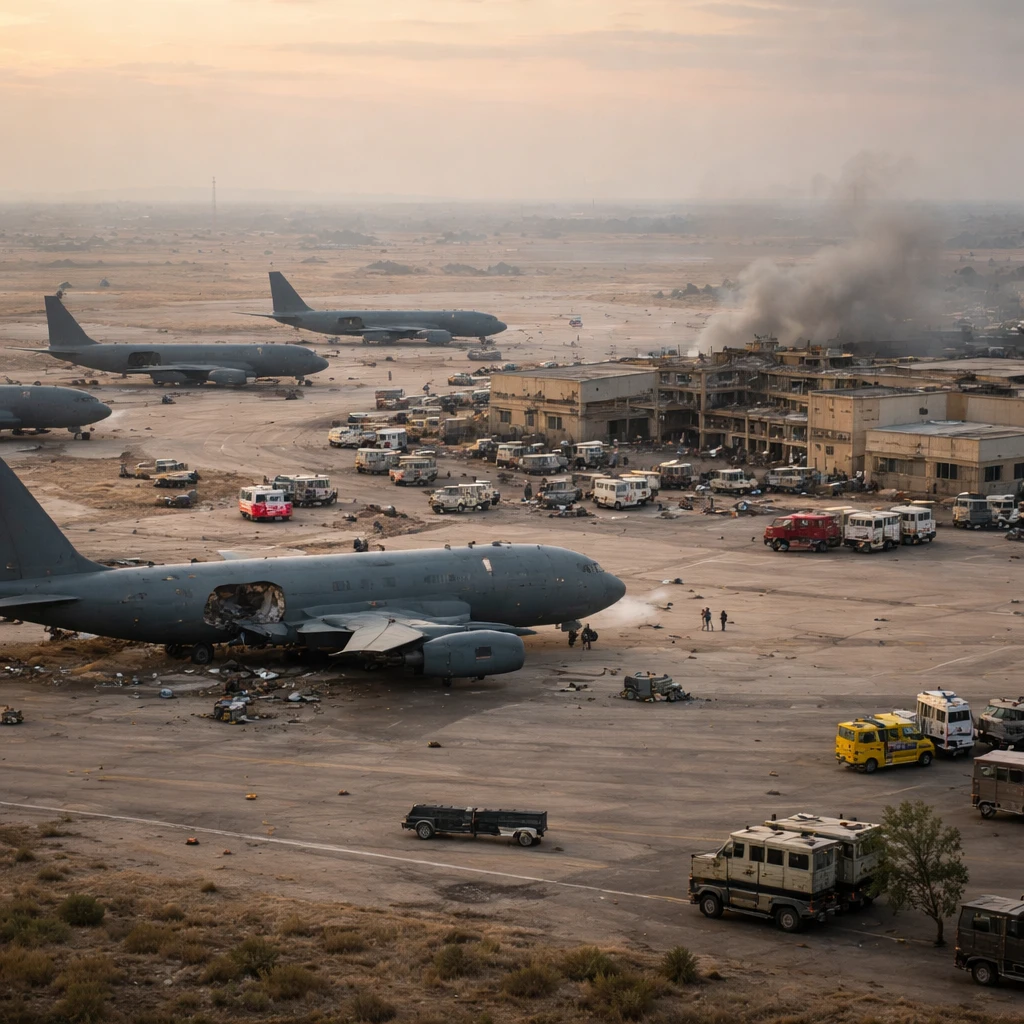
Ten U.S. servicemembers sustained injuries when the Prince Sultan air base in Saudi Arabia was struck in an attack attributed to Iran, U.S. and Arab officials said. Two of those wounded are in serious condition, according to the officials cited.
The servicemembers were inside a building on the base when it was struck. The assault also inflicted damage on multiple U.S. refueling aircraft stationed at Prince Sultan, officials said. Two officials reported that at least one missile hit the base and that several unmanned aerial vehicles were used in the attack.
This attack is at least the second to hit Prince Sultan air base during the course of a war involving Iran. An earlier strike damaged five U.S. refueling aircraft, officials said.
Officials described the strike as occurring against a backdrop of increasing regional tension. Saudi Arabia and other Gulf states are moving closer to a posture that could see greater involvement in the conflict and are adopting a more assertive stance toward Iran, officials said. The U.S. and its allies are reported to be facing a dwindling supply of air defense interceptors after four weeks of war, a separate concern highlighted by officials.
At the same time, the U.S. administration continued diplomatic engagement. President Trump's top Iran envoy, Steve Witkoff, said the administration plans to meet with Iranian officials this week. "We are negotiating. It's clear. Some ships are coming through," Witkoff said at a gathering organized in part by the Saudi Arabian sovereign wealth fund. "We think there will be meetings this week. We're certainly hopeful for it."
Witkoff outlined core elements of the 15-point deal the U.S. has presented to Iran, saying the plan has been in Iran's possession "for a bit of time." He said the measures require Iran to stop enriching uranium, to relinquish the almost 10,000 kilograms of enriched material it possesses, and to accept oversight. "Those are red lines for us," he said. "We can't have a second coming of North Korea in the Middle East. It's totally destabilizing for that region and for the world."
Diplomats working as mediators said Iran was expected to provide its response to the U.S. 15-point plan by the end of Friday. Mediators added that while some progress had been made in talks, Iranian officials were expected to reject several demands contained in the U.S. proposal.
The incident at Prince Sultan air base, the reported damage to U.S. logistical aircraft, and the contemporaneous diplomatic engagements underline parallel military and diplomatic developments tied to the conflict. Officials described a constrained supply of interceptors for air defenses, while mediators signaled ongoing but uncertain negotiations over the terms set out by Washington.