
Economy February 4, 2026

Telekom and Nvidia Launch €1 Billion Munich AI Data Center, German Finance Minister Says It Bolsters Digital Sovereignty

New Munich facility billed as one of Europe's largest for powering complex AI workloads, with SAP supplying platforms and applications

By Leila Farooq
Telekom and Nvidia Launch €1 Billion Munich AI Data Center, German Finance Minister Says It Bolsters Digital Sovereignty

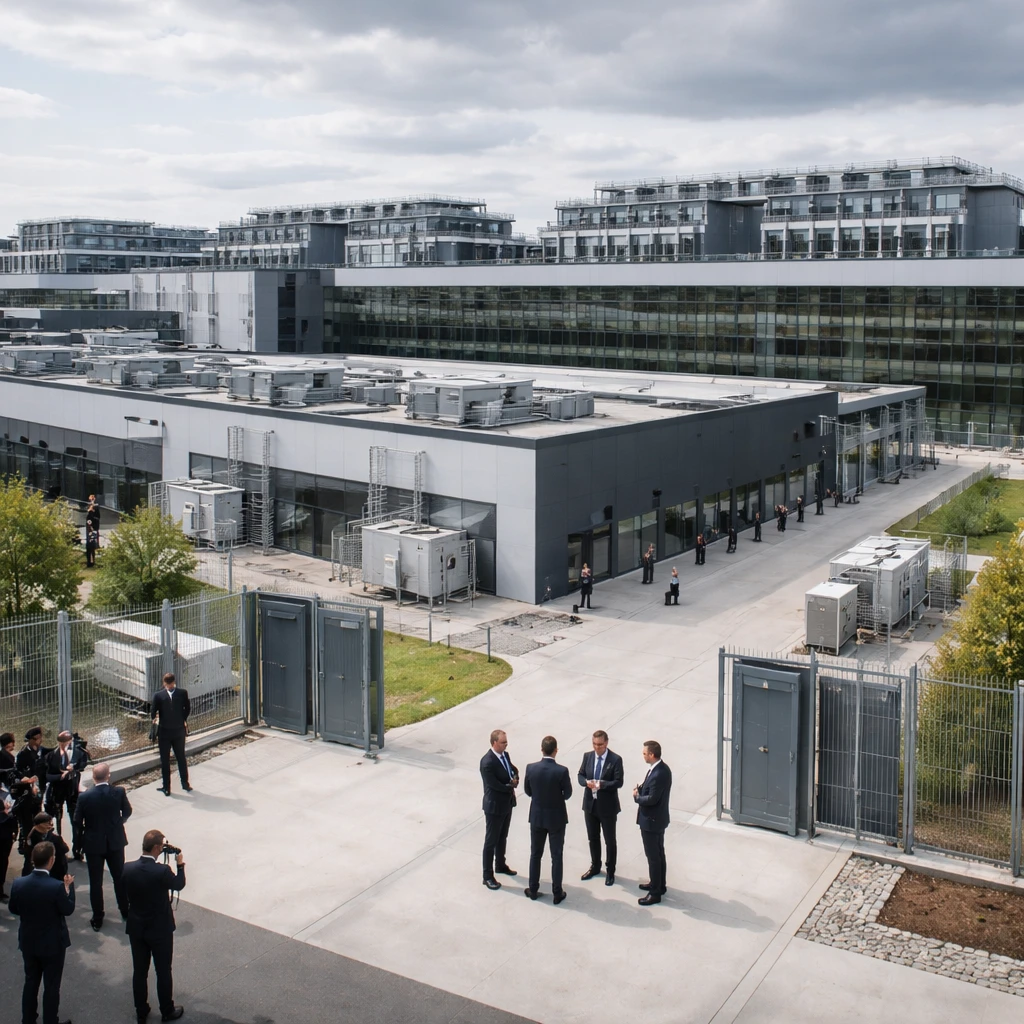
Deutsche Telekom AG and Nvidia Corp. inaugurated a €1 billion ($1.2 billion) data center in Munich on Wednesday. Finance Minister and Vice Chancellor Lars Klingbeil attended the opening and said the facility will reinforce Germany's digital independence and serve as a core pillar for the German and European AI ecosystem. SAP SE will provide platforms and applications for the site.

Key Points

  • Deutsche Telekom AG and Nvidia Corp. opened a €1 billion ($1.2 billion) data center in Munich on Wednesday.
  • Finance Minister and Vice Chancellor Lars Klingbeil attended and said the facility will help make technological leadership central to Germany's future business model and bolster digital sovereignty.
  • SAP SE is providing platforms and applications for the new facility, reflecting cross-sector corporate participation and government support for a domestic AI ecosystem.

Deutsche Telekom AG and Nvidia Corp. officially opened a new data center in Munich on Wednesday, a project valued at €1 billion ($1.2 billion) that company officials and government representatives described as a major addition to Germany's digital infrastructure.

Finance Minister and Vice Chancellor Lars Klingbeil attended the inauguration. He framed the facility as central to the country’s economic strategy, saying, "For me, it’s particularly important that technological leadership must be at the core of Germany’s future business model."

The Munich installation is presented as one of Europe's largest sites tailored to support technology that can run complex artificial-intelligence systems. Klingbeil emphasized the center's role in strengthening national capacity to operate advanced digital services, calling it "an important pillar for the German and European AI ecosystem" that "strengthens digital sovereignty."

German software company SAP SE will supply platforms and applications for the new facility, providing software components intended to run within the center's infrastructure. The participation of major corporations alongside visible government backing was highlighted as evidence of a broader strategy to cultivate an AI ecosystem within Germany.

The involvement of these industry players and support at the ministerial level was described by officials as part of a concerted effort to build an AI environment capable of competing with the United States and China. The project was presented as a tangible demonstration of the country's commitment to expanding domestic capacity for advanced computing and AI workloads.


Context and implications

Officials at the ceremony conveyed that the Munich site is more than a physical data center: it is positioned as infrastructure designed to underpin AI development and deployment in Germany and across Europe. The combination of a telecommunications operator, a chip and systems company, and enterprise software support reflects a cross-sector collaboration aimed at delivering computing power alongside application-level services.

Details on operational timelines, capacity metrics, and customer rosters were not disclosed at the event. Observers and stakeholders will look to subsequent announcements for more granular technical and commercial information.

Risks

  • The article does not provide operational details such as capacity, timelines, or customer commitments, leaving uncertainty about when and how the facility will support large-scale AI deployments - this affects cloud, telecom, and enterprise software sectors.
  • While officials frame the project as strengthening digital sovereignty, the long-term impact on Germany's competitive position relative to other global AI hubs is not detailed in the announcement - this is a risk for policymakers and investors tracking national tech strategy.
  • The piece does not disclose commercial terms or partner roles beyond platform and application provision, creating uncertainty for market participants in telecom, cloud, and enterprise software about scope and revenue models.

More from Economy

Bessent Defends Fed Independence, Flags Stablecoins as Potential Treasury Tool Feb 4, 2026 Toronto-area home transactions and prices decline sharply in January amid economic uncertainty Feb 4, 2026 Poland’s Central Bank Holds Policy Rate at 4% as Growth Outpaces Forecasts Feb 4, 2026 Treasury Sets $125 Billion Quarterly Refunding, Keeps Coupon and FRN Sizes Steady Feb 4, 2026 Russia Faces Sharper-Than-Expected Budget Gap as Oil Revenue Slips Feb 4, 2026