
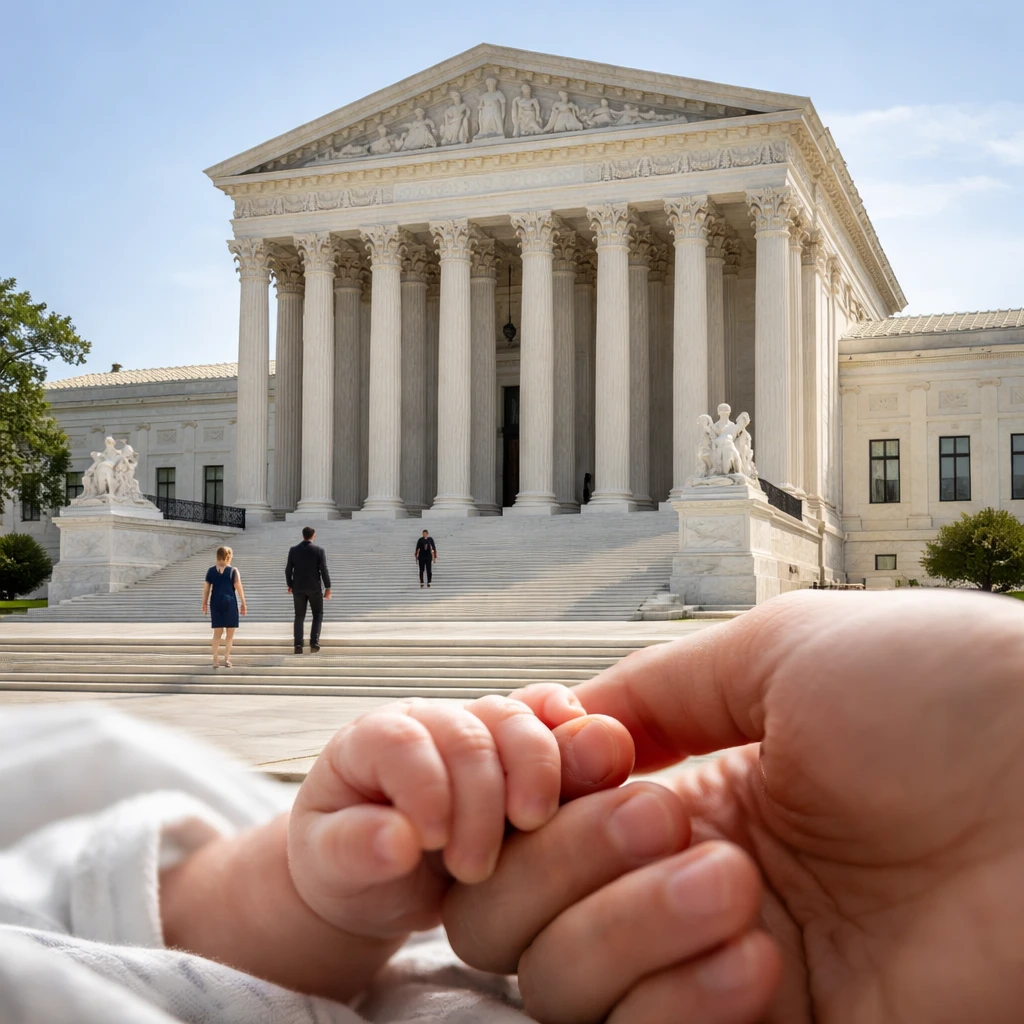
The dispute over who qualifies as an American citizen arrives at the Supreme Court this Wednesday, when the justices will hear arguments on an executive order by President Trump aimed at eliminating birthright citizenship for children born to undocumented immigrants or temporary visitors.
At issue is the long-standing reading of the 14th Amendment's Citizenship Clause, which states that "all persons born or naturalized in the United States, and subject to the jurisdiction thereof, are citizens." For decades, and particularly since the 1898 Wong Kim Ark decision, that clause has been treated as broadly guaranteeing citizenship to almost all who are born on U.S. soil. The administration, through Solicitor General D. John Sauer, is asking the Court to adopt a narrower "jurisdictional" interpretation that would exclude children whose parents lack permanent legal status.
Lower courts have already acted against the policy. At least six courts below the Supreme Court have ruled the executive order unconstitutional, creating a contested record that the high court must now resolve. The proceedings take place amid a period of heightened tension between the White House and the federal judiciary, with recent decisions and public exchanges intensifying that strain.
Legal scholars and critics in and out of government have mounted strong objections to the administration's theory, describing it as a departure from both the plain text of the Constitution and established legal history. The challenge before the Court is therefore both textual and historical: whether the Citizenship Clause should be read as a near-universal guarantee of birthright citizenship or as permitting exclusion based on parental immigration status.
Beyond constitutional interpretation, the case raises immediate practical and policy questions. The article of record highlights potential administrative and economic ripple effects if the Court were to permit a change in citizenship status. Those effects would extend to healthcare eligibility and future labor force projections, among other areas, and would require new procedures at hospitals and state agencies to determine citizenship at birth.
During preliminary exchanges, even some conservative justices signaled concerns about administering a regime that treated newborns differently based on their parents' immigration status. Justice Brett Kavanaugh, identified in the record, asked questions about how a tiered system of citizenship would function in real-world settings, spotlighting the practical implementation challenges that would follow a ruling in favor of the administration's position.
The timing of the Supreme Court hearing also follows a recent decision in which the Court rejected the administration's global tariff program, contributing to an atmosphere of political intensity. President Trump has publicly questioned the patriotism of justices whose rulings thwart his policy goals, a development that observers say raises questions about judicial independence and public reaction to the Court's ultimate ruling on this case.
Political analysts noted that the President may see the case as politically consequential regardless of the outcome: a courtroom victory would advance a central element of his immigration agenda, while a defeat could allow him to argue that even a conservative-led judiciary stands in the way of his domestic security priorities. The Court's decision will thus carry both constitutional weight and immediate policy implications for agencies that manage births, healthcare access, and demographic projections.
Clear summary
The Supreme Court will consider whether President Trump may end birthright citizenship through executive order by adopting a narrower interpretation of the 14th Amendment. Multiple lower courts have found the policy unconstitutional, and justices have raised questions about how a change would be implemented by hospitals and state agencies. The case arrives amid heightened tensions between the White House and the judiciary and could produce significant administrative and economic consequences.