
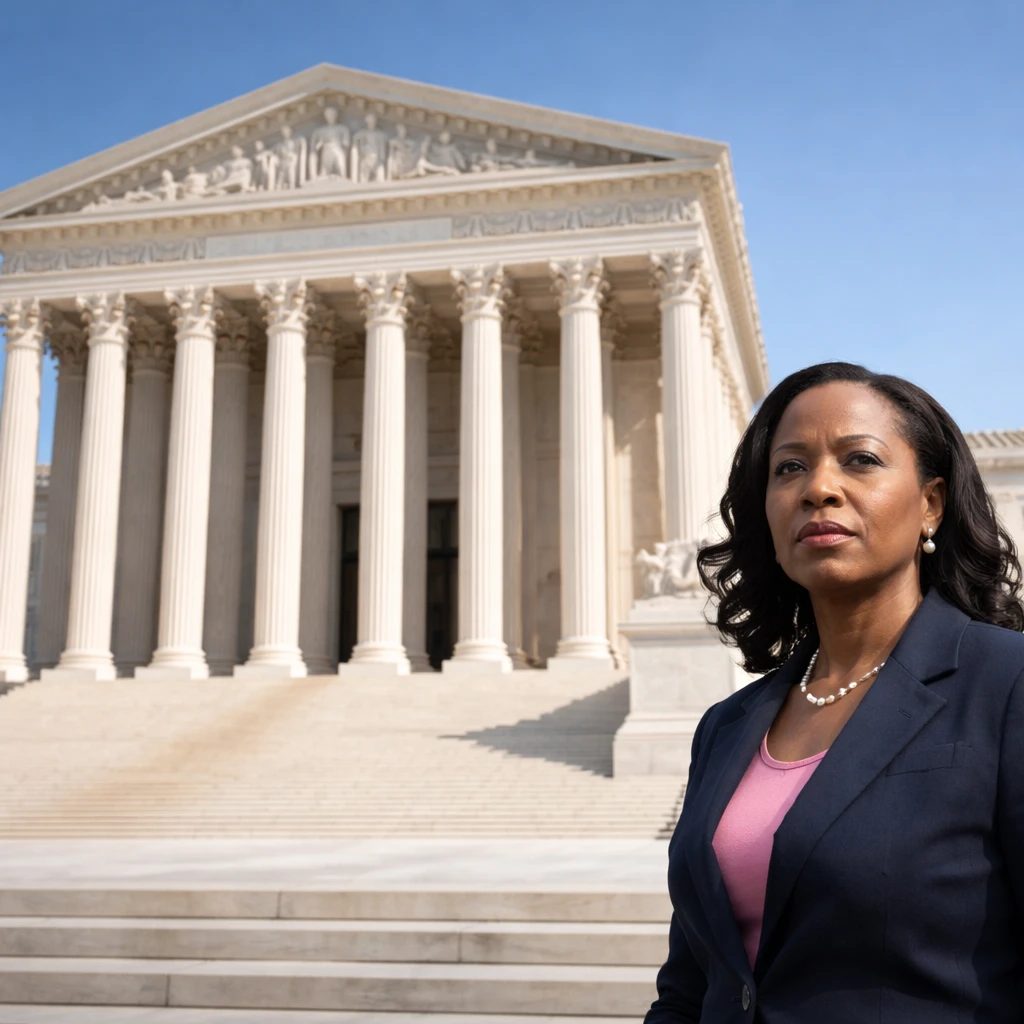
On January 21, the U.S. Supreme Court considered the contentious issue surrounding President Donald Trump’s move to dismiss Federal Reserve Governor Lisa Cook. This legal battle could have lasting effects on the central bank’s autonomy. The case focused on whether the president’s dismissal attempt, made without a formal hearing, was lawful.
During the nearly two-hour session, the justices’ remarks leaned away from permitting immediate removal, signaling hesitation to overturn a lower court’s decision that had restrained President Trump from firing Cook while her legal challenge proceeds. Despite the court holding a conservative 6-3 majority, most justices appeared more concerned with determining the appropriate way to support Cook rather than debating if she should remain in her position.
David Law, a constitutional law professor at the University of Virginia, commented mid-argument that the outcome seemed clear, suggesting Cook would retain her role at the Federal Reserve.
Central to the case is the due process issue. President Trump announced the termination of Cook via his social media platform in August, citing allegations of mortgage fraud brought forth by Bill Pulte, head of the Federal Housing Finance Agency and a Trump appointee. Cook has rejected these claims, maintaining they are a pretext related to disagreements over monetary policy, and she has not faced any formal charges.
The September ruling from a lower court deemed the president’s move, lacking prior notice or a hearing, a probable violation of the Fifth Amendment’s due process protections. Several justices underscored the absence of an opportunity for Cook to respond to the allegations, with conservative Justice Amy Coney Barrett questioning Department of Justice attorney D. John Sauer about the administration’s reluctance to provide such a hearing. Barrett emphasized that sitting down with Cook to present the evidence would not have been a significant burden.
Justice Brett Kavanaugh, another Trump appointee, also appeared inclined toward siding with Cook. He described the "simplest way to decide this case" as recognizing an insufficiency in the procedural protections afforded to Cook. He warned that the administration’s arguments could erode the Federal Reserve’s independence by enabling presidents to remove governors for policy disagreements, thereby weakening the institution’s foundational autonomy.
Meanwhile, Chief Justice John Roberts explored whether the evidence indicated an innocent paperwork error rather than deliberate misconduct. Although Sauer insisted that a mortgage paperwork mistake constitutes a substantial error, Roberts remained skeptical, noting the possibility of debate over the mistake’s significance amid the complex documentation involved in real estate transactions.
Throughout the proceedings, the justices displayed awareness of the broader implications. Kavanaugh remarked that setting a precedent allowing presidential removal of Fed governors on such grounds could lead to widespread dismissals following political turnovers, citing potential upheavals in 2029 and 2033 if administrations change. Barrett raised questions about the practical fallout, referencing concerns from economists that firing Cook might precipitate a recession. She queried if such risks warranted judicial caution at this stage.
The case embodies critical tensions between executive authority and institutional independence, with potential repercussions for monetary policy and economic stability. The Supreme Court’s forthcoming decision will be closely watched by market participants and policymakers, given the Federal Reserve’s central role in guiding economic growth and inflation management.