
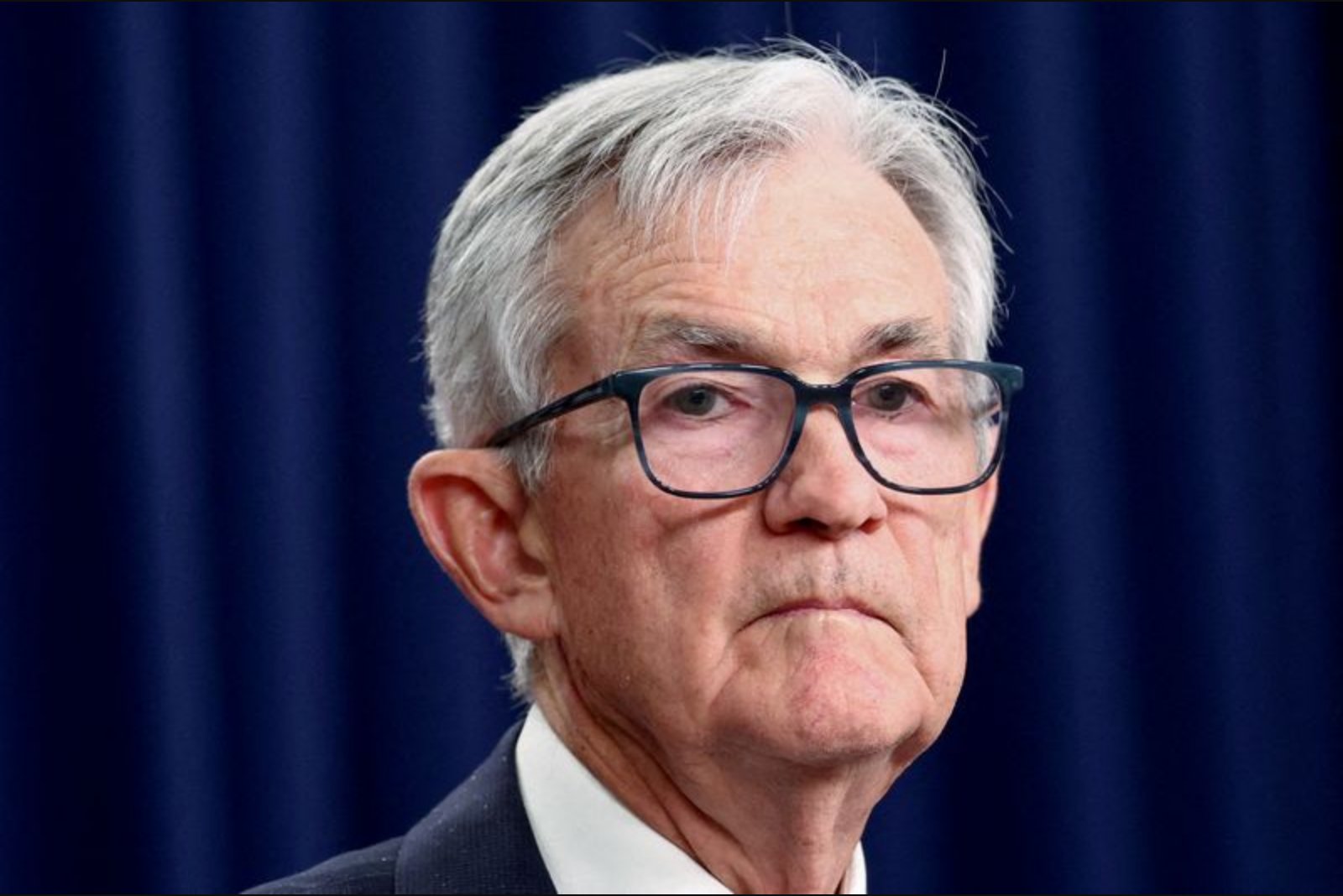
Federal Reserve Chair Jerome Powell is scheduled to speak on Monday at an introductory macroeconomics course at Harvard University, offering a high-profile setting in which investors and economists will look for signals about how the central bank plans to confront a simultaneous rise in inflation and a slowing economy.
The specific policy dilemma is textbook: when a shock pushes consumer prices higher while also restraining growth, should the Fed tighten monetary policy to prevent inflation from becoming entrenched, or should it keep—or even ease—policy settings to support employment?
The question has taken on renewed urgency as the conflict in Iran has entered its fifth week and U.S. gasoline prices have climbed to around $4 a gallon. Those developments follow closely on the Fed's decision, roughly a week and a half ago, to hold short-term interest rates unchanged in the 3.50%-3.75% range.
At the time the Fed paused, Powell said he wanted to see tariff-driven inflation in goods prices ease before addressing whether the central bank should ignore any additional inflation tied to the Iran war or respond to it with tighter policy to keep price gains from accelerating.
Since that meeting, investors' renewed concerns about inflation have contributed to higher Treasury yields. A University of Michigan survey also recorded a jump in household price expectations for both the coming year and the longer term. Other measures, including a widely watched market-based gauge, have been more reserved in their readings of inflation risk.
The policy tradeoff is succinctly captured by Pomona University economics professor Michael Steinberger, who said: "In a very typical Fed model, the Fed's not really happy with that choice. The Fed is truly darned if they do, and darned if they don't."
At a Dallas Fed event on Thursday, Vice Chair Philip Jefferson characterized the Fed's stance as broadly neutral - neither stimulative nor restrictive - and said that positioning allows the central bank to monitor incoming data and determine the appropriate next steps.
Meanwhile, Philadelphia Fed President Anna Paulson told researchers at the San Francisco Fed on Friday she is concerned that higher oil and fertilizer prices, resulting from the closure of the Hormuz Strait, could quickly and durably lift inflation expectations.
Scott Anderson, chief U.S. economist at BMO Economics, shared that concern while attending the same conference. He said: "We are more concerned about the inflation side of the shock at the moment...prices keep going up and up and up, and that definitely starts to affect behavior and decisions, not just at the consumer level but for businesses as well." Anderson noted that inflation has run above the Fed's 2% goal for the last five years, which heightens central bankers' sensitivity to upward price shocks.
Since the start of the Iran war, financial markets have shifted their expectations. Where traders had been leaning toward the possibility of a couple of rate cuts this year, markets are now pricing in roughly a one-in-three chance of a Fed rate increase by the end of the year.
Karim Basta, chief economist at III Capital Management, framed the coming choice as a balance between concerns over rising inflation and risks to employment: "It's going to come down to the classic trade-off of what are you more worried about - rising inflation or weaker employment." He added that Powell's remarks on Monday may show a tilt toward inflation concerns.
Basta also commented on the scale of the oil shock, saying that while oil prices are far below levels such as $150 or $200 a barrel that would sharply raise recession risks, prices near $100 a barrel are nevertheless high enough to push some prices notably higher. On the question of whether the Fed might raise rates in response, he said: "They have to be ready to do whatever is needed, and one of the things that possibly could be needed is to raise rates. I think it's fair that nothing can be ruled out."
Powell's appearance at Harvard will be watched not for classroom-level explanations alone but for any indication of how the Fed will weigh the competing demands of price stability and labor-market resilience in the weeks ahead. With mixed signals across data and markets, the central bank's next steps are likely to depend on incoming inflation readings and developments in energy markets.
Context and implications
- Policy posture - Broadly neutral policy leaves the Fed room to act but also places a premium on updated economic data.
- Market pricing - Treasury yields have risen and market expectations for policy have moved from potential cuts to a non-negligible chance of a rate hike by year end.
- Inflation expectations - Survey evidence points to rising household expectations, while some market gauges remain calmer.