
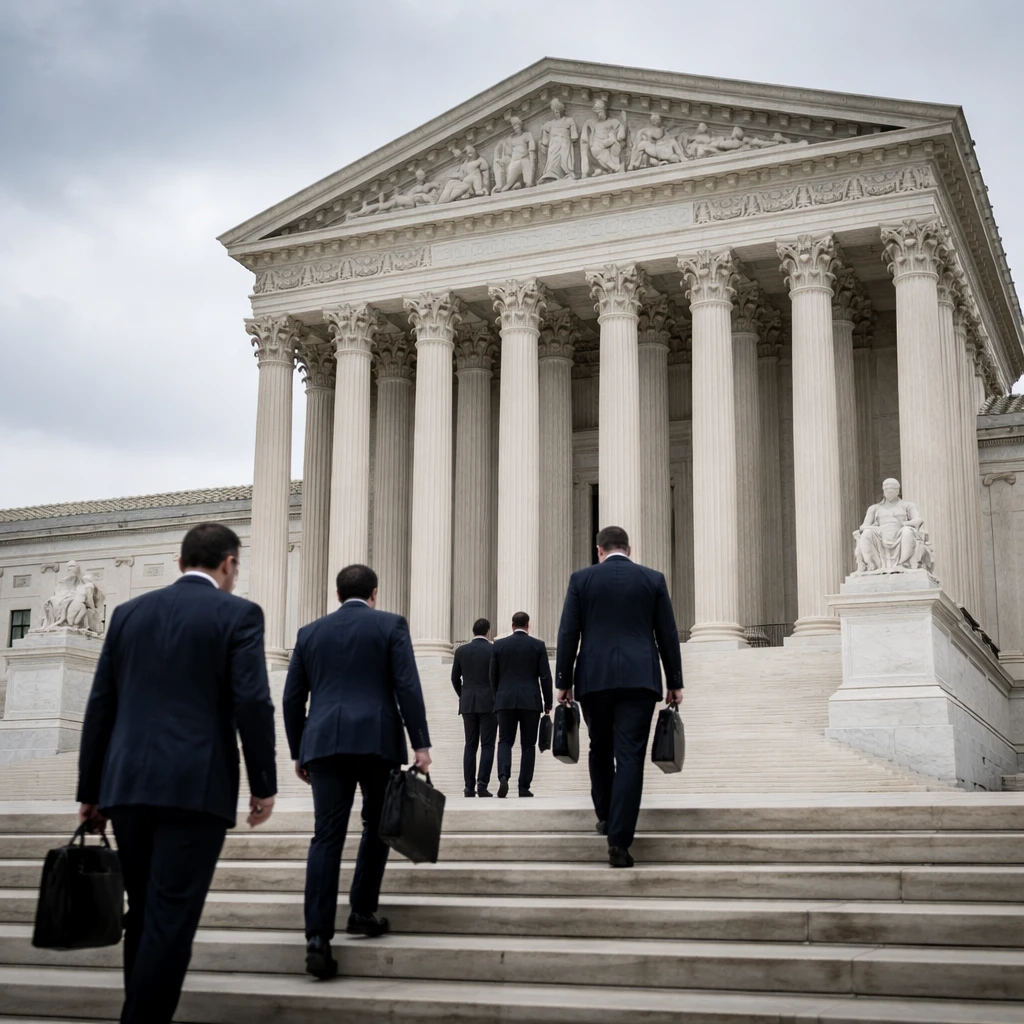
Federal Reserve Chair Jerome Powell said Wednesday that he attended Supreme Court oral arguments related to President Donald Trump’s effort to remove Fed Governor Lisa Cook, and described the proceeding as "perhaps the most important legal case in the Fed’s 113-year history."
Speaking at a news conference, Powell explained his reasoning for attending the hearing, saying: "I thought it might be hard to explain why I didn’t attend it." He pointed to historical precedent for a Fed chair appearing at the high court, noting that former Fed Chair Paul Volcker showed up at the Supreme Court in the 1980s.
Powell also addressed his role and conduct going forward, offering a succinct pledge to the public: he will "continue to do job with objectivity and commitment to serve American people."
On economic matters, Powell provided a brief assessment of recent data and the effects of a government shutdown on statistical readings. He said the Fed is "working through data distortions from a government shutdown," adding that those distortions are "no longer material."
Regarding labor market conditions and broader activity, Powell characterized the data as showing a mixed picture. He said the numbers display "some signs of labor market stabilization" alongside "some signs of continued cooling." He further noted that, compared with the Fed’s prior meeting, the outlook for economic activity has "clearly improved."
The chair’s remarks combined an unusual public acknowledgment of participation in a Supreme Court proceeding with an update on the staff’s reading of recent economic inputs. Powell framed his attendance as defensible on precedent and transparency grounds while reiterating his institutional responsibilities and the Fed’s ongoing work to interpret data affected by temporary distortions.
The comments leave standing a set of high-profile issues for markets and policymakers: the legal challenge concerning a sitting governor of the central bank, the short-term effects of a government shutdown on economic statistics, and mixed signals from labor-market measures even as the near-term growth outlook appears to have strengthened since the Fed’s last policy meeting.