
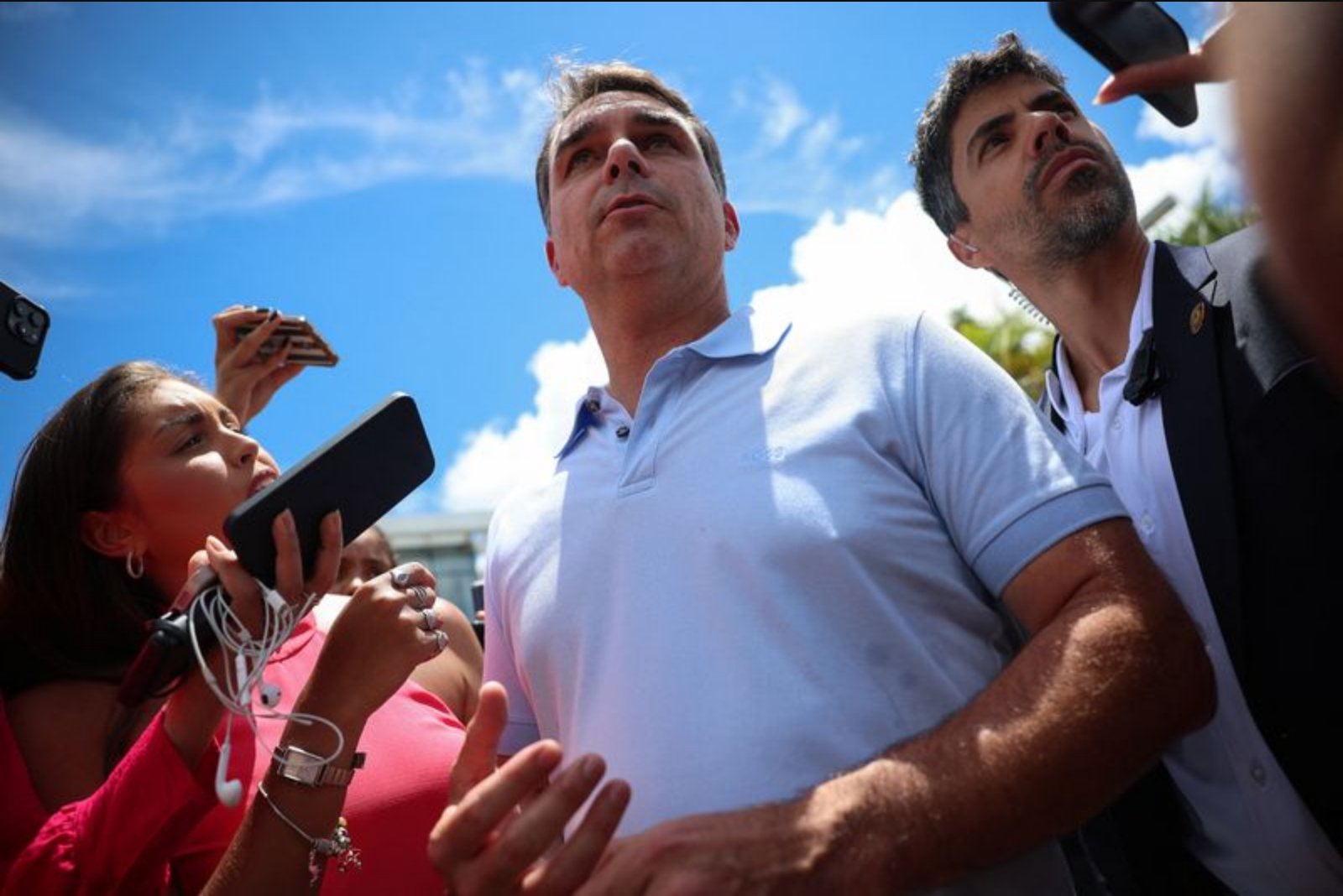
Flavio Bolsonaro’s recent rise in polling has granted him more flexibility to hold off on appointing key economic advisers, according to aides close to the campaign. The senator’s stronger showing in opinion polls that model a likely matchup with President Luiz Inacio Lula da Silva has eased some of the urgency his team once felt about presenting a fully formed economic slate ahead of the October election.
Since he declared his candidacy last year, the 44-year-old senator has spent a substantial portion of his time traveling overseas to meet conservative allies and visiting with his father, former President Jair Bolsonaro, who is serving a sentence in Brasilia related to a failed coup plot. Despite limited public detail on policy, Flavio Bolsonaro has climbed in polling to a level where he appears to be drawing even with the 80-year-old incumbent in head-to-head scenarios, a dynamic that sources say has altered the campaign timetable.
Two sources close to the senator told campaign aides that the momentum behind Flavio Bolsonaro - coupled with his signaling of an economic agenda broadly consistent with his father’s approach - should allow more time to recruit advisers and develop proposals aimed at consolidating a winning coalition. The campaign previously anticipated revealing its economic team in May; one source said that timeline could slip further if the current trend persists.
That approach contrasts with the elder Bolsonaro’s 2018 strategy, when he selected his future Economy Minister, Paulo Guedes, nearly a year before the election in order to reassure markets. In December, when Flavio Bolsonaro was first attempting to calm business audiences, an aide suggested an economic plan might be presented by February. Those earlier signals have since been supplanted by a more cautious rollout tied to polling momentum rather than a fixed schedule.
The senator’s cautious stance will be tested as other right-wing figures formalize their candidacies. Brazil’s Social Democratic Party recently selected Ronaldo Caiado, the governor of Goias state, as its candidate, and Romeu Zema, the governor of Minas Gerais, is running for the Novo Party. Political scientists and campaign observers expect a more crowded conservative field to make the contest more turbulent, even as some of the governors face long odds in overtaking Bolsonaro in early polling.
On the campaign trail, Caiado has made overtures to supporters of Jair Bolsonaro by pledging a wide-ranging amnesty for those convicted of links to the 2023 coup plot, including the former president, who is now serving his sentence at home due to health issues. Zema has emphasized his executive record in Minas Gerais and his clean track record in a country beset by corruption scandals as the foundation for a right-leaning alternative, while acknowledging early polling presents an uphill path.
Flavio Bolsonaro, who previously served as a state lawmaker in Rio de Janeiro before winning a Senate seat following his father’s 2018 campaign, has disclosed only a few details on economic policy. He has promised to cut taxes and spending and to improve the business environment, but has not laid out a comprehensive program. Campaign advisers say the improving poll numbers should make it easier to attract potential cabinet members and economic advisers.
Informal approaches have reportedly been made to several figures who served in the 2019-2022 Bolsonaro administration. Among those mentioned by sources are Mansueto Almeida, a former Treasury Secretary now at BTG Pactual, and Roberto Campos Neto, the former central bank governor who is now vice chairman at digital bank Nubank. At a conference in Boston over the weekend, Almeida said he remains in the private sector and has not been approached by any candidate. Campos Neto did not respond to a request for comment.
The campaign’s deliberative pace comes as the broader political landscape is affected by economic headwinds and a high-profile banking scandal that has unsettled Brasilia. Those developments, combined with the emerging conservative field, mean the timing and composition of any incoming economic team remain significant variables as the campaign unfolds.
Clear summary
Flavio Bolsonaro’s improved standing in simulated polls with President Lula has allowed his campaign to delay naming an economic team that had been slated for May. The senator has made few policy details public while campaigning internationally and visiting his jailed father. As other right-wing contenders enter the race and a banking scandal rattles Brasilia, recruiting advisers and finalizing an economic platform remains an open question.