
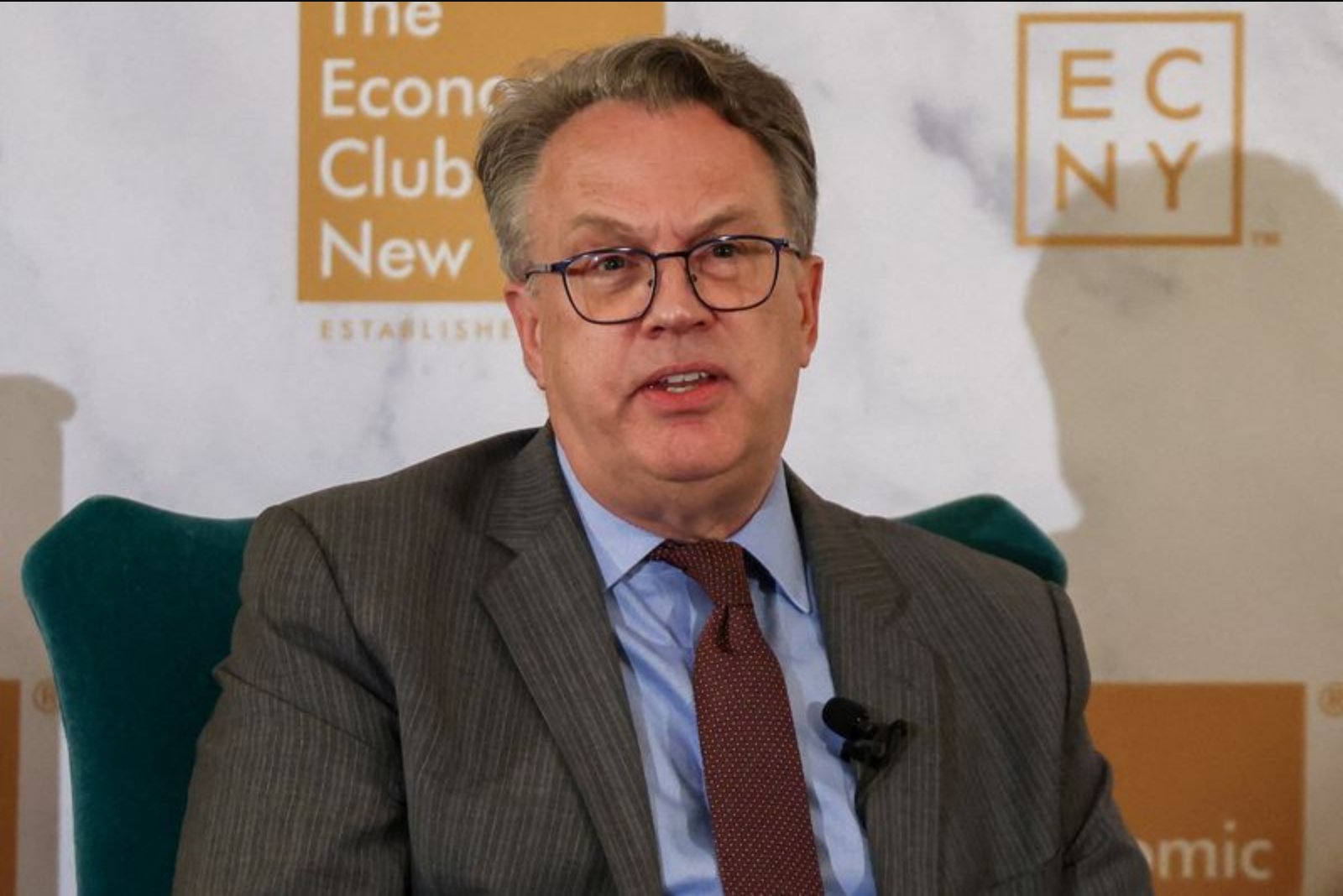
Federal Reserve Bank of New York President John Williams said on Monday that the central bank's current stance of monetary policy is in a good place to meet a range of challenges that are likely to push inflation higher in the short term. Speaking before an event organized by the Staten Island Economic Development Corporation, Williams described the environment confronting policymakers as "an unusual set of circumstances."
"But the current stance of monetary policy is well positioned to balance the risks to our maximum employment and price stability goals," Williams said in prepared remarks.
Williams emphasized the role of the war in the Middle East in shaping the inflation outlook. He warned that the conflict "could result in a large supply shock with pronounced effects that simultaneously raises inflation - through a surge in intermediate costs and commodity prices - and dampens economic activity," adding that "this has begun to play out already." He also pointed to early signs of supply chain disruptions that may further affect prices.
On the near-term inflation trajectory, Williams said uncertainty is "high," but noted that "the significant increase in energy prices resulting from developments in the Middle East will likely boost overall inflation in coming months." He allowed that some of that increase could reverse later in the year if oil prices retreat after the fighting ends.
Williams, who also serves as a vice chair of the Federal Open Market Committee, did not recommend any near-term adjustment to policy in his remarks.
War-related economic channels
The speech outlined how the conflict, which began with joint U.S.-Israeli strikes on Iran, has already had tangible economic effects. Iran's actions in blocking shipping through the Strait of Hormuz have contributed to sharp increases in energy costs, a development with immediate implications for headline inflation. Expensive energy not only lifts headline inflation through higher fuel and commodity costs, but also has the potential to squeeze consumer budgets and slow growth.
That dynamic places the Fed in a difficult position, Williams' remarks implied, complicating the central bank's ability to provide clear forward guidance. High energy prices are an upside risk to inflation, while the associated drag on spending could present a downside risk to labor market conditions.
Comments from the Fed chair and market context
Earlier on the same day, Federal Reserve Chair Jerome Powell offered a similarly cautious tone. Speaking at an event in Cambridge, Massachusetts, Powell said: "We’re facing events in the Middle East which will certainly affect gas prices, and we’re, we feel like our policy is in a good place for us to wait and see how that turns out."
Powell framed the policy challenge succinctly: "There’s sort of downside risk to the labor market, which suggests keep rates low, but there’s upside risk to inflation, which suggests maybe don’t keep rates low."
Financial markets have reacted to these competing risks by weighing different paths for Federal Reserve policy. Investors are currently considering the possibility of additional rate cuts this year, though that discussion follows a period when markets also contemplated a rate increase as war-related inflationary effects added to already elevated inflation above the Fed's 2% objective.
Policy settings and outlook
At its most recent policy meeting earlier this month, the Fed left its target federal funds rate unchanged at a range of 3.5% to 3.75% and penciled in a single rate reduction at some point in 2026. In his remarks, Williams provided his own near-term projections: he said he expects economic growth to be roughly 2.5% this year and for inflation to peak around 2.75% before moving back toward the Fed's 2% target next year. He also said he sees unemployment easing this year and into the next.
Williams' outlook on both inflation and employment is more optimistic than that of the majority of his Federal Reserve colleagues. Most other participants project the unemployment rate will remain at its current 4.4% through the end of the year, and they foresee inflation not returning to the 2% goal until 2028.
Implications
Williams' presentation underscores the tension facing policymakers: a near-term boost to inflation from energy and supply disruptions alongside risks to growth and the labor market. By signaling that current policy is well placed and stopping short of calling for immediate change, Williams echoed a cautious approach that gives the Fed time to assess how the evolving conflict and energy market developments filter through to broader price dynamics and employment.
Markets and policymakers will be monitoring the outlook for energy prices, supply chains, and labor market indicators closely to determine whether policy adjustments become necessary.