
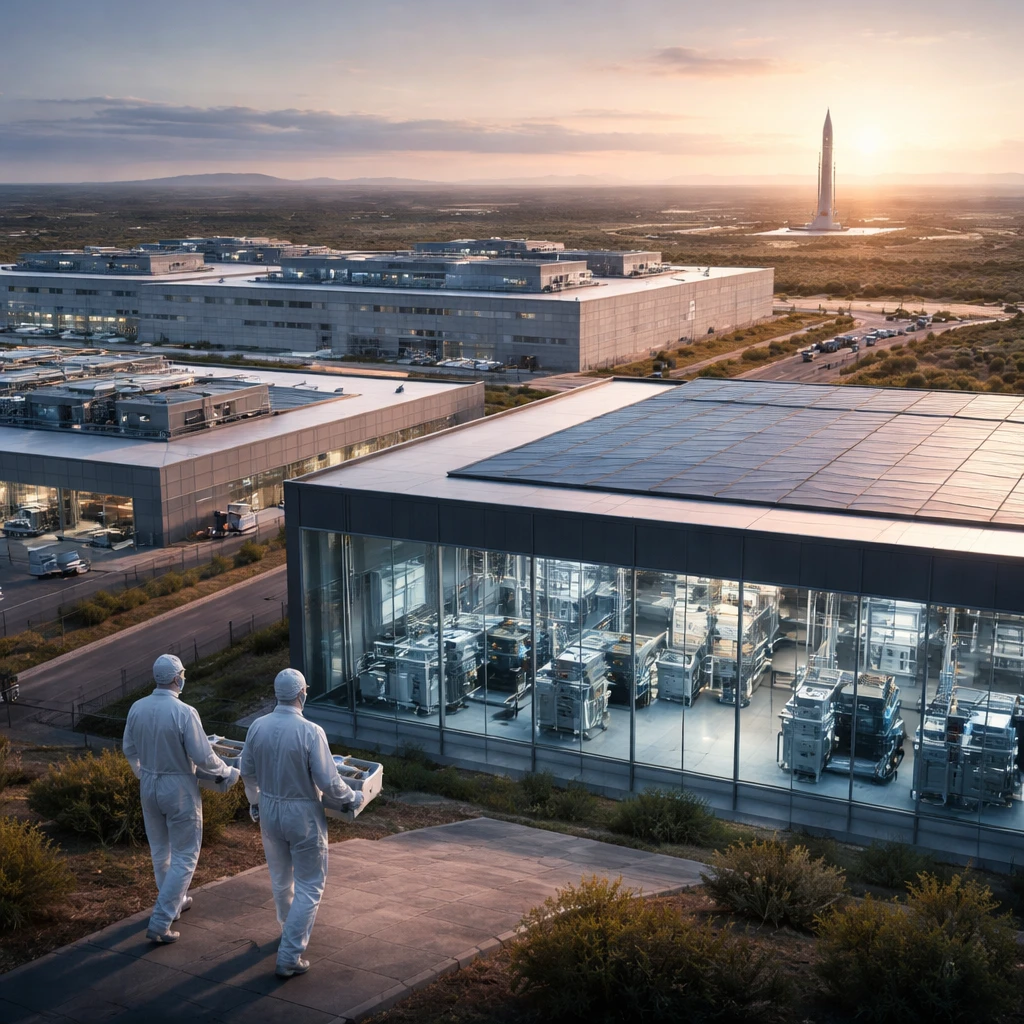
Elon Musk announced a major semiconductor initiative in Austin, Texas, called "Terafab," intended to bring chip production inside the orbit of his companies. The facility will be jointly run by Tesla Inc and SpaceX and is being positioned as a direct response to what Musk described as a global chip industry that cannot scale at the pace his businesses require.
The planned complex is designed to support up to a terawatt of computing power per year, a capacity Musk says will be necessary as Tesla and SpaceX expand into more compute-intensive fields. Targets for that computing capacity include autonomous driving systems, humanoid robotics efforts such as Optimus, and data centers located in space.
Vertical integration and industrial scaling
Terafab represents a clear push toward vertical integration across Musk’s technology stack. The aim is to reduce exposure to external supply variability by producing tailored, high-specification silicon in-house. Tesla currently sources chips from Taiwan Semiconductor Manufacturing and memory from Micron Technology, and the new Austin "advanced technology fab" is intended to manufacture 2-nanometer chips.
The production plan centers on two distinct chip families. One is an edge-inference device optimized for use in the Optimus humanoid robot and for robotaxi fleets. The second is a high-power design intended to meet the needs of SpaceX and xAI, including use cases that demand radiation-hardened and high-performance silicon for orbital operations.
The move to develop proprietary silicon follows corporate consolidation within Musk’s businesses, including the February acquisition of xAI by SpaceX. By producing its own chips, the group expects to lower the breakeven threshold for deploying large-scale artificial intelligence and to avoid relying on external product roadmaps when addressing specialized requirements.
Space-based infrastructure and capital requirements
Terafab is positioned as a foundational element of a broader plan to transfer advanced computing workload into orbit. SpaceX has filed requests with the Federal Communications Commission seeking authorization to launch a large constellation of data center satellites. The capital to build and scale that orbital network is expected to be raised through a record-setting $50 billion initial public offering planned for later this year.
The chips produced at Terafab are expected to be central to the function of "mini" AI satellites that SpaceX envisions. These satellites are projected to scale in power capacity as the network expands, moving from systems that deliver roughly 100 kilowatts up to devices operating at the megawatt level.
The announcement coincides with further technical and financial integration across Musk’s companies. Tesla’s deepening ties with xAI include a $2 billion investment and the planned integration of the Grok chatbot into Tesla vehicles, linking in-vehicle AI ambitions with the broader semiconductor and orbital computing strategy.
While the plan lays out an ambitious and capital-intensive trajectory, its success hinges on overcoming significant engineering and financial challenges inherent in high-end semiconductor manufacturing. Delivering 2-nanometer production at scale, tailoring chips for both edge inference and radiation-hardened orbital use, and supporting a terawatt of annual computing capacity present complex technical and fiscal tests for the combined enterprise.