
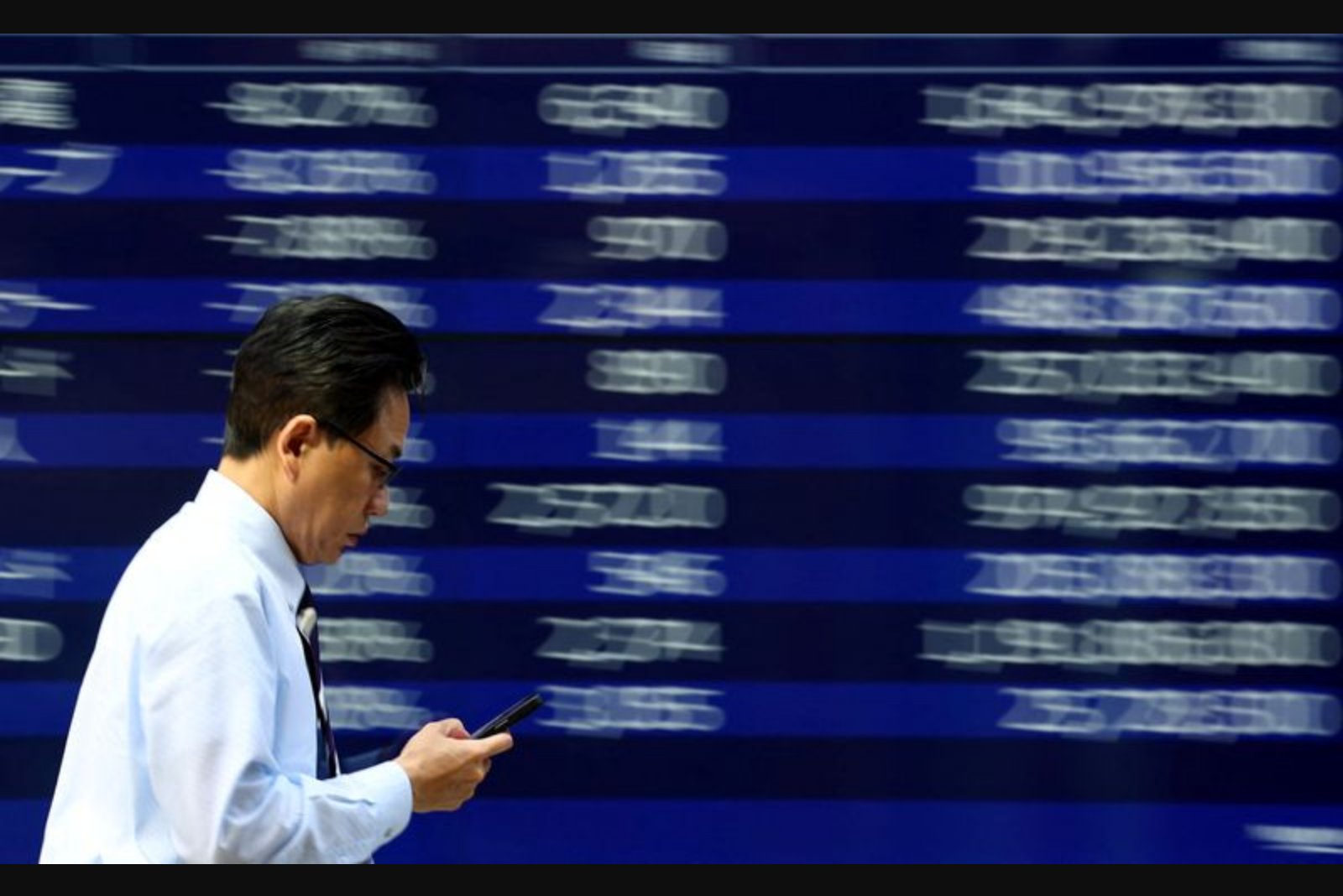
Asian stock markets moved higher on Tuesday as investors positioned themselves for a heavy schedule of U.S. mega-cap earnings, even as a fresh set of tariff measures from the White House and other political risks restrained broader enthusiasm.
Late on Monday President Donald Trump accused South Korea’s legislature of "not living up" to its trade deal with Washington and said he was hiking tariffs on imports from the country - including autos, lumber and pharmaceuticals - to 25%. The announcement stamped a degree of uncertainty on the regional outlook, yet markets overall absorbed the news without a broad sell-off.
Nasdaq futures were up 0.2% as traders prepared for a wave of quarterly reports from the so-called Magnificent Seven, with names such as Microsoft, Apple and Tesla due to report earnings beginning on Wednesday. That stream of results is being watched closely as a gauge of whether the AI-driven rally in technology stocks can be sustained.
South Korea’s benchmark KOSPI initially fell after the tariff news but quickly reversed course and was last up 0.8%.
Precious metals rally amid dollar weakness
Safe-haven assets benefited from the combination of tariff-related uncertainty and a softer U.S. dollar. Gold climbed 1% to $5,066 an ounce, staying just below an all-time high of $5,110 an ounce. Silver jumped 6.4% to $110.60 an ounce, trading not far from a recent record of $117.70 that was set on Monday.
Christopher Louney, commodity strategist at RBC Capital Markets, attributed the move to the intersection of elevated uncertainty and a weaker dollar. He said: "The frenetic nature of uncertainty coupled with a weaker dollar have been the primary contributors to this latest leg higher (for gold)." Louney added that "Similar major rallies of the past point to early September or mid-December based on duration alone. This means the current duration is by no means an outlier," and he suggested gold could reach as high as $7,100/oz at year-end based on its 2025 performance.
Regional equity performance and U.S. market tone
Across the region, MSCI’s broadest index of Asia-Pacific shares outside Japan rose 0.4% on the day. Japan’s Nikkei dipped 0.1%, pressured by a recent sharp rebound in the yen that has clouded prospects for the country’s export-oriented firms. Chinese blue-chip stocks were flat, while Hong Kong’s Hang Seng index added 0.4%.
Wall Street had climbed for a fourth consecutive session overnight, with the S&P 500 and the Nasdaq reaching their highest levels in more than a week. Investors are placing considerable emphasis on upcoming reports from U.S. technology giants, viewing their results as a critical test for the resilience of the AI-led market advance.
Federal Reserve meeting and political overhang
The Federal Reserve is scheduled to announce its latest policy decision on Wednesday, and markets expect no change to interest rates. However, the Fed meeting is unfolding against a politically charged backdrop. The Trump administration has opened a criminal investigation of Federal Reserve Chair Jerome Powell, whose term ends in May. Separately, online betting markets were reported to attach a 50% chance to BlackRock’s bond chief Rick Rieder being the likely successor - described in reports as an advocate of lower rates like Trump.
Dollar declines and yen dynamics
The U.S. dollar continued to show signs of strain in the opening weeks of 2026. A mix of factors, including Washington’s desire for a weaker currency and erratic policymaking attributed to the administration, prompted investors to reconsider assumptions of greenback stability. The dollar’s recent slide to over four-month lows was pushed further by sharp gains in the Japanese yen that began on Friday, when talk of rate checks by the New York Fed raised the prospect of coordinated U.S.-Japan steps to halt the yen’s earlier decline.
On Tuesday the dollar was steady at 154.30 yen, having lost 2.6% across the prior two sessions and trading well below the 160-yen level often cited as a threshold for potential Japanese intervention. Against a basket of six major currencies, the greenback was flat at 97.09, close to a 4-1/2 month low of 96.8.
Fixed income, oil and Washington funding risks
In U.S. government debt markets, the benchmark 10-year Treasury yield inched up 1 basis point to 4.225% after sliding for four straight sessions from a recent peak of 4.313%.
Concerns about a possible U.S. government shutdown also lingered in the background. Lawmakers remained divided over funding for the Department of Homeland Security, an impasse made more acute by reports of a second U.S. citizen fatally shot by federal immigration officers in Minnesota.
Oil markets were largely subdued on Tuesday. Brent crude futures eased 0.1% to $60.58 a barrel, while U.S. West Texas Intermediate crude slipped 0.2% to $65.48 a barrel.
The confluence of elevated geopolitical risk, sensitive currency dynamics and a closely watched calendar of U.S. corporate and central bank events left markets in a cautiously constructive mood as Asia opened for trading.