
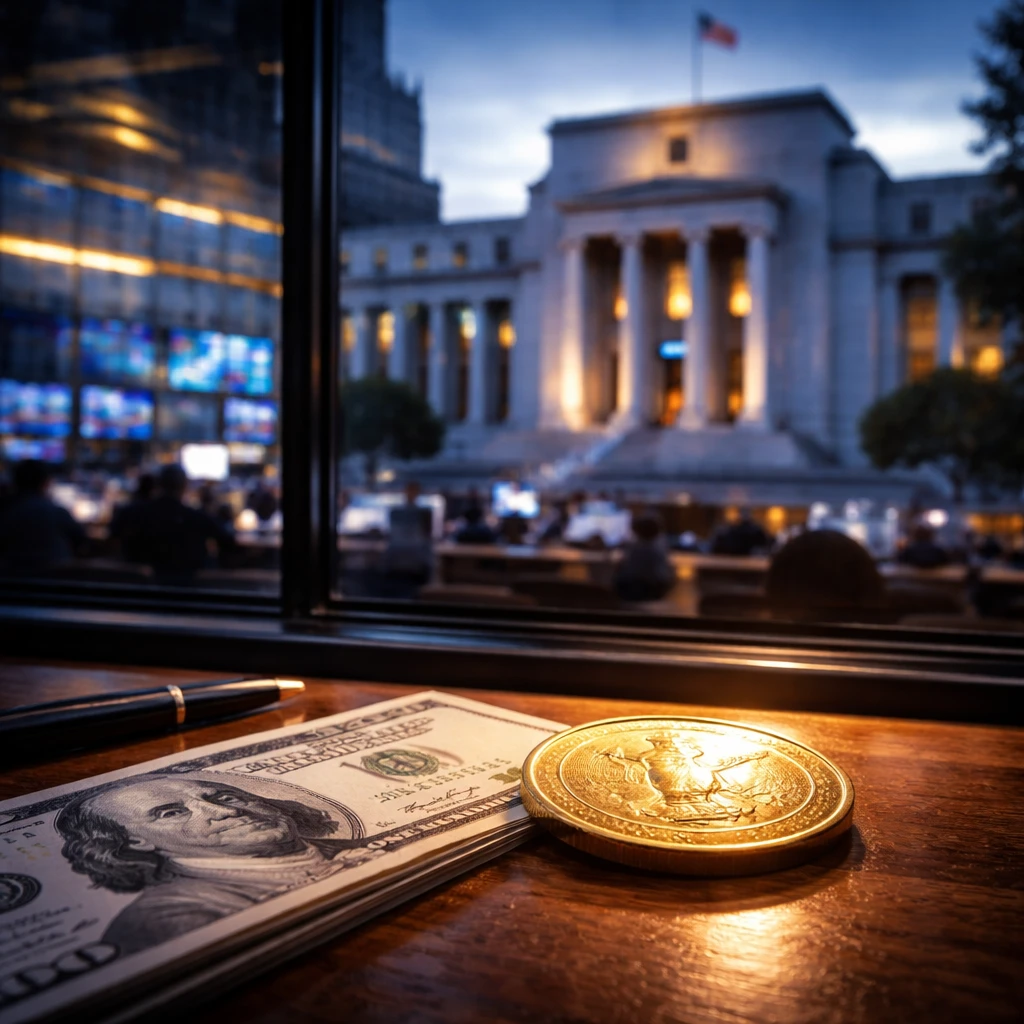
President Donald Trump early on Friday named former Federal Reserve Governor Kevin Warsh as his pick to replace Chair Jerome Powell.
Warsh served on the Fed's Board of Governors from 2006 to 2011 and was widely noted for his role as an intermediary between Wall Street and the banking industry at the height of the financial crisis. His selection calmed some concerns about the central bank's independence even as it triggered notable market moves.
Investors reacted quickly. Wall Street slipped amid renewed focus on Warsh's historically hawkish views, the dollar strengthened, and precious metals experienced the most dramatic swings. A pronounced runup in gold and silver earlier saw a sharp unwind following the announcement.
Market context and initial reaction
Observers described the nomination as a potentially meaningful change for U.S. monetary policy while noting that concrete outcomes will depend on how Warsh leads a committee-driven institution. Some market participants interpreted the pick as a tilt toward a hawkish posture, which can raise term premiums and challenge rate-sensitive assets in the near term. Others read the selection as compatible with continuity if Warsh emphasizes the Fed's independent, data-dependent approach.
Voices from the buy side and strategists
Derek Izuel, chief investment officer at Shelton Capital Management, emphasized the committee nature of policy decisions and cautioned against over-attributing market moves to a single leader. He said:
“Leadership changes at the Fed matter at the margin, but policy outcomes are ultimately committee-driven. The bigger question for markets is whether the next chair reinforces the Fed’s independence and its data-dependent reaction function. If investors perceive a tilt toward tighter policy or a stronger inflation focus, that can lift term premiums and pressure rate-sensitive assets in the near term. If the market instead interprets continuity with the current framework, the reaction is typically more muted.”
Charlie Ripley, senior investment strategist at Allianz Investment Management, flagged the nomination's potential to alter the Fed's posture toward inflation and its operational choices. He noted Warsh's reputation as an inflation hawk but suggested his return could introduce nuance to leadership. Ripley added that a Warsh-led Fed may be less inclined to use the balance sheet to cap long-term rates and predicted higher risk premiums on long-term rates and the dollar, with implications for duration-sensitive strategies:
“The nomination of Kevin Warsh…has potential to be a pivotal change for U.S. monetary policy and the mandate for the Fed. Warsh, while having experience as a former Fed governor, he is known as an inflation hawk, but his return is expected to brings a more nuanced approach to the Fed’s leadership.There is a sense that a Warsh Fed technically leans more hawkish with an unwillingness to utilize the balance sheet to cap long-term rates. With inflation risks continuing to loom on the horizon, balancing political pressures to reduce policy rates will remain a challenge. On balance, we see Warsh’s nomination ultimately leads to higher risk premiums on long-term rates and the dollar. Momentum towards a directionally steeper yield curve puts duration buyers on notice, with more potential to underperform.”
Jeffrey Roach, chief economist at LPL Financial, reflected on Warsh's past role and temperament. He described Warsh as Bernanke's bridge to Wall Street during his tenure and noted that Warsh's willingness to rethink conventional frameworks could be reassuring to some. Roach also warned that Warsh's scepticism of aspects of prevailing monetary frameworks could make some investors nervous:
“With five years of history on the Board of Governors under the Bernanke Fed, Kevin Warsh was known as Bernanke’s bridge to Wall Street. Warsh is also known as a critical thinker and should have no problem getting confirmed. Investors could get nervous with Warsh’s view that many current monetary frameworks are just junk food such as forward-guidance and data-dependency. I think this could potentially be hazardous. Bottom line: Warsh is a safe pick. He’s forthright, willing to rethink convention, and not necessarily a yes-man for the President.”
Mix of expectations on hawkishness and dovishness
Several economists offered nuanced takes, reflecting a balance between Warsh's past hawkish reputation and more recent statements that some interpret as supportive of lower rates.
Tom Porcelli, chief economist at Wells Fargo, reported conversations with clients that indicated a degree of comfort with Warsh relative to other potential nominees, while also highlighting uncertainty stemming from Warsh's relative public quiet on the outlook and the appropriate federal funds rate path. Porcelli wrote that, based on Warsh's optimism about productivity growth and views about supporting "Main Street," he might adopt a dovish stance. At the same time, Porcelli reminded readers that historically Warsh was among the more hawkish finalists on the President's shortlist and that his reputation for hawkishness is rooted in his time on the Board and his post-Fed career.
Matthew Luzzetti, chief U.S. economist at Deutsche Bank, stressed that although Warsh has recently argued for lower rates, he is not viewed as structurally dovish. Luzzetti pointed to prior instances when Warsh's views skewed hawkish compared with peers, referencing his concerns about inflationary risks from quantitative easing around the global financial crisis and his opposition to a past 50 basis point reduction in policy. Luzzetti concluded that Warsh would need to persuade colleagues that rate cuts are warranted this year, a case he judged unlikely to prevail unless the labor market weakens significantly or inflation eases materially.
Longer-term reputation and chairmanship uncertainty
Chris Zaccarelli, chief investment officer at Northlight Asset Management, said markets were likely relieved a known former Fed official had been nominated but cautioned that expectations for an especially dovish chair may be disappointed. He observed that it will take time for Warsh to define his chairmanship and noted historical examples where appointees develop legacies and styles that differ from the initial impressions of those who nominated them:
"While the markets are probably relieved that a well-known, former Fed official has been nominated as the next Fed chair, they are also likely to pivot to concerns that he won’t be as dovish as they were expecting the new chair to be.Like all other Fed Chair appointees it will take some time for him to find his footing and establish his reputation as chair, but in the past we have seen a number of examples where Fed Chairmen – and Supreme Court justices for that matter – end up having a different legacy and style than people (and the Presidents that appointed them) had expected.”
Joseph Brusuelas, chief economist at RSM U.S., said Warsh met a high bar for the job but urged that questions be posed about central bank independence, balance-sheet reduction, and crisis response. He acknowledged Warsh's record of emphasizing inflation risk during early portions of the Great Financial Crisis and described that track record as a source of concern about how Warsh might act during future financial or economic stress. Brusuelas concluded that while he would not have recommended Warsh personally, he recognized Warsh as qualified for the role:
"I personally find Warsh to meet the very high bar for being the Fed Chair. He should be asked challenging questions on central bank independence, his view on reducing the Fed balance sheet and reform of the central bank. Moreover, he should be challenged to how he would respond in a financial crisis given his public track record of focusing on inflation risk during a time of rising unemployment and deflation during the early portion of the Great Financial crisis. Warsh has a range of views and track record that presents significant concerns about how he would proceed during a financial and economic crisis. I would not have recommended him but he is qualified for the job.”
Implications for markets and investors
Overall, the nomination prompted a reassessment across asset classes. Market participants considered the potential for higher long-term risk premiums, a firmer dollar, pressure on rate-sensitive assets, and volatility in precious metals that had previously benefited from expectations of easier policy. At the same time, several commentators emphasized that policy ultimately reflects committee decisions and that Warsh's ability to shape outcomes will depend on his capacity to persuade colleagues and respond to incoming data.
As the confirmation process proceeds and Warsh defines his priorities, investors will be watching for signals about the Fed's balance-sheet strategy, its willingness to use unconventional tools to influence long-term rates, and how independence and data dependency factor into future decisions.