
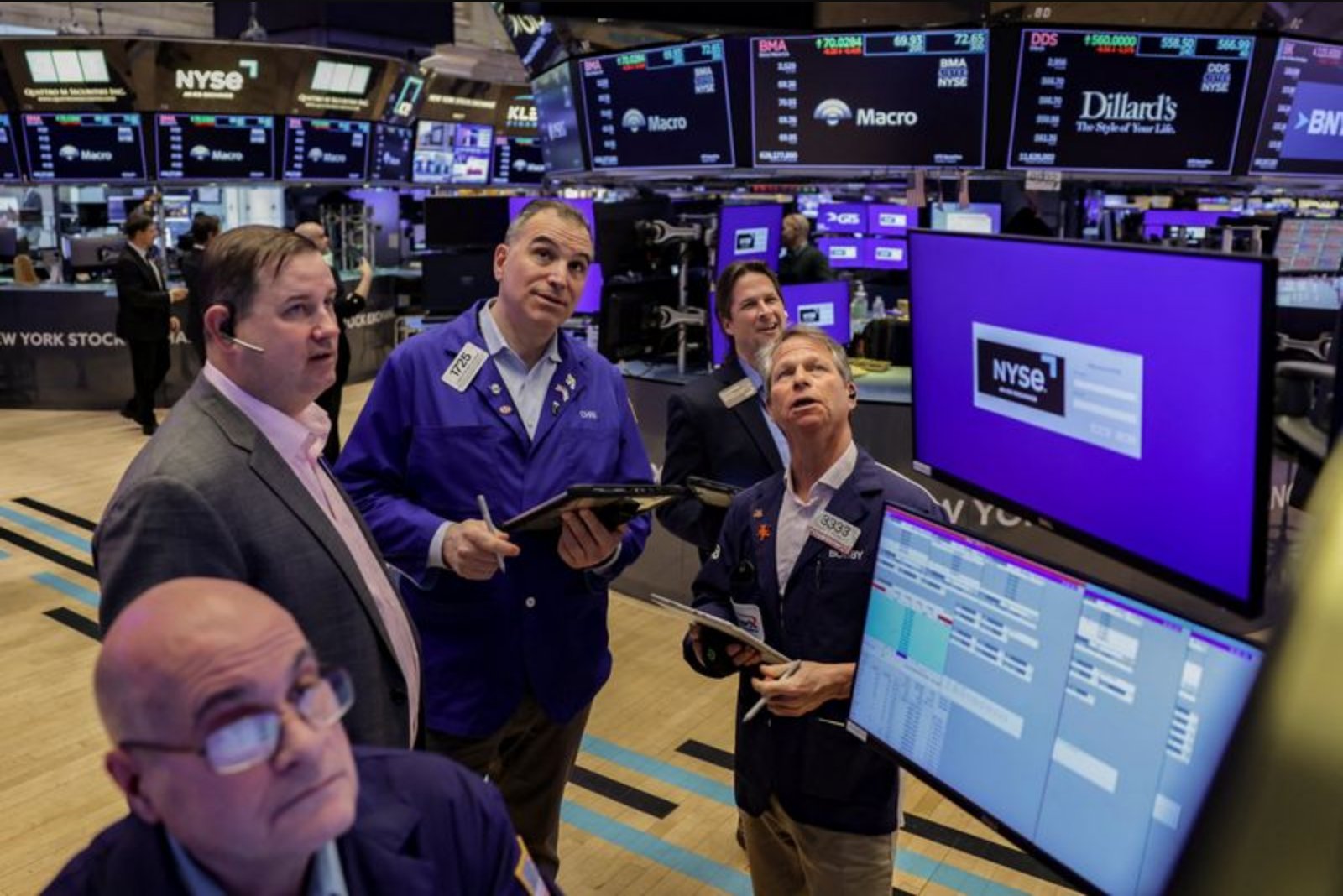
Wall Street closed lower on Tuesday after a session that began on firmer footing for global stocks. The late-day slide followed a combination of rising oil prices, a jump in Treasury yields and weak business activity surveys that together reinforced perceptions the war in the Middle East remains a persistent market risk.
Markets were already processing a set of mixed signals: robust gains across much of Asia and modest advances in Europe contrasted with losses among the big three U.S. indices. The day’s trade highlighted the difficulty investors face when traditional safe-haven choices do not provide a uniform refuge.
Recommended reading to contextualize today’s moves
- Iran war starts to hit global economy, business surveys show
- War-torn bonds may need recession to bounce back: Mike Dolan
- Japan’s core inflation slows below BOJ target, complicates rate communication
- Ares caps withdrawals at private credit fund after redemption requests surge
- Traders bet $500 million on oil price just before Trump’s post on delay to Iran attack
Today’s key market moves
- Stocks: Strong gains in Asia helped global indexes earlier, with major Asian indexes nudging about 3% higher. Europe finished up around 0.5% and the UK rose roughly 0.7%, but the main U.S. indices ended the day down. Mexico gained 2.2%.
- Sectors and individual shares: Seven S&P 500 sectors advanced, led by energy with a roughly 2% increase and materials up about 1.7%. Four sectors fell, with communications services down 2.5% and technology off about 0.7%. Notable decliners included Estee Lauder down 10%, Salesforce off 6%, and IBM down 3%.
- FX: The dollar strengthened by about 0.5%. Among G10 currencies, the Australian dollar and New Zealand dollar were the largest decliners. In emerging market FX, the South African rand, Hungarian forint, Thai baht and Indian rupee each fell 1% or more.
- Bonds: Treasury yields rose, with the short end of the curve up about 10 basis points and the yield curve bear-flattening after an extremely weak two-year auction.
- Commodities: Oil climbed approximately 4.5% while gold fell roughly 1%.
Talking points
PMI signals - Purchasing managers index readings for March released on Tuesday painted a softer picture for private sector activity across several major economies. U.S. private sector output slid to its weakest level in 11 months, euro zone activity dropped to a 10-month low, and the pace of expansion in Britain slowed to the weakest in six months. Those readings suggest the combination of conflict in the Middle East, a global energy shock and higher oil and gas prices is beginning to weigh on growth. The longer these pressures persist, the more they could squeeze activity and broaden strains in labor markets, complicating policymaker choices around interest rates.
Private credit strain - Concerns about the private credit market intensified as two large funds limited withdrawals. Apollo’s $25 billion Apollo Debt Solutions and Ares Management’s $22.7 billion Ares Strategic Income Fund each imposed a 5% cap on redemptions. Shares of both firms lagged the market on Tuesday. Broadly, equities of several prominent firms in the private credit sector are down 25-35% year-to-date amid growing unease about asset valuations. The more managers restrict investor access, the more questions will mount about whether strains in private credit could have wider market implications.
U.S. equity outlook remains mixed - Barclays equity strategists published a note on Tuesday raising their S&P 500 earnings-per-share forecast for the year to $321 from $305 and lifting their index price target to 7,650 from 7,400. That uplift implies roughly 15% upside from the market’s close on Tuesday. The strategists acknowledged risks are skewed more toward downside than upside, but they highlighted stronger nominal growth in the United States and continued momentum in the technology sector as reasons to be incrementally positive on U.S. equities. "We are incrementally bullish on US equities, though the road likely stays bumpy until we turn a corner," they wrote.
What could influence markets next
- Developments in the Middle East
- Moves in energy markets
- Australia - February inflation data
- Germany - Ifo business sentiment index for March
- Speech by European Central Bank President Christine Lagarde at the "ECB and its Watchers" conference, joined by policymakers Olli Rehn, Philip Lane and Martin Kocher
- UK - February PPI and CPI inflation readings
- US - February import prices
- US - EIA weekly crude oil stock report
- US Treasury auctions of $70 billion in five-year notes and $28 billion of two-year floating rate notes
- Remarks by US Federal Reserve Governor Stephen Miran
As markets digest these cross-currents - geopolitical risk, energy price volatility, and signs of cooling activity - the absence of a single, clear safe-haven destination complicates portfolio decisions. Investors and policymakers alike will be watching the flow of data and developments closely for clues about the next sustained direction of markets.