
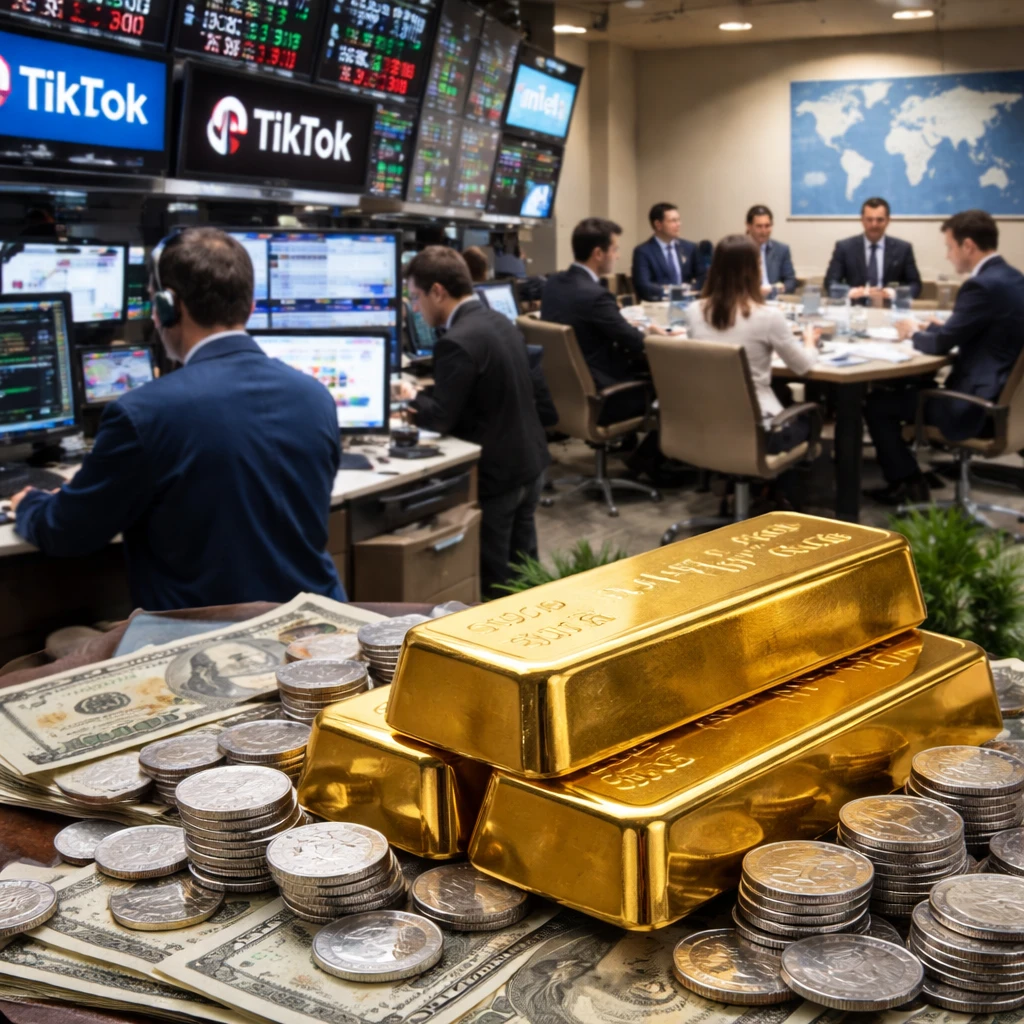
Financial markets in the United States experienced modest fluctuations Friday as investors digested a wide range of corporate earnings reports alongside key economic indicators, all unfolding within a context of easing geopolitical strains between the U.S. and European regions.
Shares of major technology company Intel fell in after-hours trading after the firm announced a loss for the final quarter of its fiscal year and provided a cautious outlook for the coming period. Intel highlighted ongoing supply constraints affecting the artificial intelligence data center market, despite heightened demand.
Simultaneously, TikTok revealed a new joint venture structure that will maintain its operational presence within the United States, addressing longstanding national security concerns. The U.S. government and significant private investors collectively hold the majority of this newly formed U.S.-based entity.
On the monetary policy front, the Bank of Japan chose to keep interest rates steady but indicated the possibility of gradual increases in response to projected economic growth and inflation.
Meanwhile, gold prices reached historic highs amid rising geopolitical tensions, notably following U.S. naval deployments near Iran, reinforcing demand for safe-haven assets.
Futures Activity and Market Context
Prior to the market open Friday, futures tied to key U.S. stock indexes edged slightly lower. At 3:50 a.m. ET, Dow futures dropped by 33 points (0.1%), S&P 500 futures declined 4 points (0.1%), and Nasdaq 100 futures lost 43 points (0.2%). This comes after a volatile trading week influenced by fluctuating geopolitical and trade discussions.
Investor optimism had previously been lifted as President Donald Trump rescinded plans to impose additional tariffs on multiple European nations starting February, alleviating some immediate trade tensions.
Trump further announced a comprehensive agreement seemingly granting the United States broad access to Greenland, following talks with NATO allies. However, details of this arrangement remain limited, and prior episodes regarding Greenland’s political status have left EU officials cautious about future U.S.-Europe relations.
With concerns over Greenland diminishing, market focus returned to the intense corporate earnings season and the forthcoming Federal Reserve interest rate decision scheduled for next week.
Intel Reports Fourth-Quarter Loss Amid AI Demand Pressures
Intel’s quarterly report revealed a net loss of $333 million for the last three months of its fiscal year, surpassing the magnitude of losses anticipated by analysts. The chip giant, supported by key investors such as Nvidia and backing from the U.S. government, faces growing challenges amid soaring artificial intelligence data center demand.
Chief Financial Officer David Zinsner acknowledged the current supply shortages as an industry-wide issue expected to persist through 2026, complicating Intel’s ability to capitalize fully on AI-driven growth.
For the upcoming quarter, Intel forecasted an anticipated loss of $0.21 per share, underscoring the competitive pressure in the AI chip market where Nvidia and Advanced Micro Devices maintain dominant positions.
Investor disappointment stemmed also from a lack of substantive updates on critical corporate developments. Intel deferred release of data concerning new clients for its chip fabrication business, which had been highly anticipated, and provided limited disclosure about purchasers of its advanced 14A manufacturing process technology.
Analysts at Vital Knowledge noted the absence of significant customer announcements for the 14A process, with speculation that high-profile companies such as Apple might have been potential clients but were not mentioned.
TikTok Forms New U.S. Joint Venture to Maintain Operations
Addressing ongoing U.S. governmental issues regarding data privacy and national security risks linked to its China-based parent company ByteDance, TikTok announced a new joint venture structured to preserve its U.S. operations.
This arrangement, brokered under the Trump administration, involves major U.S. and global investors such as Oracle, Silver Lake, and Abu Dhabi’s MGX holding an 80.1% majority stake, with ByteDance retaining a 20% interest.
The move counters prior congressional demands that ByteDance divest its American assets by January 2024, following concerns over potential security vulnerabilities. Former President Trump had attempted to ban the app in 2020 but later opted not to enforce recent legislation to remove TikTok from U.S. markets.
Trump lauded the venture as being led by "Great American Patriots and Investors," highlighting the political significance of the platform, which credits it with aiding his political aspirations.
Bank of Japan Maintains Rates, Signals Cautious Tightening
The Bank of Japan (BOJ) held its key overnight interest rate steady at 0.75%, a decision aligned with market expectations. The vote among the nine-member board resulted in eight members supporting the status quo, while Hajime Takata advocated for a 25 basis point increase.
The BOJ revised upward its forecasts for economic growth and inflation for fiscal years 2025 and 2026, anticipating real GDP growth of 0.8% to 0.9% in fiscal 2025, a slight climb from previous estimates.
Officials emphasized that interest rates are expected to trend higher in line with economic expansion and a goal of 2% annual inflation, maintaining a stance to manage long-term price stability.
Capital Economics analysts view the current deeply negative real policy rate as justifying further monetary tightening, forecasting the BOJ will act possibly by mid-2024 despite challenges such as declining headline inflation and potential government tax policies impacting food prices.
Gold and Precious Metals Reach New Heights
Gold prices surged to record highs in Asian trading, approaching the psychologically significant benchmark of $5,000 per ounce. This spike was driven by President Trump’s announcement of U.S. naval deployments near Iran, which intensified demand for safe-haven investments.
Spot gold briefly climbed as much as 0.7% to $4,967.48 an ounce, with futures rising over 1% to nearly $4,970.
Alongside gold, silver and platinum also set new record prices, with spot silver jumping approximately 3% to $99.03 per ounce, and platinum rising to a peak of $2,692.31 per ounce.
While the announcement of a trade deal concerning Greenland caused some retreat in precious metal markets, ongoing geopolitical uncertainties sustained elevated investor interest in these assets.