
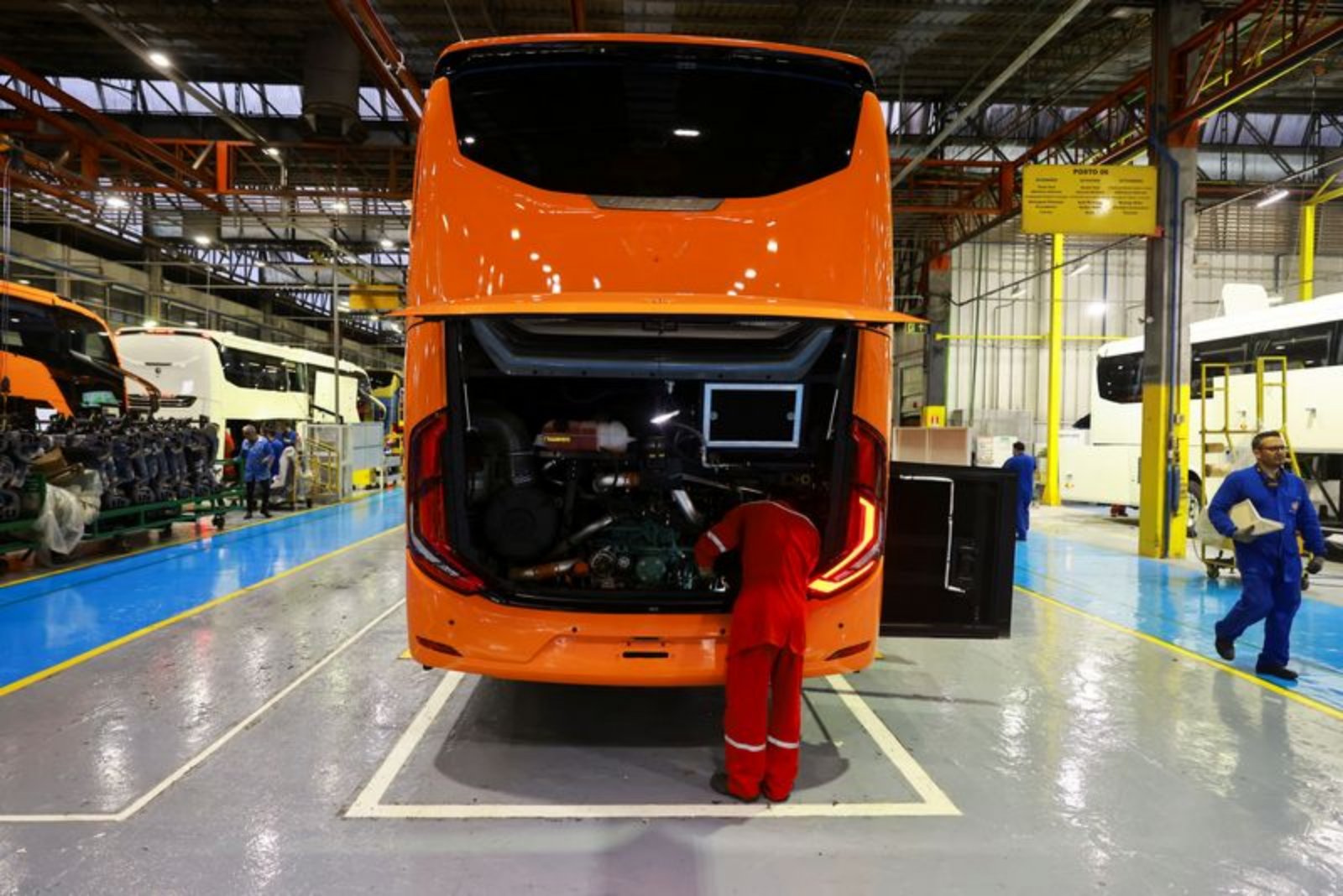
Marcopolo, the Brazilian bus manufacturer, plans to expand sales outside Brazil to offset a projected slowdown in its domestic market next year, company executives told Reuters.
Chief Executive Andre Armaganijan said international activity will continue to be a key revenue driver after the company recorded a higher share of earnings from abroad in 2025. International operations - a category that includes both exports and sales in other countries - represented 45.4% of Marcopolo's total net revenue in 2025, up from 36.3% in 2024.
"We had solid growth in 2025. Argentina was one of our major export markets, and now in 2026 we are starting to see other interesting markets," Armaganijan said, pointing to robust activity in Peru and Bolivia and noting opportunities in Paraguay.
The company expects the Brazilian market to perform slightly below last year's level as a prolonged period of high interest rates has delayed fleet renewals. That monetary backdrop began to change last week when Brazil's central bank initiated a cautious easing cycle, lowering the benchmark Selic rate by 25 basis points to 14.75% after holding it at 15% since July.
Marcopolo reported that revenue from its domestic market fell 10% year-on-year in 2025, to 4.95 billion reais (about $943.94 million, using $1 = 5.2440 reais).
European expansion and certification
Beyond Latin America, Marcopolo is moving to establish a foothold in Europe. The company said it is pursuing product certification there and late last year announced a partnership with Volvo to sell buses in France and Italy, with Volvo acting as the prime contractor and providing sales and after-sales support in both markets.
International Operations Director Jose Luiz Goes said Marcopolo's initial focus on the continent will be France, Italy, Portugal and Spain. He added that the company ultimately intends to establish a final assembly line in Europe.
Executives framed the export push as a strategic response to weaker domestic demand and a path to diversify revenue sources. The company is aiming to translate the stronger international share of revenue recorded in 2025 into offsetting growth for 2026 should domestic fleet renewal activity remain subdued.