
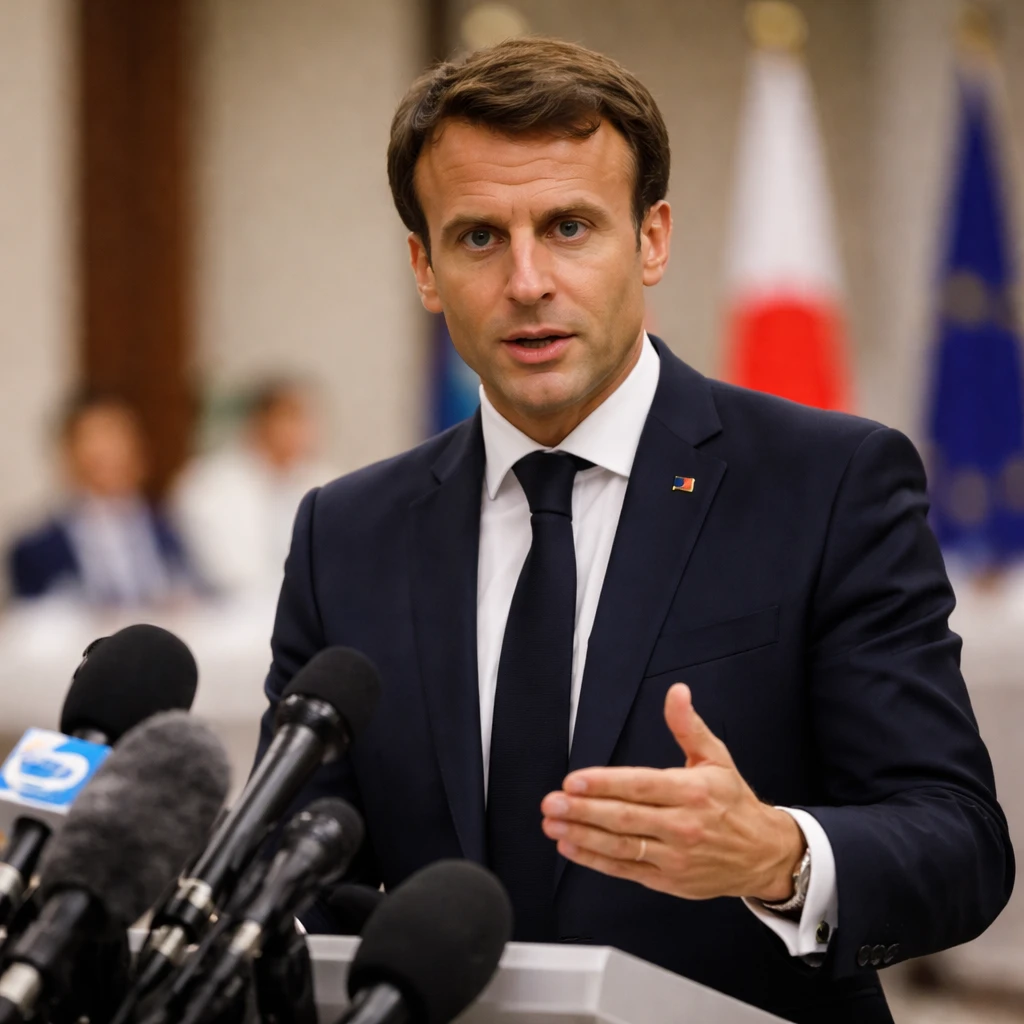
French President Emmanuel Macron told reporters on Thursday that using military force to compel the reopening of the Strait of Hormuz is not a feasible option. His remarks were made while responding to a challenge from U.S. President Donald Trump for allies to assist in reopening the crucial maritime corridor.
Macron said, "Some people defend the idea of freeing the Strait of Hormuz by force via a military operation, a position sometimes expressed by the United States, although it has varied. This was never the option we have supported because it is unrealistic." He delivered the comments during a trip to South Korea.
The French president explained why he regards a military operation as impractical, saying it would require too much time and would place vessels transiting the strait at risk from Iran's Revolutionary Guards and from ballistic missile attacks. He emphasized those operational and security constraints as central to his view that force is not the right path.
Instead of unilateral or purely military measures, Macron described work with European and other partners to assemble a coalition tasked with ensuring free passage through the Strait of Hormuz once hostilities end. He said such a solution would need to be achieved through dialogue with Iran. "What we say from the beginning is that this strait must be reopened because it is strategic for energy flows, fertilisers and international trade, but that it can only be done in consultation with Iran," he said.
When questioned about President Trump's public criticism of NATO allies and suggestions of withdrawing the United States from the alliance, Macron declined to provide an ongoing commentary on actions taken by the U.S. with Israel. He said, "I don’t want to provide a running commentary of an operation the Americans have decided on their own with Israel. They can deplore the fact they’re not being helped, but that’s not our operation. We want peace as soon as possible."
Macron also took aim at personal attacks directed at him, describing comments from President Trump that mocked him and his wife Brigitte as "neither elegant, nor commensurate" with the gravity of the situation.
Macron’s statements underline a preference for coordinated diplomatic engagement over military intervention to resolve disruptions affecting a strategic maritime chokepoint that supports energy shipments, agricultural inputs, and broader international trade.