
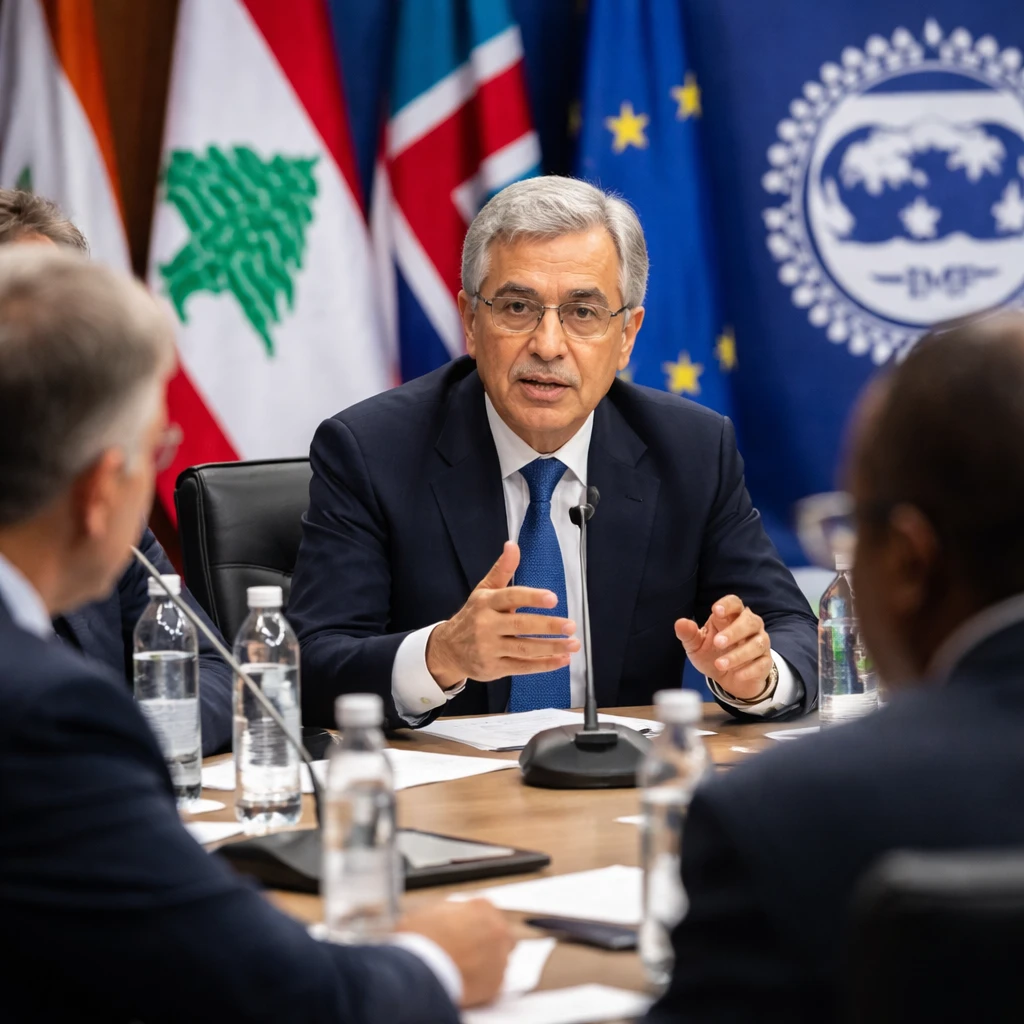
At the World Economic Forum gathering in Davos, Switzerland, Lebanon's Prime Minister Nawaf Salam disclosed that the International Monetary Fund (IMF) has requested specific modifications to Lebanon’s draft "financial gap" law. This legislation is a pivotal component of a broader reform package intended to extricate Lebanon from its severe financial meltdown, which is considered the worst in the nation's history. A primary objective of the law is to grant depositors access to savings that have been inaccessible for six years.
The draft legislation seeks to establish a transparent framework that distributes the financial losses resulting from Lebanon’s 2019 economic crash across various parties, including the government, the central bank, commercial banks, and depositors. A key point under discussion is the need to clarify the "hierarchy of claims," which determines the sequence in which losses will be allocated among stakeholders. According to Salam, the IMF has focused on sharpening these provisions to ensure greater legal and practical clarity.
"We want to engage with the IMF and improve the draft law," Salam stated, emphasizing that the law is still under development and that negotiations have been constructive so far. Lebanon’s financial losses were estimated at approximately $70 billion in 2022, though analysts suggest the figure may now be even higher. Salam underscored the urgency of advancing an IMF-supported recovery program and warned of escalating international pressure.
"The longer reforms are delayed, the more people's savings will be eroded," he said, highlighting the risk that Lebanon faces being further downgraded on financial watchlists. Currently on a "grey list" for financial compliance, the country risks being moved to a "black list" if improvements stall, which would deepen its economic isolation.
The law, passed by the cabinet in December and pending parliamentary approval, aims to provide a clear roadmap for depositors to recover funds—guaranteeing reimbursement of up to $100,000 per account over a period of four years, with priority given to smaller depositors. Additionally, the plan includes launching in-depth forensic audits intended to reveal the extent of losses and delineate accountability.
Lebanon’s Finance Minister Yassine Jaber, who is working closely with Salam to drive these reforms, emphasized the critical need to rehabilitate a banking system severely weakened by the crisis. Jaber described the current economy as predominantly "cash-based," reflecting the collapse in banking operations and the paralysis it has created in the broader financial system. He framed this reform effort as unprecedented, marking the first time that a Lebanese government has directly confronted the combined collapse of its banking sector, central bank, and treasury.
Recognizing the challenge posed by political and vested interests blocking reform over the past six years, Jaber stated that the responsibility now lies with Lebanon’s legislators to act decisively. Failure to do so, he warned, would entrench the country in "a deep, dark tunnel" with no pathway back to a functional financial system. Further delay, he cautioned, risks locking Lebanon in a cash economy and pushing it toward the more severe consequences of international financial blacklisting.
As Lebanon pursues the reform agenda, officials remain committed to negotiating with the IMF to secure a program that can restore economic stability and rebuild trust in the financial infrastructure.