
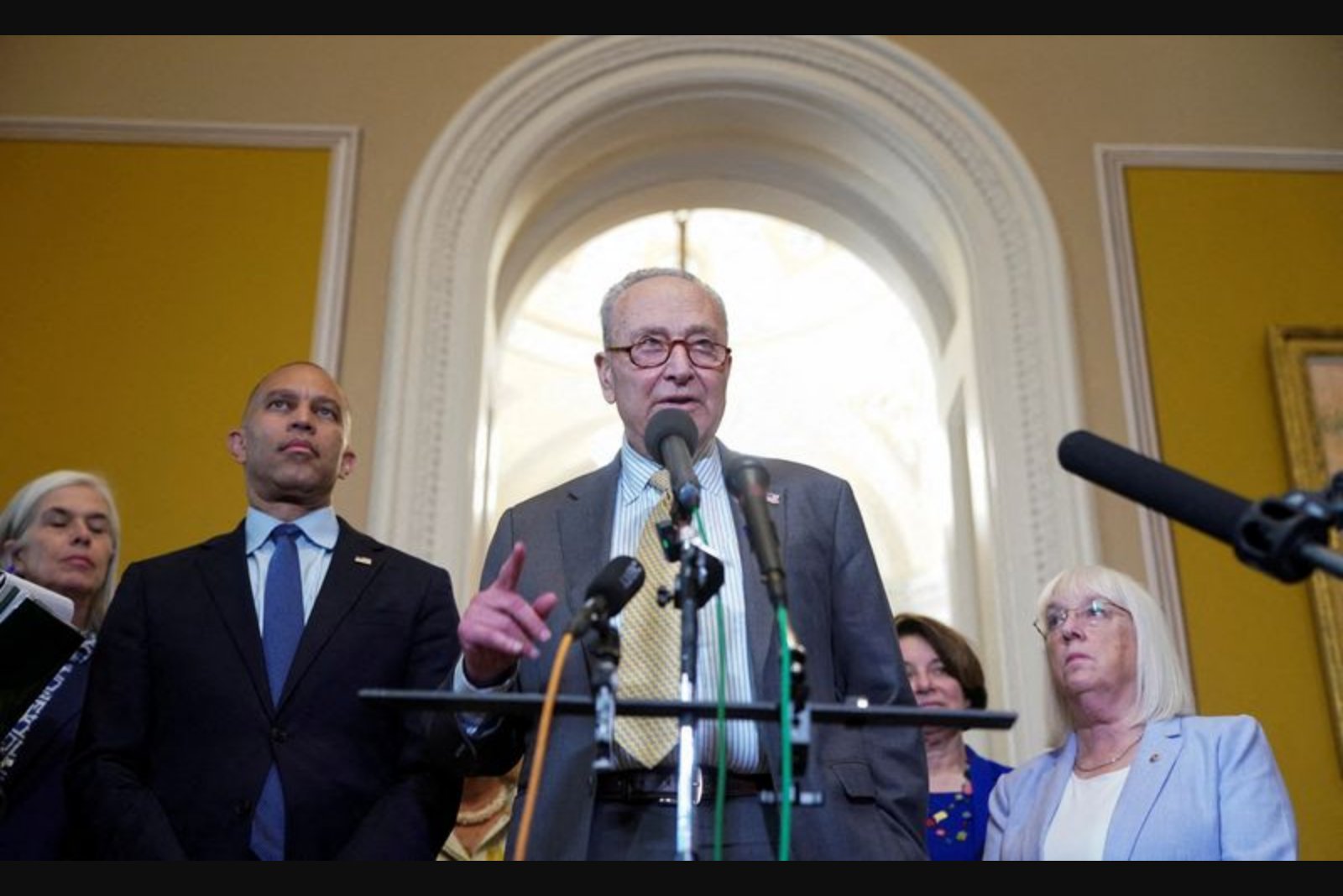
Democratic members of Congress from New York and New Jersey on Wednesday sent a letter to President Donald Trump urging him to restore federal funding for a $16 billion tunnel project serving the New York City area, warning that work will be suspended next week unless the administration reverses course.
The letter, signed by Senators Chuck Schumer, Kirsten Gillibrand, Cory Booker and Andy Kim along with a group of House lawmakers representing the two states, said in explicit terms that "continued delays threaten catastrophic disruption to the Northeast Corridor, massive job losses, and serious harm to the regional and national economy, despite the project being fully funded, fully permitted, and already under construction."
The White House did not immediately comment but on Tuesday blamed Democrats for the dispute. The U.S. Transportation Department, which has withheld funding for the effort, referred questions about the impasse to the White House.
President Trump said in October he had terminated the project, citing Schumer's support for it. His administration has repeatedly targeted major transit and infrastructure projects in Democratic-led states. Former Transportation Secretary Pete Buttigieg described the withholding of funds as "straight-up mob boss politics."
The Gateway Development Commission, established in 2019 to oversee the large-scale construction program, warned that the project will be suspended on February 6 if federal funding approved during the administration of former President Joe Biden is not restored.
Officials and lawmakers stress the fragility of the existing Hudson River tunnel system, which was built in 1910 and was heavily damaged by Hurricane Sandy in 2012. Any failure of that tunnel would significantly disrupt commuting in a metropolitan area that generates roughly 10% of the nation's economic output and is used by about 200,000 travelers daily.
Backers note that more than $1 billion has already been expended on the initiative. The plan includes repairs to the existing tunnel and construction of a new tunnel to carry Amtrak and state commuter trains between New Jersey and Manhattan. Federal support for the overall program includes $12 billion in grants and $4 billion in loans.
In December, the U.S. Transportation Department accused Gateway of violating the Disadvantaged Business Enterprise program that aims to assist small businesses run by "socially and economically disadvantaged individuals." The department's allegation followed a court ruling which removed the presumption that women and certain minority racial groups are automatically economically disadvantaged when bidding for contracts. Gateway said it has informed USDOT that it is in compliance with federal law.
President Trump, who previously served as a New York City real estate developer, declined to approve funding for these tunnel projects during his first term in office.
For regional and national stakeholders, the current standoff raises immediate operational and economic concerns. The construction pause threatened by the funding freeze would interrupt work already underway and could delay the completion of critical repairs and new capacity that planners say is necessary to preserve and enhance rail service under the Hudson River.
Lawmakers framed their appeal in stark economic terms, emphasizing the potential for job losses and broader damage to commerce if the Northeast Corridor suffers a major capacity constraint. The letter's language also underlines that, in the lawmakers' view, the project has satisfied permitting and funding thresholds and is otherwise moving forward.
At the same time, USDOT's compliance allegations introduce a legal and administrative dimension that the Gateway commission and project supporters say has been addressed and does not warrant halting construction. The administration's position, and its earlier decision in October to terminate the project, remain central to whether federal funds will be reinstated before the February 6 deadline.
The scope of economic exposure cited by elected officials highlights the project's scale: a multibillion-dollar recovery and build effort tied to one of the nation's busiest commuter corridors, with substantial prior investment already made and federal grants and loans committed to complete the work.