
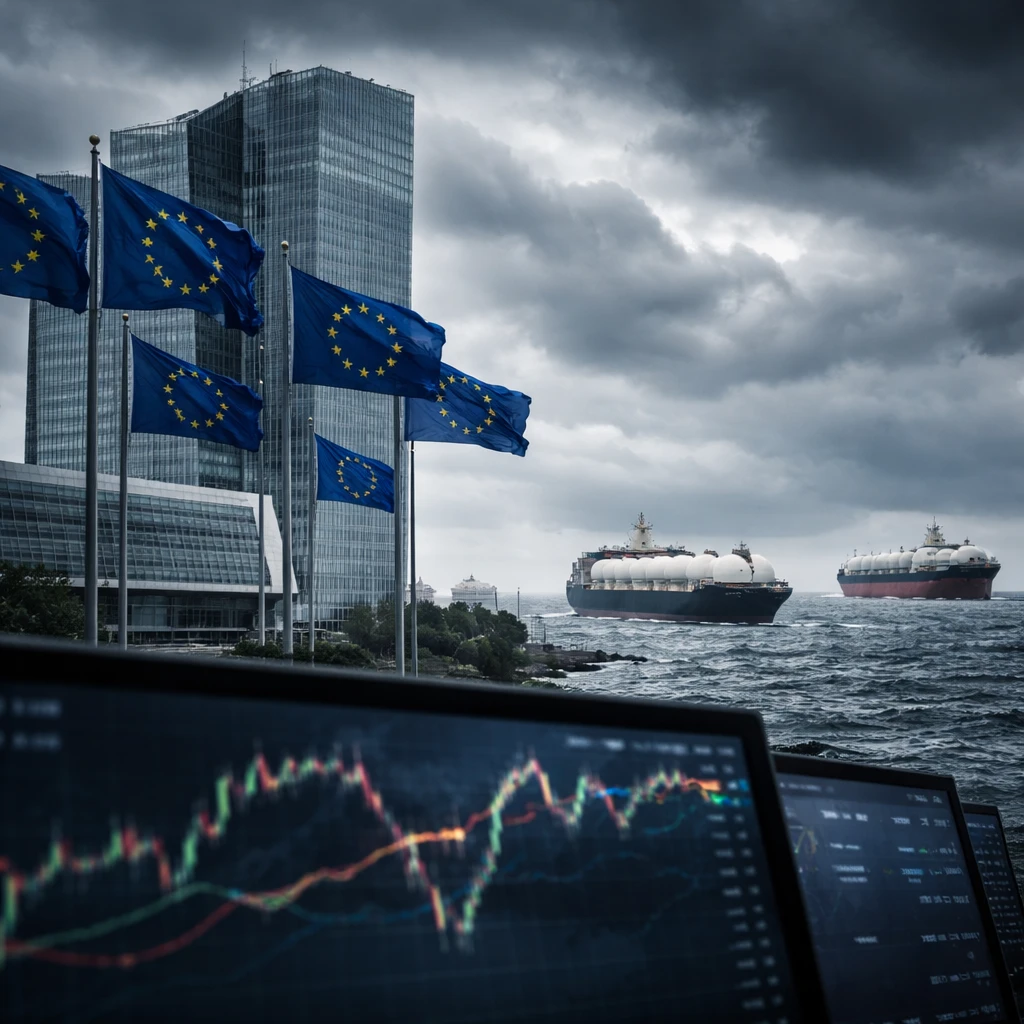
European Central Bank President Christine Lagarde warned that fresh energy-driven price pressures could prompt a calibrated policy response even if any upward deviation from the bank's 2% inflation goal proves short-lived. Speaking at an event in Germany, Lagarde stressed the bank's unwillingness to hesitate in the face of sustained deviations from target, while also acknowledging a spectrum of possible outcomes depending on how contained the energy shock remains.
Lagarde used blunt language to describe the central bank's stance. She said that "large, sustained" deviations from the 2% target require "forceful monetary policy action" to prevent inflation from becoming entrenched. She added emphatically: "[W]e will not be paralyzed by hesitation: our commitment to delivering 2% inflation over the medium term is unconditional."
The remarks come against a backdrop of renewed energy-market volatility stemming from the war in Iran. That conflict has been linked to attacks on energy infrastructure in Qatar, which the ECB president noted as a factor underpinning a rise in natural-gas prices in Europe. In addition, the closure of the Strait of Hormuz - a strategic waterway south of Iran through which roughly one-fifth of the world's oil flows - has coincided with a spike in oil prices since the outbreak of the conflict in late February.
Faced with these developments, the ECB opted to keep interest rates unchanged at its policy meeting last week. Nonetheless, officials raised the bank's inflation forecast for the year, signalling concern that price pressures could accelerate in the months ahead. A contemporaneous survey of business activity for the euro area also flagged risks, warning of "ringing stagflation alarm bells," a phrase that points to an uneasy mix of stubborn inflation and weak growth.
Lagarde outlined the conditionality of the ECB's next moves. She said that "if the current shock remains contained in energy markets, it may have a limited effect on broader inflation. But if it intensifies or persists, the pass-through could accelerate." In that scenario, she suggested that if the shock produces a large, though "not-too-persistent overshoot of our target," some "measured adjustment of policy could be warranted."
The president's comments underscore the tightrope the ECB faces: guarding its 2% inflation objective while monitoring whether energy price spikes are ephemeral or the start of a more durable inflation impulse. For markets and policymakers, the key questions are how the shock evolves in energy markets and how much of the rise in commodity prices transmits into broader price-setting across the eurozone economy.
Contextual note: The central bank's language highlights a willingness to act if inflationary pressures broaden beyond energy markets, while retaining flexibility should the shock prove short-lived.