
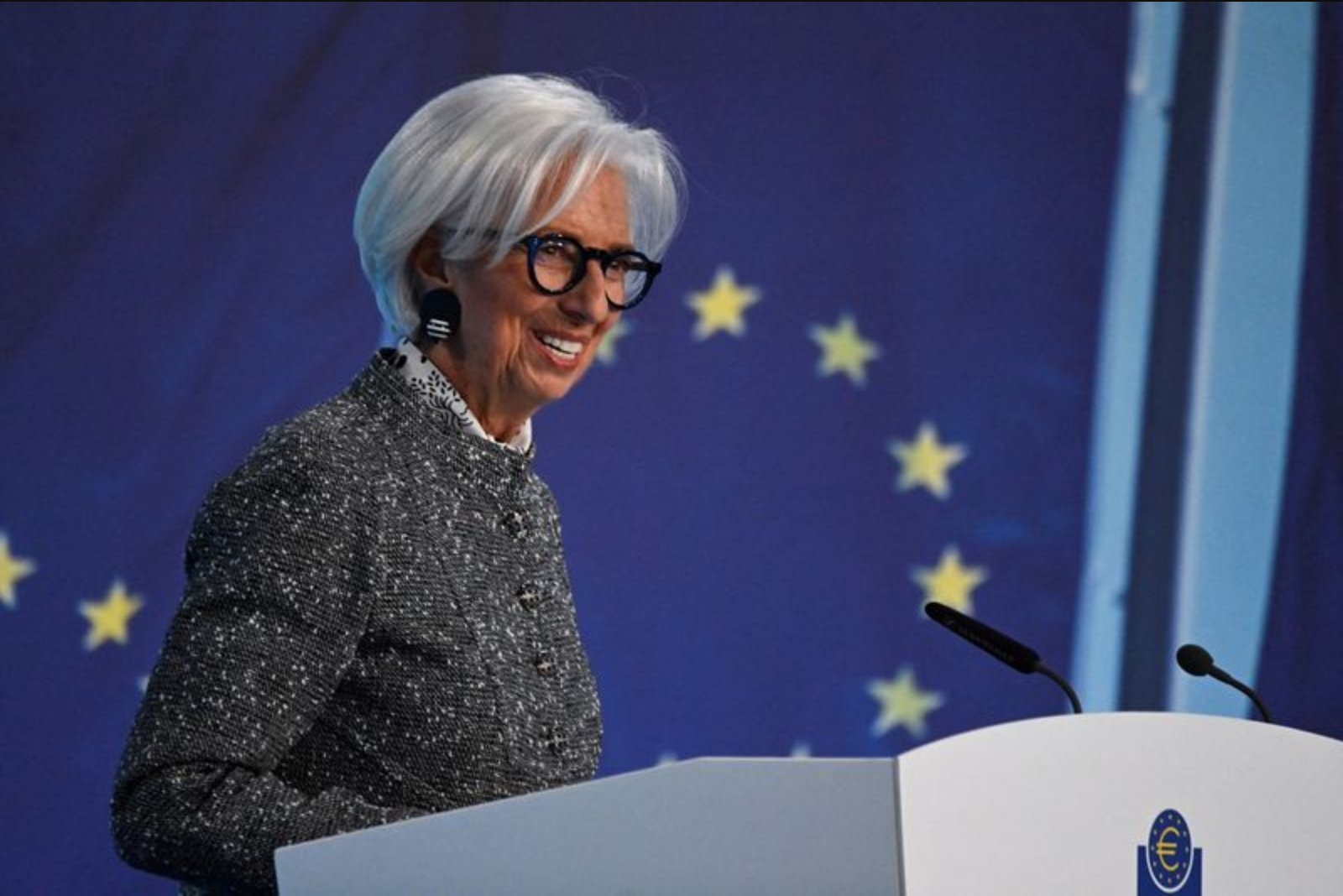
FRANKFURT, March 25 - European Central Bank President Christine Lagarde said on Wednesday that even a relatively short-lived overshoot of the bank's inflation target stemming from the present energy shock may call for some measured tightening of monetary policy.
The ECB left interest rates unchanged last week but cautioned that a jump in prices was possible, triggering internal discussion among officials about the conditions under which rate increases would be needed to counter a rapid rise in inflation becoming entrenched.
"If the shock gives rise to a large though not-too-persistent overshoot of our target, some measured adjustment of policy could be warranted," Lagarde said in a speech in Frankfurt. She added that ignoring such an overshoot entirely could create a communication problem: "the public may find it difficult to understand a reaction function that does not react."
Lagarde did not map this language directly onto any single scenario the ECB set out last week, but her description resembles elements of the bank's so-called "adverse" trajectory for inflation. The ECB's baseline forecast sees inflation averaging 2.6% this year, up from roughly 2% over the past year. In the adverse case, inflation would top 4% in the second half of the year before returning to target by mid-2027. Under a severe scenario, inflation would peak above 6% early next year and remain above target for several years.
Response calibrated to persistence and size of the overshoot
Lagarde stressed the importance of both the magnitude and the persistence of any deviation from the inflation goal. "If we expect inflation to deviate significantly and persistently from target, the response must be appropriately forceful or persistent," she said, warning that absent such a response "self-reinforcing mechanisms would kick in and the risk of de-anchoring would become acute."
The ECB must now be alert to early indicators that the shock is embedding itself into broader inflation dynamics. Lagarde said the bank needs to detect potential spillovers, notably through wages or shifts in inflation expectations. "As expected deviations from our inflation target grow larger and more persistent, the case for action becomes stronger," she said.
Markets and policy context
Financial markets have adjusted to the risk, pricing in two to three ECB rate hikes this year on expectations that inflation will remain above target for several years. Market participants point to the bank's perceived slow response to the 2021-2022 inflation surge as a rationale for earlier, smaller steps now: at that time the ECB treated the spike as transitory and did not begin raising rates until inflation was about 8%, roughly four times the target.
Lagarde said the present circumstances differ in important respects and cited several factors that point to a smaller pass-through from the energy shock than in the earlier episode. She noted the energy shock is so far smaller, particularly for natural gas; the labour market is not as tight; there is no post-pandemic pent-up demand; fiscal settings are tighter; and the ECB's policy rate is already higher than it was prior to the previous surge. She also argued that historical evidence indicates broad pass-through from energy prices is the exception rather than the rule.
What the ECB will watch for
Lagarde's remarks make clear the bank will focus on a narrow set of indicators to determine whether a measured policy adjustment is needed: the size and persistence of the inflation overshoot, wage developments, and the evolution of inflation expectations. The emphasis is both on timely detection and on communicating the bank's likely reaction to avoid misunderstanding among the public.
Her remarks underscore the balancing act facing policymakers: acting too little risks embedding higher inflation, while acting pre-emptively could prove unnecessary if the shock proves transient. The ECB's near-term choices will have implications for borrowing costs, financial markets and sectors sensitive to energy prices and wage dynamics.