
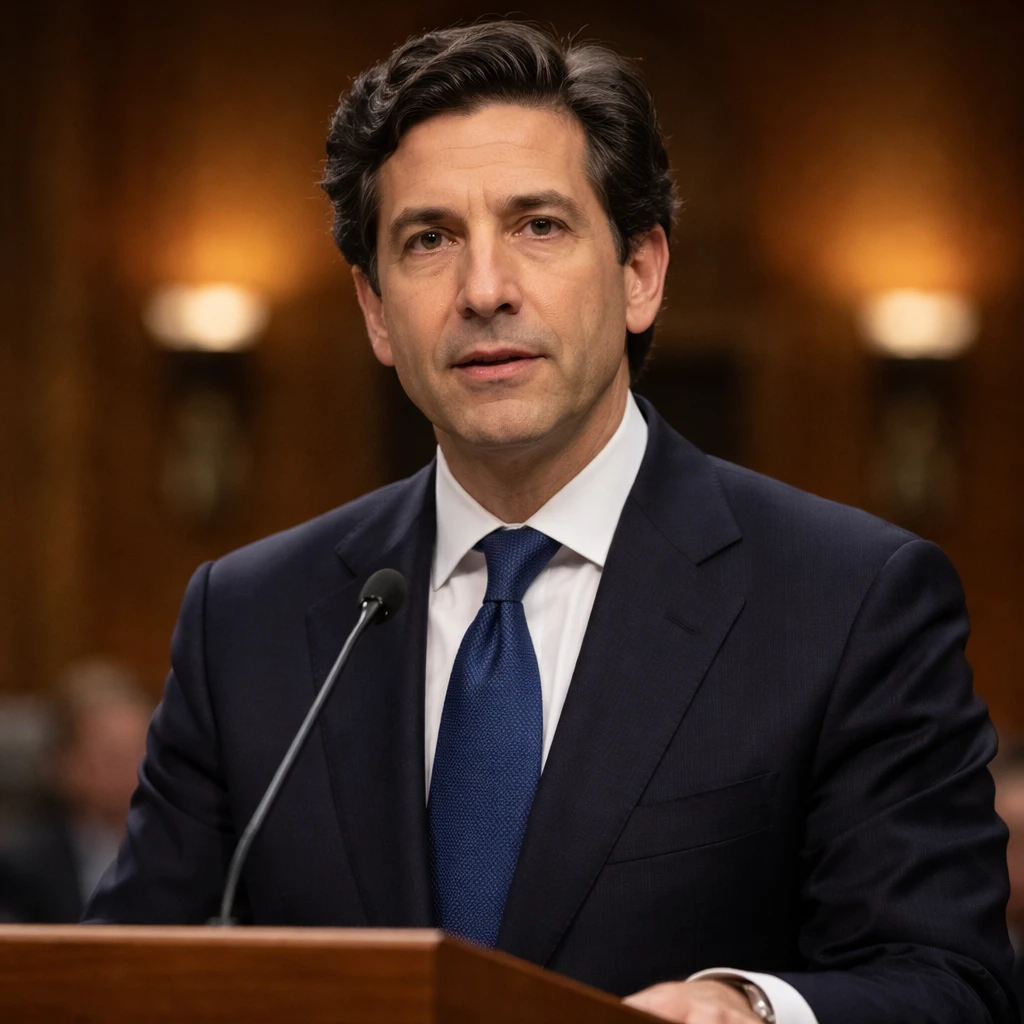
President Donald Trump confirmed former Federal Reserve Governor Kevin Warsh as his nominee to succeed Jerome Powell early on Friday, ending weeks of speculation over who would lead the central bank.
The selection follows an extended public clash between Mr. Trump and Powell, during which the president criticized the Fed chief for not cutting interest rates and at times suggested he could be removed from office. The White House has initiated an inquiry into the Fed - an action Powell described as punitive because the central bank did not set policy to match the president's preferences.
As concerns about the Federal Reserve's institutional independence spread among market participants and policy observers, Warsh's nomination was widely seen as reassuring by many traders and investors. "Kevin Warsh's nomination for Fed Chair is exactly what markets were hoping for, as he’s a steady hand, well known in market circles and is expected to maintain the independence of the central bank, which is critical for markets. Most importantly, Warsh faces few hurdles when it comes to being confirmed by the Senate," said Richard Saperstein, chief investment officer at Treasury Partners.
Background and career highlights
Kevin Warsh was born in Albany, New York. He completed undergraduate studies in public policy with an emphasis on economics and statistics at Stanford University, graduating with honors in 1992. He then attended Harvard Law School, where he studied the intersection of law, economics and regulatory policy, earning a law degree in 1995.
Warsh moved into finance after law school, joining Morgan Stanley in 1995. He worked in the firm's mergers and acquisitions unit and advised a range of companies across industries. His responsibilities included structuring capital markets transactions and facilitating both fixed income and equity financing. He remained at Morgan Stanley until 2002.
In 2002, Warsh entered government service as special assistant to the president for economic policy and as executive secretary at the National Economic Council under President George W. Bush. Four years later, in 2006, the president nominated Warsh to the Federal Reserve's Board of Governors. Warsh served on the Fed's board through 2011.
Role at the Fed
During his time at the Fed, Warsh drew on his Wall Street experience as the financial crisis unfolded. He worked as a conduit between the central bank and the banking industry during the crisis and played a prominent role in shaping and communicating policy responses.
The record shows Warsh was centrally involved in the Fed's adoption of the policy often referred to as quantitative tightening - a program described in coverage as the central bank buying up bonds in the market to try to spur the economy. He earned a reputation for hawkish views while on the board, though commentary in recent months suggests his public stance on rates has moved closer to the president's calls for lower interest rates.
Jaret Seiberg, a financial policy analyst at TD Cowen, emphasized Warsh's experience with bank policy: "Warsh has the deepest bank policy background of any of the four finalists as he was a key player in the Federal Reserve's response to the Financial Crisis. We view that as a positive as it means his arrival is less likely to slow deregulatory efforts at the Federal Reserve including the expected rewrite of bank capital rules."
Market reaction and interpretation
The choice of Warsh was read through multiple lenses on Wall Street. For some, his nomination reduced fears that the president would put a political outsider in charge of the central bank and thereby compromise its independence. For others, the pick suggested a tilt that could be interpreted as institutionally cautious or slightly hawkish.
Macquarie strategists Thierry Wizman and Gareth Berry noted that traders may have interpreted the selection as an "institutional" and perhaps a "hawkish" decision, since Warsh comes from established policy circles and his appointment implies chairmanship of the Federal Open Market Committee as well as the Fed.
At the same time, the strategists pointed out that Warsh left the Fed in 2011, several years before his term was due to expire, because he disagreed with Fed policy at the time. They observed that in that period Warsh had been an iconoclast and had aligned with Mr. Trump on some policy views. The strategists also highlighted the view that Warsh has in recent times adopted positions similar to the president's on a range of monetary policy questions. "Warsh has been Trump’s ‘monetary policy twin’ from day one," they wrote.
News of the nomination spilled into markets immediately. Traders sold off across some assets on the day the nomination became public, with notable moves in the dollar and precious-metals markets. Equity benchmarks also reacted, and some widely held exchange-traded funds that track the S&P 500, such as SPDR S&P 500 ETF Trust (NYSE:SPY), Vanguard S&P 500 ETF (NYSE:VOO) and iShares Core S&P 500 ETF (NYSE:IVV), were mentioned in market coverage of the session.
Policy outlook as reflected in the nomination
Observers have read Warsh's selection as a signal that the administration sought a nominee with familiarity both with Wall Street and with the Fed's institutional machinery. His earlier criticism of some post-crisis Fed programs and his role in bank policy adjustments have led analysts to conclude his arrival may not slow efforts to revisit regulatory rules and capital requirements.
At the same time, commentary about his alignment with the president on recent calls for lower interest rates has introduced nuance into expectations about his stance. While once characterized as hawkish, recent statements and alignments have prompted questions about whether his policy posture now more closely resembles the president's preferences.
What remains uncertain
Despite broad-based commentary on the nomination, outstanding questions remain about how Warsh would execute policy as chair and how he would balance demands for independence with political pressures. Market moves on the announcement reflected those uncertainties, and analysts continue to weigh how his prior record would translate into actions should he be confirmed.
As the confirmation process moves forward, attention will remain on the Senate's response and on how markets adjust to a new Federal Reserve leader whose background blends private-sector experience, crisis-era policymaking and recent public alignment with presidential views on rates.