
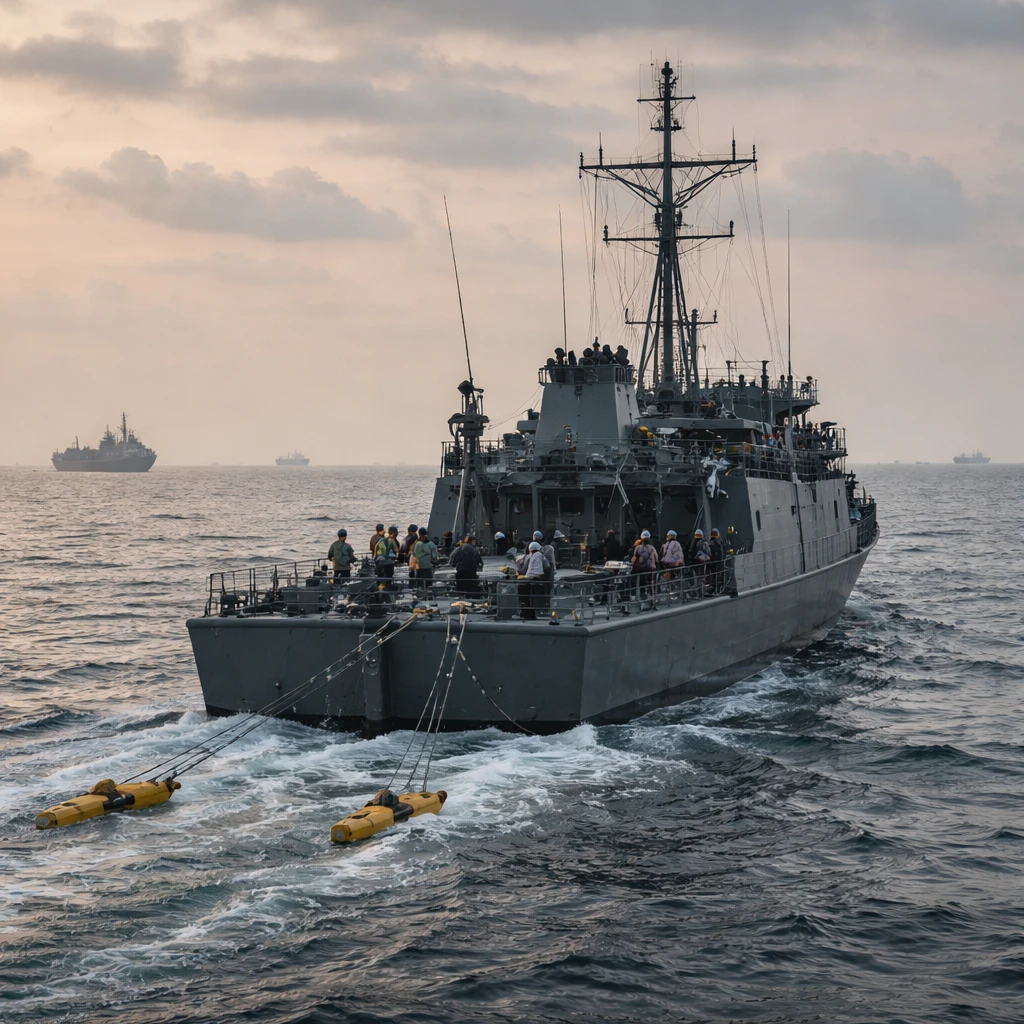
Japan has signaled a conditional willingness to commit its Self-Defense Forces to minesweeping operations in the Strait of Hormuz, provided that a ceasefire is established in the current conflict involving the U.S., Israel and Iran. Foreign Minister Toshimitsu Motegi described the proposal as hypothetical but said the removal of naval mines would be a vital step in restoring safe navigation through the waterway.
The Strait of Hormuz is the main channel for about 20% of global oil shipments. Its extended closure has prompted Tokyo and other major consuming nations to tap strategic petroleum reserves to alleviate sharply higher energy costs. For Japan in particular, the disruption is acute: roughly 90% of the country's crude oil imports transit the strait, creating a direct threat to industrial output and to inflationary pressures expected into 2026.
Legal and strategic limits on overseas deployment
Any decision to dispatch the Self-Defense Forces would test Japan's postwar constitutional restrictions and the 2015 security legislation that sets the framework for overseas operations. Under existing law, the Self-Defense Forces may be deployed abroad only when an attack on a close security partner creates a situation that threatens Japan's survival and no alternative solutions are available. Those legal conditions frame Tokyo's calculus and are a central consideration for policymakers weighing a minesweeping mission.
Prime Minister Sanae Takaichi reportedly briefed U.S. President Donald Trump during a recent summit in Washington about these legal constraints, at a time when the White House has been urging allies to step up naval contributions to secure key maritime routes.
Diplomacy, safe passage and navigation priorities
Tokyo has engaged in talks with Iranian officials exploring possible safe passage for vessels connected to Japan, but has not pursued separate transit arrangements. Instead, Japanese authorities say their objective is to help establish conditions that permit universal navigation through the strait. Officials have framed the problem as one of restoring open, predictable shipping lanes rather than arranging exemptions or special corridors.
Markets are closely watching whether diplomatic progress leads to tangible improvements in physical transit risk. A successful minesweeping operation would ease the immediate supply shock and could lower the elevated insurance premiums that have been saddling the global tanker fleet. Observers note that the transition from active conflict to a managed reopening of the strait will strongly influence global energy benchmarks in the months ahead.
Economic and market implications
As long as the strait remains contested, reliance on emergency reserves will continue to act as a temporary buffer, preventing a more severe interruption of the global "just-in-time" energy supply chain. The prospect of Japanese involvement in clearing the waterway therefore signals a possible move toward longer-term stabilization, but it remains conditional on a cessation of hostilities that would permit safe operations.
Any minesweeping mission would alter immediate logistics and insurance dynamics for the tanker sector and could dampen that component of energy price risk if it proceeds. For Japan, the operation would address a direct vulnerability to crude supply, with implications for industrial output and inflationary trends.
Conclusion
Japan's potential minesweeping role is contingent on a ceasefire and constrained by domestic legal limits. While the removal of naval mines is framed as essential to restoring the Strait of Hormuz to full commercial use, Tokyo's actions will depend on both diplomatic developments and constitutional guardrails that govern the overseas use of its Self-Defense Forces.